Ireland here runs from the Cliffs of Moher dropping into the Atlantic to patchwork green fields, Connemara light and painted village shopfronts. Some pieces are soft and misty; others go bold with colour and weather. Pick by the place you know best, or by how much drama you want on the wall. If a city view suits you better, Dublin art prints sit close by, and Scotland art prints cover another wild stretch of coast.
Ireland is too varied to capture in one image. The Cliffs of Moher in November fog, a Dublin doorway in primary red, sheep scattered across a Connemara hillside, these are...
Most people who want a Dublin gallery wall stop at one print. Not because they don't want more, but because they're worried five Dublin prints on one wall will look...
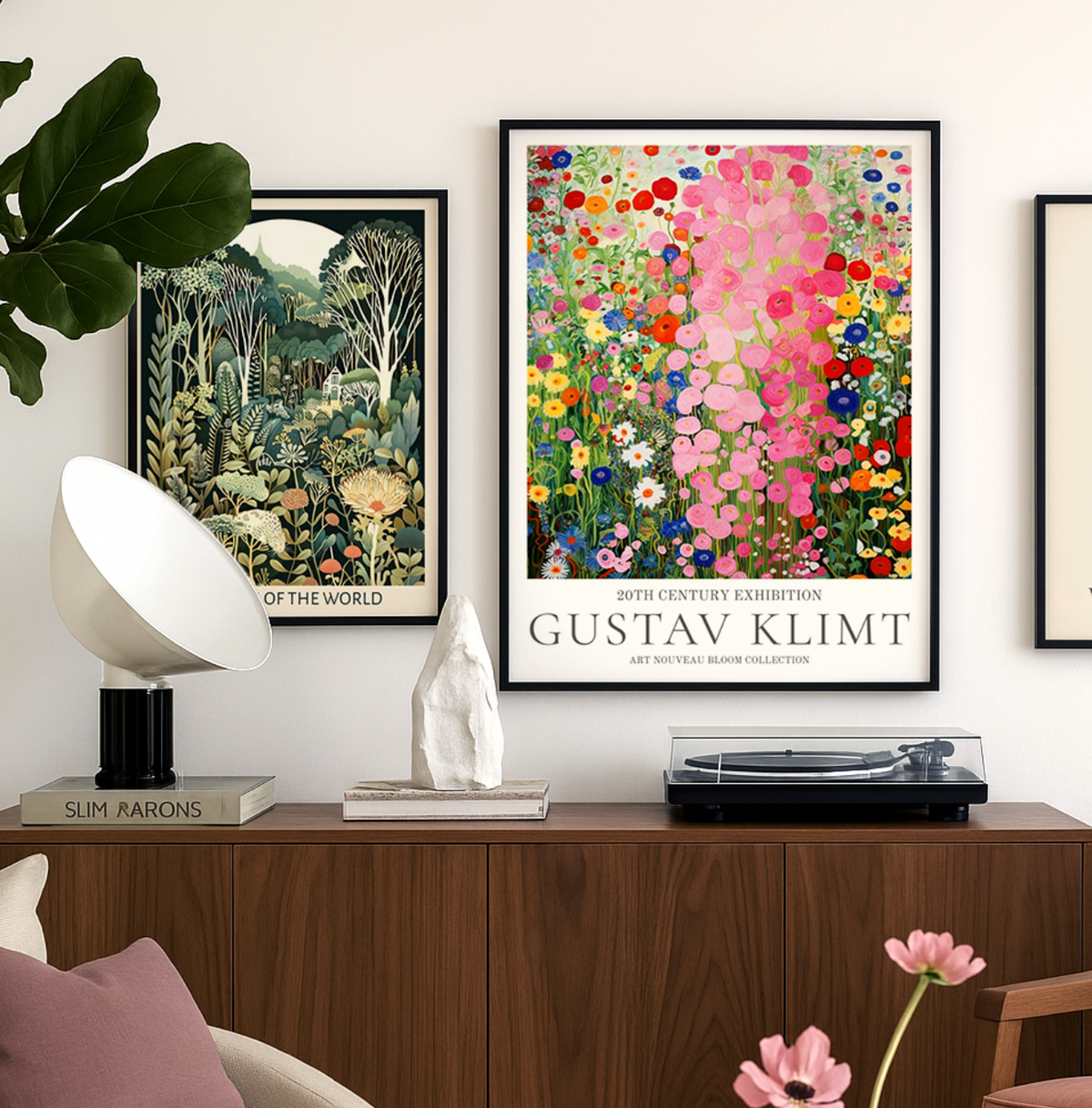
Gustav Klimt wasn’t just an artist — he was a master of seduction through pattern, color, and symbolism. At Fab, we celebrate his work not just as art history, but...
Questions before you pick an Irish print
Short answers on framing choices, hanging spots, delivery and sending something back
What's the difference between vintage-style and contemporary Irish art prints?
Vintage-style Irish prints lean on softened, aged tones, travel-poster shapes or old photographic looks, so they feel nostalgic and pair naturally with traditional or rustic rooms. Contemporary Irish prints tend toward cleaner lines, bolder color blocking or minimal graphic treatments that suit modern interiors. Both are reproductions made for decoration, so choose whichever mood matches your furniture and existing frames rather than worrying about period accuracy.
What colors go with Irish landscape and coastal wall art?
Irish scenery art usually carries green, stone gray, slate blue and mist-white, so those tones make an easy starting point for a room palette. Warm neutrals like cream, oatmeal and pale oak keep the greens from feeling cold, while charcoal or navy accents echo cliffs and sea. If a print is very green, repeat that shade in one small item, such as a cushion or ceramic, instead of matching the whole room to it.
How can I build a gallery wall around Irish places like Dublin, Galway or the Cliffs of Moher?
Pick one unifying thread first, either a single city, a coastal route or a consistent art style, then vary the scale. A larger anchor image of a dramatic landscape or coastline reads well in the center, with two to four smaller city or countryside scenes around it. Keeping frames in one finish and spacing gaps evenly, around two to three inches, makes a mixed set of Irish views look intentional rather than scattered.
Should I choose an Irish photography print or a painted or illustrated one?
Photographic Irish prints give you crisp detail and a true-to-life sense of place, which suits hallways, offices and any wall where you want a strong focal image. Painted or illustrated versions simplify the scene into shape and color, so they blend more quietly into a busy living room or bedroom. Consider your wall's viewing distance too: photography rewards close viewing, while graphic styles read clearly from across the room.
Which Ireland art prints work best in a living room?
For a living room, we'd go with an Irish landscape print of the coast or countryside in a large format (70x100cm) above the sofa. The moody greens, greys, and Atlantic blues in Irish coastal scenes pair beautifully with neutral interiors and add real depth without overwhelming the space. If your room leans warm (think tan leather, wooden floors), a Wild Atlantic Way or Connemara scene brings a gorgeous cool contrast. Our framed prints arrive ready to hang with solid wood frames and UV-protective glazing, so you won't get fading even on a south-facing wall.
How do I mix modern decor with Ireland wall art?
The trick is contrast. Choose a contemporary photographic print of an Irish landscape, like a minimalist shot of the Cliffs of Moher or a moody black-and-white Dublin streetscape, and frame it in our black or natural wood frame. Avoid anything that looks like a heritage postcard. A single large-format Ireland art print on an otherwise clean wall reads as modern and intentional, while a gallery wall of smaller Irish prints can feel cluttered fast. One bold piece, strong framing, done.
What size Ireland print should I choose for a blank wall?
Use the two-thirds rule: your print should be roughly two-thirds the width of the furniture below it. So above a standard 180cm sofa, a 100x70cm framed Irish landscape print is the sweet spot. If the wall is truly empty with no furniture beneath, go as large as you can. Our biggest framed art prints at 70x100cm make a genuine statement, and because they ship fully fitted and ready to hang, there's no DIY framing headache involved. A small print on a big wall always looks like an afterthought.
Are Ireland art prints a good gift for someone with Irish heritage?
Honestly, they're one of the best gifts you can give. A beautifully framed print of the Cliffs of Moher, Ring of Kerry, or a specific county means far more than generic homeware because it's personal. Our prints are museum-grade giclée on thick matte paper with solid wood framing, so they genuinely look and feel like a considered gift, not a poster. They arrive ready to hang, which means the person receiving it can put it straight on the wall without hunting for a framer.
Which Irish landmarks make the most popular prints?
The Cliffs of Moher are far and away the most sought-after, and for good reason: those dramatic Atlantic cliff faces look incredible at scale. After that, the Wild Atlantic Way coastline, Galway's colourful harbour, the Ring of Kerry, and Dublin's Georgian streets are all consistently popular. For something a little less obvious, the Burren's lunar landscape or a quiet Connemara bog scene gives you that unmistakable Ireland feel without being a landmark everyone recognises instantly. Irish photography prints of these locations tend to have that rich, moody palette that works in almost any room.
Choosing a selection results in a full page refresh.

 Order today for delivery by




 Questions before you pick an Irish print