Ohara Koson worked almost entirely in birds and flowers: a crow hunched on a snow-laden branch, egrets in the rain, sparrows breaking from a bough. Backgrounds stay quiet, so the subject does the talking, useful above a bedside table or in a narrow hallway where a pair can hang in sequence. For more in this register, browse Japanese bird art prints or Utagawa Hiroshige art prints.
Japanese bird prints are quietly the most versatile art you can buy. They sit happily in a modernist flat, a Victorian terrace, or a beige rental, and they rarely fight...
A blank wall can be intimidating. You know you want art, but where do you even start? You scroll through endless options online, walk through galleries feeling lost, or stare...
Your bedroom is the most personal room in your home. It's where you start and end each day, where you retreat when you need space, where you go to feel...
Buying a Koson print: your questions
Short answers on framing, hanging Koson's bird studies and how ordering from Fab works
What makes Japanese bird and flower prints so popular as wall art?
The kacho-e, or bird-and-flower genre, pairs a single graceful subject with lots of empty space, so the image reads clearly from across a room without crowding your walls. The soft, muted palettes sit easily beside neutrals, wood tones and greenery, which is why cranes, sparrows and kingfishers turn up so often in calm bedrooms, hallways and reading corners.
Which rooms suit vintage Japanese bird prints best?
They work beautifully anywhere you want a calm, uncluttered mood: above a bed, along a stairwell, in a home office or flanking a bathroom mirror. Because the palettes are gentle, they hold their own against pale walls and natural materials like linen, rattan and oak. In a busier living room, go for one larger piece rather than several small ones so the negative space still reads.
How do Ohara Koson prints look framed and on the wall?
Honestly, they look stunning. Koson's Japanese bird art prints have incredibly delicate colour work and fine linework that really benefits from museum-grade giclée printing on thick matte paper, which captures every feather and petal without glare. We'd recommend a black frame for a more traditional feel or oak for a warmer, Japandi-leaning room. A 50x70cm framed print is a perfect fit above a console table or in a hallway, while a 70x100cm makes a genuine statement piece over a sofa. Every framed print arrives ready to hang with the print properly fitted to the frame, so there's no warping, bubbling, or fiddling with separate parts.
Which Koson bird prints work best as a pair or set?
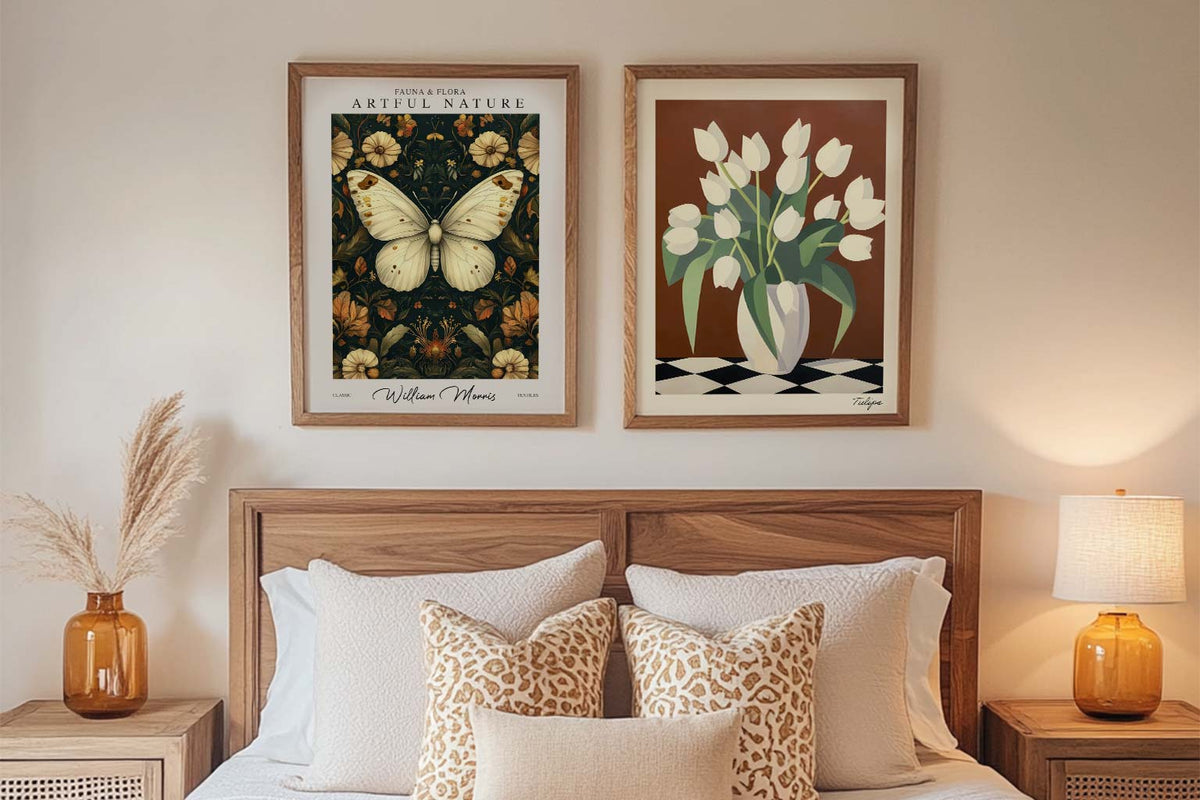
Koson's compositions lend themselves brilliantly to pairing because so many feature a single bird against a minimal background, creating a natural visual rhythm when you hang two or three together. We love pairing a heron piece with one of his songbird prints for a mix of scale and movement. Hang two 40x50cm framed prints side by side with about 5cm between them above a bed or along a hallway for a curated gallery feel. Sticking to the same frame colour keeps things cohesive while letting the different subjects do the talking.
Will the colours in these vintage Japanese bird prints fade over time?
Not with ours. We use museum-grade giclée inks that are rated to last hundreds of years, even in direct sunlight. On top of that, every framed Koson print comes with UV-protective acrylic glaze, so you can hang these in a sun-drenched living room or a south-facing bedroom without worrying. The matte paper also means you won't get that annoying glare you sometimes get with cheaper glazing, so the soft, muted palette Koson is known for stays exactly as it should.
Are these good as a gift for someone who loves Japanese art?
They're one of our best gift picks, full stop. Koson's traditional Japanese art prints are universally appealing without being generic, and the quality of the framing makes it feel like a seriously considered present rather than a last-minute click. A framed 30x40cm print is a thoughtful, manageable size that works in any room, and because it arrives ready to hang with proper fixtures, the recipient doesn't need to do anything except find their favourite wall. We also offer a 99-day returns policy, so there's zero risk if they'd prefer a different piece.
How is shin hanga different from ukiyo-e, and which style are these prints?
Koson is one of the defining artists of the shin hanga movement, which emerged in the early 20th century as a revival and refinement of traditional ukiyo-e woodblock printing. Where ukiyo-e focused on everyday life, kabuki actors, and landscapes, shin hanga brought a more romantic, almost painterly sensibility to the same collaborative printing process, with richer colour gradients and a stronger Western influence in composition. Koson's Japanese wildlife art prints sit squarely in this tradition, with their luminous backgrounds, precise botanical detail, and that unmistakable sense of stillness. They're a brilliant entry point if you're drawn to Japanese nature prints but want something more refined than the bolder ukiyo-e style.
Choosing a selection results in a full page refresh.

 Order today for delivery by






 Buying a Koson print: your questions