
 Commandez aujourd'hui, livré le
 Who Did Klimt Paint? His Most Famous Portraits Explained
The real women behind Klimt's most celebrated portraits, and how to choose the one that belongs on your wall.


Gustav Klimt painted around 200 works in his lifetime, but his portraits are what made him immortal. Behind the gold leaf and decorative swirls were real women: socialites, fashion designers, nine-year-old daughters of industrialists, and one lifelong companion whose face may or may not appear in his most famous painting. Here's who they were, why they mattered, and which ones make the most sense on your wall.
Why Klimt's portraits of people still feel so modern
Look at a Klimt portrait next to a traditional society portrait from the same era and the difference is immediate. Where his contemporaries painted women in believable rooms with believable furniture, Klimt dissolved the background into pattern. Faces remain photo-real. Everything else, the dress, the chair, the floor, becomes ornament.
That collision between realism and abstraction is why these paintings still look contemporary over a century later. They sit comfortably next to modernist furniture, minimal interiors, even quite stark contemporary art. A Klimt portrait does not feel like a costume drama. It feels like a designer made it last week.
The other reason they endure: Klimt painted women as subjects, not objects. His sitters look back at you. They are powerful, often unsettlingly so. Judith holds a severed head and smirks. Adele Bloch-Bauer stares with an expression somewhere between boredom and challenge. That directness is rare in early 20th century portraiture and it is precisely what makes these works hang well.

Adele Bloch-Bauer: the woman behind 'The Woman in Gold'
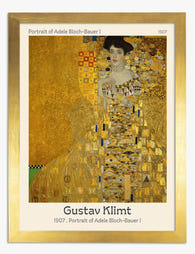
Adele Bloch-Bauer was the only person Klimt painted twice. She was 25 when she first sat for him, the wife of the wealthy Viennese sugar industrialist Ferdinand Bloch-Bauer, and one of the few women in their circle who hosted intellectual salons. She read philosophy. She smoked, which scandalised people. She was, by all accounts, sharp, anxious and unhappy.
Klimt worked on her first portrait, 'Portrait of Adele Bloch-Bauer I', from 1903 to 1907. Four years. The result is the painting most people now know as 'The Woman in Gold': her face floating in a sea of gold leaf, Egyptian eyes embedded in the dress, her hands clasped in a slightly awkward gesture that was apparently Adele's habit (she was self-conscious about a disfigured finger).
The story did not end with her death in 1925. The Nazis seized the painting from her family in 1938. It hung in the Belvedere in Vienna for decades, treated as an Austrian national treasure. Then in 2006, after a long legal fight, her niece Maria Altmann won it back. She sold it for $135 million, at the time the highest price ever paid for a painting. It now lives at the Neue Galerie in New York.
The second portrait, from 1912, is quieter. Less gold, more colour, Adele in a softer pose against patterned wallpaper. If the first painting is icon, the second is human. Both are worth knowing if you are exploring Klimt's portraits of people before choosing one for your home.
Judith, Danaë, and the mythological women Klimt reimagined
This is where most articles get confused. Judith and Danaë were not real women who sat for Klimt. They are figures from biblical and Greek mythology, painted as allegories rather than commissions. Understanding this distinction matters because these works function differently, both as art and as decoration.
'Judith and the Head of Holofernes' (1901) shows the Old Testament heroine who seduced and beheaded an enemy general to save her people. Klimt's Judith is half-undressed, eyes lidded, mouth parted. She looks post-coital, not victorious. In her hand, almost as an afterthought, she holds the severed head. It was shocking in 1901 and is still shocking now. Vienna at the time labelled her "Salome" because they could not cope with a heroine who looked like that.
'Danaë' (1907) takes a Greek myth (Zeus visits a princess in the form of golden rain) and turns it into one of the most erotic paintings of its era. Danaë is curled in a foetal position, lost in pleasure, with golden rain pouring between her thighs. It is unambiguous and entirely unapologetic.
These mythological works tend to be more sensual, more dramatic, and more decorative than the society portraits. They suit rooms where you want something with energy: a hallway, a study, a bedroom. If you want something more restrained, the commissioned portraits read calmer on the wall.
The Kiss: is it really a portrait?
Technically no. Officially, 'The Kiss' (1907-1908) is an allegorical work, not a portrait of identifiable people. But art historians have long suspected the woman is Emilie Flöge, Klimt's lifelong companion, and the man is a stylised self-portrait.
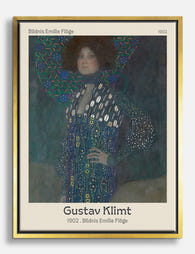
The case for Emilie is strong. She and Klimt met when she was 17 and he was 29 (he was in a relationship with her sister, who later died). For the next 27 years they were inseparable, though probably not romantically involved in the conventional sense. He fathered at least 14 children with other women. She ran a successful fashion house in Vienna that Klimt helped design textiles for. When he had a stroke in 1918, his first words were reportedly, "Send for Emilie."
She appears, named, in another work: 'Portrait of Emilie Flöge' (1902). That painting is less famous, partly because Emilie reportedly hated it. She thought the blue and gold patterned dress looked nothing like her, and she was right, it was almost certainly one of her own avant-garde designs that Klimt had reimagined as ornament.
So is 'The Kiss' a portrait? In spirit, probably. In the strict art-historical sense, no. Either way it remains the most reproduced image in the full Klimt collection, and for good reason: it works at almost any size, in almost any room, in framed or unframed form.

Klimt's lesser-known figurative works worth discovering
If you only know Adele and The Kiss, you are missing some of his strongest work.
Fritza Riedler (1906)
Painted the year before Adele I, this portrait shows the wife of an Austrian engineer seated in front of an Egyptian-influenced halo of pattern. The face is photographic. The dress dissolves into geometry. It is arguably the cleaner, more confident composition of the two.
Mäda Primavesi (1912)
A full-length portrait of a nine-year-old girl, hands on hips, glaring out of the canvas like she owns the place. The Primavesi family were among Klimt's most important late patrons. Mäda's stance is unforgettable: most child portraits of the era are passive and sweet. She looks like she is about to argue with you.
Serena Lederer (1899) and the Lederer family
The Lederers were Klimt's most loyal collectors, owning over a dozen of his works before the Nazis confiscated them. Serena's portrait is more conventional than later work but shows Klimt's transition from academic painting into ornament.
The destroyed faculty paintings
Klimt's three ceiling paintings for the University of Vienna ('Philosophy', 'Medicine', 'Jurisprudence') were considered pornographic at the time and rejected. They were stored at Schloss Immendorf and burned by retreating SS troops in 1945. We only have black and white photographs. It is one of the great losses in modern art and worth knowing about, even if you cannot hang them.
How Klimt's portrait style broke every rule of traditional portraiture
To understand why these paintings look the way they do, it helps to know what Klimt was rejecting.
Traditional portraiture demanded believable space. The sitter sat in a room. There was a floor, a wall, perhaps a window. Klimt eliminated all of it. His backgrounds are flat fields of pattern with no depth, no perspective, no sense of where the person is.
Traditional portraiture rendered fabric realistically. Silk looked like silk. Velvet looked like velvet. Klimt turned clothing into ornament. The dress in Adele I is not a dress, it is a mosaic of symbols. You can barely tell where the body ends and the decoration begins.
Traditional portraiture used a restrained palette. Klimt used gold leaf. Actual gold and silver leaf, applied to canvas, an unheard-of technique outside Byzantine religious icons. He had grown up watching his father work as a gold engraver, and he visited Ravenna in 1903 to study early Christian mosaics. The shimmer in his "golden phase" works (roughly 1899 to 1910) comes from real metal catching real light.
Traditional portraiture flattered the sitter. Klimt sometimes did the opposite. He painted Adele with her nervous hand gesture. He painted Mäda looking confrontational. He painted Judith looking sexually ecstatic while holding a severed head. His sitters are real people with real personalities, not idealised society women.
This rule-breaking is what makes his work feel current. It also has a practical implication for your wall: Klimt portraits do not need a "matching" interior. They generate their own context. You can hang one in a minimalist white room or a maximalist Victorian lounge and it will work.

Choosing the right Klimt portrait print for your home
A few practical things to weigh up.
Scale and gold
The gold-heavy works (Adele I, The Kiss, Judith, Danaë) reward size. The shimmer Klimt built into them is part of the point, and at small sizes that energy gets lost. We think anything below 50x70cm undersells these particular images. If you want one of his golden phase works as a feature, go to at least 70x100cm framed, or push up to 100x150cm on canvas for real impact.
The non-gold portraits (Fritza Riedler, Mäda Primavesi, the second Adele) work at smaller scales because they rely on composition and colour rather than metallic shimmer. A 40x50cm framed print in a hallway or above a desk works beautifully.
Framed or unframed
For the golden phase works, we tend to recommend framed prints. The decorative density of these images benefits from the visual containment a frame provides, otherwise the eye does not know where to stop. A thin black or natural oak frame works best. Avoid ornate gold frames, the painting is already doing that job.
For canvas, the mythological works (Judith, Danaë, The Kiss) translate well because the format suits dramatic, full-bleed imagery. The mirrored edge wrap means no part of the image gets cropped, which matters because Klimt composed right to the edges.
Room by room
In a bedroom: The Kiss, the second Adele, or Danaë. Intimate, warm, more about feeling than statement.
In a living room: Adele Bloch-Bauer I or Judith. Both have presence and operate as conversation pieces. Sized large, they anchor a room the way a fireplace would.
In a study or hallway: Mäda Primavesi or Fritza Riedler. Smaller scale, more contained, the kind of image you discover slowly rather than across the room.
If you want to compare against other styles of the era before deciding, the Art Nouveau collection sits in similar visual territory, and the broader portrait art prints range gives you a sense of how Klimt holds his own against other figurative work.

One last thing worth saying: the women in these paintings were real, with real lives, real money troubles, real grief, real boredom at sitting for years on end. When you hang a Klimt portrait, you are not just hanging decoration. You are hanging Adele, who lost her children and died at 43. Or Mäda, who survived two world wars and lived until 2000. Or Emilie, who kept Klimt's letters until the day she died. That is what makes them worth looking at every morning.

Produits Fab présentés dans cet article
-
Affiche Adele Bloch-Bauer par Gustav Klimt
Translation missing: fr.products.product.sale_price À partir de €16,95€23,95 -

Toile muse dorée de Gustav Klimt
Translation missing: fr.products.product.sale_price À partir de €64,95€92,95 -
Toile Emilie Flöge de Gustav Klimt
Translation missing: fr.products.product.sale_price À partir de €64,95€92,95 -

Affiche Emilie Flöge de Gustav Klimt
Translation missing: fr.products.product.sale_price À partir de €16,95€23,95 -

Affiche femme fleurie de Gustav Klimt
Translation missing: fr.products.product.sale_price À partir de €16,95€23,95 -

Toile Helene Klimt par Gustav Klimt
Translation missing: fr.products.product.sale_price À partir de €64,95€92,95 -

Affiche Helene Klimt de Gustav Klimt
Translation missing: fr.products.product.sale_price À partir de €16,95€23,95 -

Toile portrait de Fritza Riedler par Gustav Klimt
Translation missing: fr.products.product.sale_price À partir de €64,95€92,95 -

Affiche dame au chapeau de fourrure de Gustav Klimt
Translation missing: fr.products.product.sale_price À partir de €16,95€23,95 -

Affiche Gustav Klimt - Fritza Riedler
Translation missing: fr.products.product.sale_price À partir de €16,95€23,95 -

Toile dame au chapeau de fourrure de Gustav Klimt
Translation missing: fr.products.product.sale_price À partir de €64,95€92,95 -

Toile Hermine Gallia de Gustav Klimt
Translation missing: fr.products.product.sale_price À partir de €64,95€92,95 -
Affiche Johanna Staude par Gustav Klimt
Translation missing: fr.products.product.sale_price À partir de €16,95€23,95 -

Toile dame en blanc de Gustav Klimt
Translation missing: fr.products.product.sale_price À partir de €64,95€92,95 -

Affiche dame en blanc de Gustav Klimt
Translation missing: fr.products.product.sale_price À partir de €16,95€23,95 -

Toile aux fleurs éclatantes inspirée par Gustav Klimt
Translation missing: fr.products.product.sale_price À partir de €64,95€92,95 -

Toile fleurs abstraites inspirée de Klimt
Translation missing: fr.products.product.sale_price À partir de €64,95€92,95 -
Toile symphonie florale de Gustav Klimt
Translation missing: fr.products.product.sale_price À partir de €64,95€92,95 -

Affiche muse féline, esprit Klimt
Translation missing: fr.products.product.sale_price À partir de €16,95€23,95 -
Toile fleurs éclatantes de Klimt
Translation missing: fr.products.product.sale_price À partir de €64,95€92,95


Plus de The Frame

Why William Morris Prints Look Brilliant in Mod...
William Morris has been quietly miscategorised for decades. His patterns get filed under "country cottage" or "Arts and Crafts revival" and rarely escape, which is a shame because his tree...

Why Arts and Crafts Nature Prints Are the Antid...
The minimalism hangover: why bare walls stopped feeling calming For about a decade, the aspirational interior was a white box with one boucle chair in it. That look has officially...

Botanical Petal Art: Why Close-Up Prints Feel M...
Full florals have had a long run, and they're not going anywhere. But if you've noticed that the botanical art appearing in design magazines, boutique hotel lobbies, and the better-styled...