
 Commandez aujourd'hui, livré le
 Building a Gallery Wall with Mixed Art Periods: A Step-by-Step Approach
A curator's approach to pairing centuries of art on one wall, with era pairings that actually work.


Most gallery wall advice treats "eclectic" as a synonym for "anything goes." It isn't. A mixed-era wall that feels collected rather than chaotic relies on specific pairings, a clear hierarchy, and a few principles borrowed from how museums actually hang their rooms.
What makes a mixed-era gallery wall different from a standard one
A standard gallery wall solves one problem: arrangement. A mixed-era gallery wall solves two. You're arranging pieces, but you're also reconciling visual languages that were never designed to share a room.
A Dutch still life from 1640 was painted to glow under candlelight, with deep shadows and saturated reds. A 1965 colour field painting was made for white-walled gallery space. Hang them next to each other carelessly and the older work will look murky, the newer one will look bare. Hang them well and each one sharpens the other.
The shift you need to make is from decorator to curator. You're not asking "what looks nice together," you're asking "what visual conversation am I trying to start." That sounds grand. It mostly comes down to choosing two or three periods that have something genuine in common, then letting the contrasts do the work.

Choosing your era pairings: which periods play well together
The most common mistake is mixing too many periods at once. Three is the maximum. Two is often better. Beyond that, the wall loses any sense of intent and starts to read as a junk drawer.
Here are pairings we keep returning to, and why they work.
Impressionism and Abstract Expressionism
Both are about gesture, light, and the loosening of form. Monet's water lilies and a Rothko-influenced print share more DNA than people assume: visible brushwork, atmospheric colour, a refusal to draw hard edges. The Impressionist piece grounds the abstract one in a recognisable subject. The abstract piece gives the Impressionist one permission to feel modern.
Art Nouveau and Bauhaus
Pure opposites that benefit from proximity. Art Nouveau's curling vines and figurative softness make Bauhaus grids look more elegant than austere. Bauhaus geometry makes Art Nouveau look intentional rather than fussy. Keep the palette tight: muted ochres, blacks, and a single accent colour across both.
Renaissance portraiture and contemporary photography or illustration
Shared subject matter (the human face) carries the contrast. A Botticelli-style profile next to a modern graphic portrait reads as a deliberate study of how we've drawn people across 500 years. This is where the contemporary collection earns its place, providing the modern counterweight that lets a classical piece feel current rather than dusty.
Art Deco and Mid-Century Modern
The easiest mix on this list because Art Deco is already a bridge. Its geometric stylisation feeds directly into mid-century graphic design. Both periods love confident shapes, warm metallics, and a slightly stylised approach to nature. You can hang these together with almost no friction.
Japanese woodblock (Ukiyo-e) and Minimalism
Both rely on negative space and flat planes of colour. A Hokusai-style print and a contemporary minimal landscape can sit centimetres apart and feel like they were made in the same studio. This pairing is forgiving and works particularly well in smaller rooms.
Pairings that need real care
Baroque and Pop Art. Rococo and anything graphic. These can work, but they demand a unifying element doing serious heavy lifting, usually a shared palette or aggressive framing consistency. If you're new to mixed-era walls, skip these for now.
Layout templates: the asymmetric grid vs. the salon hang
Two layouts handle 90% of mixed-era walls. Pick based on the formality of the room and how confident you feel.
The asymmetric grid
A loose 2x3 or 3x3 arrangement where prints sit on shared horizontal and vertical lines but vary in size. This template suits mixed-era walls because the structure compensates for the visual diversity of the art. Your eye gets a stable framework even as it moves between centuries.
Best for: living rooms, hallways, anywhere with clean architectural lines. Works well above sofas and sideboards.
The salon hang
Inspired by 18th-century Parisian salons where paintings were stacked floor to ceiling. For our purposes, this means a denser, more sculptural arrangement with prints at varying heights and no strict grid. The salon hang is more forgiving of awkward print sizes and more demanding of curatorial confidence.
Best for: dining rooms, studies, stairwells, rooms where you want the wall to feel like an event rather than a backdrop.
A rule we hold to: don't mix the templates within a single wall. Pick one and commit. Hybrid arrangements almost always look indecisive.

How many prints you actually need
Fewer than you think. The instinct is to fill the wall. Resist it.
- Five prints is the sweet spot for most mixed-era walls. Enough variety to read as curated, few enough that each piece earns its place.
- Seven prints if you're working with a large wall (over 2 metres wide) or going for the salon look.
- Nine prints is the upper limit. Beyond this, you've stopped having a gallery wall and started having a feature wall, which is a different project.
- Three prints can absolutely work as a mixed-era piece, especially in a horizontal row above a sofa. A trio of prints from three different periods sharing one tonal family is one of the strongest configurations there is. Sets of three lend themselves naturally to this.
The reason fewer prints work better with mixed eras: each piece has to do more visual work than it would in a single-period wall. Cramming twelve prints from five centuries onto one wall flattens them all. Five prints with breathing room lets each one keep its character.
Spacing, alignment, and the visual weight of different eras
Standard gallery wall spacing is 5 to 8 cm between frames. For mixed-era walls, push to 7 to 10 cm. The slightly larger gaps give your eye time to register each era shift instead of blurring everything into one busy texture.
The 57-inch rule (centring the arrangement at 145 cm from the floor, roughly eye level) still applies. Treat the entire gallery as one composition and centre that composition, not each individual print.
Visual weight is the principle most people miss
Different periods carry different visual weight. A Baroque portrait, dense with shadow and ornament, will dominate a wall even at a smaller size. A minimalist line drawing of the same dimensions will recede. If you hang them with equal spacing as equal partners, the Baroque piece wins and the minimalist piece looks like an afterthought.
Two ways to balance this:
- Scale up the lighter piece. Make the minimalist print 60x80 cm and the Baroque print 40x50 cm. The physical size compensates for the lighter visual weight.
- Use grouping. Surround the dominant piece with multiple smaller pieces from the lighter era. Two or three minimalist prints can collectively balance one dense historical work.
Older landscape genres, Hudson River School, Dutch marine paintings, and Romantic-era pastorals especially, need real size to compete with bolder modern work. Don't hang a 30x40 cm Dutch landscape next to a 70x100 cm contemporary abstract and expect parity. It won't happen.
Framing decisions that hold the whole thing together
This is where most mixed-era walls succeed or fail. The art does the talking, but the framing decides whether it sounds like a conversation or a shouting match.
Our default position: use one frame style across the entire wall. Same wood, same finish, same width. When you're mixing centuries of art, the frame is the only thing keeping the wall visually unified. Varying frames on top of varying eras is one variable too many.
Solid oak in a natural finish is the most forgiving choice. It reads warm enough for historical pieces and clean enough for contemporary ones. Black frames work beautifully for high-contrast walls, especially salon hangs. White frames can flatten older work and we tend to avoid them for mixed-era projects.
Mounts matter more than people realise. A generous white mount (5 to 7 cm) around a historical print modernises it instantly and makes it sit more comfortably next to contemporary work. No mount, or a very thin one, suits graphic and minimal pieces better.
A practical concern that ruins more gallery walls than poor curation: prints and frames arriving separately and never quite fitting properly. If you're ordering multiple framed pieces for one wall, order them as framed prints from the start, ready to hang, with the print already properly fitted. Warped mounts and gappy frame edges are visible from across the room and impossible to ignore once you've noticed them.

A worked example: building a 5-print mixed-era gallery wall from scratch
Let's build one. The wall is above a 200 cm sofa in a living room with warm white walls and a sage green velvet sofa. We'll aim for an asymmetric grid, five prints, three eras, and a unified framing approach.
Step 1: Pick the anchor period
The anchor period takes roughly 40 to 50% of the wall. We'll choose Impressionism because it bridges nicely to both older and newer work, and the soft palette plays well with sage green. Two prints from this era.
Step 2: Pick the secondary period
This adds contrast. We'll choose contemporary abstract for clean lines and modernity. Two prints.
Step 3: Pick the bridge or accent period
One print only. We'll choose Art Nouveau botanical because its organic lines connect to the Impressionist softness and its stylisation connects to the contemporary work. One print.
Step 4: Decide sizes
- One large Impressionist landscape, 70x50 cm, top left.
- One medium Impressionist piece (figure or floral), 50x70 cm, bottom centre.
- Two contemporary abstracts, 40x50 cm each, right side stacked.
- One Art Nouveau botanical, 50x70 cm, bottom left, anchoring the lower edge.
Step 5: Identify the unifying element
In this case, palette. Every print contains sage, cream, or muted ochre somewhere. The wall behind disappears and the prints start speaking to each other.
Step 6: Frame consistently
All five in natural oak with white mounts of 5 cm. The frames recede, the unification holds, and the era contrasts become the point rather than the problem.
Step 7: Hang and adjust
Centre the composition at 145 cm from the floor, keep 8 cm between frames, and stand back at least 3 metres before you make any final adjustments. Most walls need 24 hours of living with before you spot the one piece that wants to move 2 cm to the left.
If you'd rather start from a pre-built combination, our mixed eras collection and wall art sets are organised around exactly these kinds of curated pairings.
If your wall isn't working
Three diagnostics, in order:
- Is one piece dominating? Likely a visual weight problem. Scale that piece down or scale others up.
- Does it feel chaotic? Likely too many periods. Remove the era with the fewest prints and replace those with pieces from your other periods.
- Does it feel flat? Likely a unifying element problem. Find what's missing: shared palette, shared subject, shared frame style, and introduce it.
A good mixed-era gallery wall isn't a free-for-all. It's a small, deliberate argument about which centuries belong on your wall and why. Two or three periods, a clear anchor, consistent framing, and enough confidence to leave the fourth print off. That's the entire formula.


Produits Fab présentés dans cet article
-
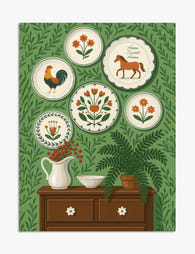
Affiche mur d’assiettes au charme folk
Translation missing: fr.products.product.sale_price À partir de €14,95€24,95 -

Toile femme devant un mur d'assiettes vintage
Translation missing: fr.products.product.sale_price À partir de €54,95€91,95 -
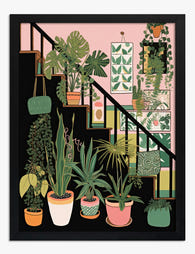
Affiche escalier botanique
Translation missing: fr.products.product.sale_price À partir de €14,95€24,95 -

Toile scène vintage aux assiettes à motifs et robe fleurie
Translation missing: fr.products.product.sale_price À partir de €54,95€91,95 -

Toile assiettes murales style folk
Translation missing: fr.products.product.sale_price À partir de €54,95€91,95 -
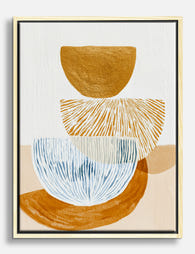
Toile étude de l’équilibre moderne
Translation missing: fr.products.product.sale_price À partir de €54,95€91,95 -

Affiche nuances de terracotta chaleureuses
Translation missing: fr.products.product.sale_price À partir de €14,95€24,95 -
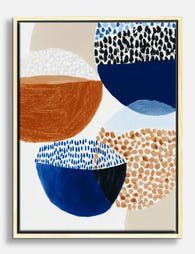
Toile étude de formes éclectiques
Translation missing: fr.products.product.sale_price À partir de €54,95€91,95 -
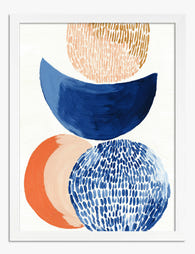
Affiche formes abstraites en harmonie, couleurs vives
Translation missing: fr.products.product.sale_price À partir de €14,95€24,95 -
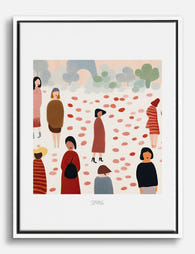
Toile rassemblement de printemps
Translation missing: fr.products.product.sale_price À partir de €54,95€91,95 -

Affiche moment convivial dans un studio chaleureux
Translation missing: fr.products.product.sale_price À partir de €14,95€24,95 -

Toile abstraite équilibre moderne tons terre
Translation missing: fr.products.product.sale_price À partir de €54,95€91,95 -

Toile abstraite, formes organiques et tons terre
Translation missing: fr.products.product.sale_price À partir de €54,95€91,95 -

Affiche abstraite terracotta et bleu
Translation missing: fr.products.product.sale_price À partir de €14,95€24,95 -

Affiche femme de dos devant mur d’assiettes vintage
Translation missing: fr.products.product.sale_price À partir de €14,95€24,95 -

Affiche abstraite aux formes organiques neutres
Translation missing: fr.products.product.sale_price À partir de €14,95€24,95 -

Affiche équilibre de formes
Translation missing: fr.products.product.sale_price À partir de €14,95€24,95 -

Affiche table conviviale en pastels
Translation missing: fr.products.product.sale_price À partir de €16,95€23,95 -

Toile rassemblement joyeux
Translation missing: fr.products.product.sale_price À partir de €54,95€91,95


Plus de The Frame

Kitchen Art: What Works, What Fades
Kitchens are the worst room in your home for art. Heat cycles, steam plumes, airborne grease, and direct overhead lighting will quietly destroy anything you hang without thinking. This guide...

The Bedroom Finishing Guide: Art, Scale, and Light
Most bedrooms get decorated, but very few get finished. The difference is not how much you put on the walls, it is whether the art, the scale of your furniture,...

One Statement Piece Is All Your Living Room Needs
Most blank walls stay blank because the brief feels enormous. You don't actually need a gallery, a grid, or a curated grouping you'll second-guess for six months. You need one...