
 Heute bestellen, Lieferung bis
 Office and Study: Art That Helps You Focus or Art That Helps You Think?
A practical framework for choosing wall art based on whether your brain needs to lock in or open up.


The art you hang in a workspace isn't neutral decoration. It either supports the kind of thinking you do at your desk, or it quietly works against it. The trick is knowing which kind of thinking you actually do.
The focus vs. thinking distinction
Most office art advice treats "productivity" as one thing. It isn't. Knowledge work splits into two very different cognitive modes, and the art that helps one actively hinders the other.
Focus work is convergent. Writing a report, debugging code, reviewing contracts, doing your tax return. You're narrowing in, holding a single thread, and any visual noise pulls cognitive resources away from the task. Research from the University of Illinois on attention residue (Sophie Leroy's well-known work) shows that even momentary shifts of attention leave a measurable cost on focused tasks.
Thinking work is divergent. Brainstorming, strategy, design, problem-solving when you're stuck. You need mental stimulation, novel connections, and a slight loosening of attention. A 2009 study by Mehta and Zhu published in the Journal of Consumer Research found that moderate ambient stimulation actually enhances creative cognition, while the same level of stimulation impairs detailed analytical work.
So before you choose anything, answer one question honestly: when you sit at your desk, are you mostly executing or mostly exploring?

A quick self-assessment
If you're not sure which mode dominates your day, run through these:
- When you finish a great work session, do you feel like you produced something concrete, or like you cracked a problem?
- Do interruptions feel like a small annoyance or a major derailment?
- Do you work better in silence, or with a podcast/music in the background?
- Is your work measured in output (words, code, decks) or in ideas (concepts, directions, decisions)?
If you lean toward concrete output, silence, and feeling derailed by interruption, you're a focus worker. If you lean toward ideas, ambient noise, and cracking problems, you're a thinking worker. Most people are about 70/30 in one direction. A handful are genuinely split, and we'll come back to them.
Art for focus work
The goal here is a wall that supports a calm, narrow attention. Not boring, but not competitive with your screen.
Visual characteristics
Focus art should be low in visual complexity. That means a limited palette (ideally three or four colours total), generous negative space, and a composition your eye can resolve in under two seconds. Think single-subject botanical studies, minimalist line drawings, soft abstract washes, calm landscapes with a clear horizon, or architectural photography with strong symmetry.
Symmetry matters more than people realise. Symmetrical compositions are processed faster by the visual system, which means your brain finishes "looking" at the piece quickly and returns to the task. Asymmetric or complex compositions invite re-examination, which is the last thing you want when you're mid-sentence.
Colour for focus
Blue is the genuine workhorse. A 2009 University of British Columbia study (Mehta and Zhu again) found that blue environments improved performance on detail-orientated tasks. Soft blues, slate, deep navy, and cool greys all support sustained attention. Sage and eucalyptus greens work similarly, drawing on the well-documented restorative effect of natural imagery (Kaplan's attention restoration theory).
Avoid high-saturation reds, oranges, and yellows in your direct line of sight if you do focus work. They're stimulating in a way that pulls attention.
Subject matter
Nature is your friend. Forests, single trees, calm water, mountains in soft light, botanical illustrations. Decades of research starting with Roger Ulrich's 1984 hospital window study have shown that natural imagery reduces stress and supports cognitive recovery. Architectural minimalism (a single arched doorway, a quiet interior) works similarly.
If you want to browse the territory, our botanical prints and landscape prints collections are both built for this kind of calm.
Art for thinking work
If you're paid to come up with ideas, the rules invert. A bare, monastic wall will leave you under-stimulated, and you'll find yourself scrolling for input instead.
Visual characteristics
Thinking art can handle complexity. Layered abstracts, surrealist compositions, dense colour fields, collage, busy cityscapes, narrative figurative work. The piece should reward repeated looking. You want something you haven't fully decoded after three months of staring at it.
Asymmetry helps. The slight cognitive itch of an unresolved composition keeps your mind in a mildly searching state, which is the mental posture creative work requires.
Colour for thinking
Warmer, more saturated palettes. Terracotta, ochre, mustard, deep rust, burgundy. Reds in moderation. The same 2009 Mehta and Zhu paper found that red environments improved performance on creative tasks where novel associations mattered.
This doesn't mean a piece needs to be loud. A largely muted abstract with one assertive block of vermillion can do the work of stimulating divergent thinking without exhausting you.
Subject matter
Abstract work earns its keep here. So does anything surreal, anything that combines unexpected elements, or anything with a story you can't quite pin down. Our abstract prints collection is the obvious starting point, but figurative work with strong narrative tension (a person mid-gesture, a scene with implied story) does similar work.

Background art vs. working art
Here's a distinction most office art guides miss entirely. The art behind you on Zoom calls is doing a completely different job from the art you actually look at while working.
Background art signals something to clients and colleagues. It can be more expressive, more personal, more "on brand." This is where a bolder, larger statement piece earns its place, because nobody (including you) is staring at it during deep work.
Working art sits in your direct or peripheral vision when you're at your desk. This is the piece that needs to match your cognitive mode. It's usually smaller, calmer, and positioned where your eyes naturally rest when you look up from the screen.
A common mistake: hanging your most striking piece directly above the monitor because it looks best on camera. If you do focus work, that piece is taxing you all day. Move it behind you and put something quieter in your eyeline.
How to test what's already on your walls
Before you buy anything, audit what you've got.
For a week, notice three things:
- Where do your eyes go when you pause? If they keep landing on a particular piece and lingering, that piece is pulling attention. Fine if you're thinking, bad if you're focusing.
- Do you still "see" it? Art that's become invisible isn't doing anything either way. Not harmful, but not helping.
- Does looking at it make you feel slightly tense or slightly relaxed? Trust the body response. Tension during focus work is a sign the piece is too busy.
Motivational quotes are the worst offender here. They feel useful when you buy them, become wallpaper within a fortnight, and then occupy prime wall space doing nothing.
The hybrid workspace
If your work genuinely splits between focus and thinking modes, you have a few options.
Zone the room. Calmer art in the eyeline of your desk, more stimulating work on the wall you face when you step back to brainstorm or take calls. A simple shift in body position changes your cognitive context.
Use a rotating wall. One large piece on a hook that you swap seasonally, or even by project phase. We don't talk about this much, but a print that goes up for a three-month strategy sprint and comes down for execution mode is a perfectly legitimate use of art.
Lean into time of day. Morning focus work facing a calm landscape, afternoon thinking sessions in a chair angled toward something bolder. Not everyone has the space for this, but if you do, it works.
For people genuinely balancing both modes, minimalist prints on the working wall paired with a single bolder piece elsewhere in the room tends to be the cleanest solution.
Practical placement
Some specifics that apply regardless of work type:
- Hang at seated eye level. The centre of the piece should sit roughly 145-150cm from the floor if you're going to be sitting in front of it. Standing eye level is too high for a desk workspace.
- Leave breathing room. At least 20cm between the top of your monitor and the bottom of the frame, otherwise the piece reads as cluttered with your screen.
- Match scale to wall. Above a 120cm desk, a 50x70cm or 60x80cm piece looks right. Smaller and it floats. For a wider wall behind you, a 70x100cm framed print or a 100x150cm canvas can carry the room.
- Consider glare. If your desk faces a window, glass-framed art behind you will bounce light into your screen. UV-protective acrylic glaze (which we use on our framed prints) cuts this dramatically compared to standard glass, but the cleanest solution is still a canvas, which has no reflective surface at all.
Framed or canvas for a workspace?
A genuinely useful question, and the answer depends on the room.
Framed prints look more polished and read as more "considered," which matters if your office doubles as a client-facing space on video calls. They're heavier and need a proper hook, but they arrive ready to hang with fixtures attached, so the install is straightforward. The matte paper inside avoids the glare problem that high-gloss prints have.
Canvas prints are lighter, work well in rooms with humidity fluctuations (a converted loft, a garden studio), and have a softer, less formal feel. They're also the better bet for very large pieces because the weight stays manageable. The mirrored edge wrapping means you don't lose any of the image to the side of the stretcher.
For most home offices, we lean framed for focus art (the formality reinforces the work mode) and canvas for thinking art (the softer presence suits a more exploratory headspace). But this is genuinely a preference call.

Common mistakes
A short list of things we see often.
Too many small pieces. A gallery wall of six small prints reads as visual noise during focus work and as overwhelming during thinking work. One or two larger pieces almost always outperform a cluster.
Generic "inspiration." Stock motivational imagery (mountains with quotes, sunrise with platitudes) reads as corporate from day one and becomes invisible by week three.
Buying for the room you wish you had. A serene Japandi print won't fix a chaotic workspace. Sort the desk first, then choose the art.
Ignoring personal meaning. Art connected to your actual goals, places you love, or work you admire is more motivating over time than anything chosen purely on style. A landscape of a place that means something to you will hold your attention longer than a more "correct" piece you have no relationship with.
The honest summary
Work out which mode dominates your day. If it's focus, choose calm, symmetrical, cool-toned, low-complexity pieces and put them in your eyeline. If it's thinking, choose warmer, more complex, asymmetric work that rewards repeated looking. If you genuinely split both, zone the room or rotate.
And test the art that's already there before you buy anything new. The piece that's quietly draining your attention is doing more damage than an empty wall ever would.


In diesem Blog vorgestellte Fab-Produkte
-

Leinwandbild Yoga-Studie: Flow & Fokus
Translation missing: de.products.product.sale_price Ab €64,95€92,95 -

Poster Leseecke - Carl Larsson
Translation missing: de.products.product.sale_price Ab €16,95€23,95 -

Poster Bauhaus Kreisstudie in Orange und Rot
Translation missing: de.products.product.sale_price Ab €16,95€23,95 -

Leinwandbild Nachdenkliche Autorin am Schreibtisch
Translation missing: de.products.product.sale_price Ab €64,95€92,95 -

Poster Ruhe und Balance – Strukturierter Kreis über Linie
Translation missing: de.products.product.sale_price Ab €16,95€23,95 -

Poster Urbanes Literatur-Refugium
Translation missing: de.products.product.sale_price Ab €16,95€23,95 -

Poster Minimalistische Stuhlstudie
Translation missing: de.products.product.sale_price Ab €16,95€23,95 -

Leinwandbild Out-of-Office-Gefühl
Translation missing: de.products.product.sale_price Ab €64,95€92,95 -

Leinwandbild Ruhige Balance – Minimalistische Line-Art
Translation missing: de.products.product.sale_price Ab €64,95€92,95 -

Poster Gemütliche Bibliothek mit gelbem Sofa
Translation missing: de.products.product.sale_price Ab €16,95€23,95 -

Leinwandbild Bauhaus-Kreise in warmen Orange- und Rottönen
Translation missing: de.products.product.sale_price Ab €64,95€92,95 -
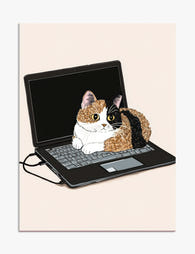
Poster Katze schläft auf der Tastatur
Translation missing: de.products.product.sale_price Ab €16,95€23,95 -
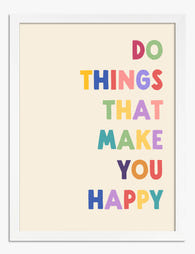
Poster Lebensfreude – tägliche Erinnerung
Translation missing: de.products.product.sale_price Ab €16,95€23,95 -

Poster Nachdenkliche Morgenmuse – Porträt
Translation missing: de.products.product.sale_price Ab €16,95€23,95 -
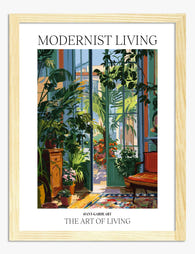
Poster botanische Oase im modernen Wintergarten
Translation missing: de.products.product.sale_price Ab €16,95€23,95 -

Poster Offener Geist, offenes Herz
Translation missing: de.products.product.sale_price Ab €16,95€23,95 -
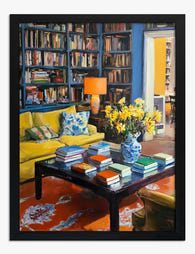
Poster Gemütliche Leseecke
Translation missing: de.products.product.sale_price Ab €16,95€23,95 -

Leinwandbild Nachdenkliche Figur in Grün
Translation missing: de.products.product.sale_price Ab €64,95€92,95 -

Poster Bedeutungsvolle Verbindungen – Handschriftliches Zitat
Translation missing: de.products.product.sale_price Ab €16,95€23,95 -
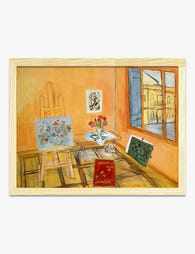
Poster Atelier-Interieur von Raoul Dufy
Translation missing: de.products.product.sale_price Ab €16,95€23,95


Mehr aus The Frame

Nursery Art That Grows with the Room
Most nursery art gets retired by the time the cot comes down. That's a waste of money, wall space and the chance to build something genuinely meaningful. This guide is...

Dining Room Art That Holds the Room Together
The dining room is the most underestimated wall in the house. It's where people sit still for an hour, eyes wandering, and yet most of us treat it as an...

Hallway Art: The Most Overlooked Surface in the...
Your hallway is the most-viewed room in your home. You pass through it every time you make coffee, take a shower, answer the door, or go to bed. And yet...