
 Heute bestellen, Lieferung bis
 How to Style Botanical Prints So They Don't Look Like a Dentist's Waiting Room
Stop hanging four matching ferns in a tidy grid. Here's how to make plant prints feel personal, not clinical.


Botanical prints have a reputation problem. Hung wrong, they read as filler art, the kind of forgettable greenery you stare at while waiting for a root canal. Hung well, they're some of the most atmospheric, characterful pieces you can put on a wall, and this guide is about closing that gap.
The dentist's office problem: why most botanical print displays fall flat
The clinical look usually comes from three habits stacked on top of each other. Four identical prints. Four identical thin black frames. Hung in a tidy two-by-two grid at exactly the same height. It's symmetrical, it's safe, and it looks like it was chosen by a facilities manager.
Botanical art has been styled this way for so long that people assume the format is the art. It isn't. The prints themselves can be gorgeous, but the grid format strips them of personality and turns them into wallpaper. Your eye glides over the wall instead of landing on it.
The other failure mode is scale. People buy small prints because they feel like a low-risk decision, then hang them on a big empty wall where they float like postage stamps. The result reads as tentative, and tentative is the enemy of a room that feels considered.
There's also a category confusion worth clearing up. Botanical prints depict plant specimens, often illustrative, often vintage in feel. Greenhouse prints depict the architecture itself, the glass houses, palm houses and conservatories. Mixing the two is one of the easiest shortcuts to a layered, grown-up look, and we'll come back to it.

Scale is everything: why one large print beats four small ones
If you take one thing from this guide, take this. A single large print, properly placed, will almost always beat a cluster of small ones. It has presence. It commits. It tells the room what it's about.
For a sofa or a bed, you want the artwork to span roughly two-thirds of the furniture below it. Above a standard three-seater, that means something in the 70x100cm range, which is the largest framed size we offer. Above a king bed, you can push to canvas at 100x150cm and the room will thank you.
Hanging height is where most people go wrong. The centre of the artwork should sit at roughly 145 to 150cm from the floor, which is gallery height. Most people hang too high, especially over sofas, leaving an awkward gap of blank wall between the back cushions and the frame. Eight to ten centimetres of breathing room above the sofa back is plenty.
If you genuinely want more than one print, vary the sizes. A 70x100cm anchored next to a 30x40cm and a 50x70cm reads as collected. Three of the same size in a row reads as merchandise.
Budget reality check
You don't need to spend a fortune to get this right. At the lower end, one well-chosen 50x70cm print in a solid wood frame will outperform a six-piece set every time. Mid-range, pair a large statement piece with one or two smaller supporting prints in mixed frames. At the top end, commit to a single 70x100cm framed botanical or a 100x150cm canvas as the room's anchor and build everything else around it.
Unexpected rooms for botanical and greenhouse prints (yes, even the bedroom)
Botanicals get shoved into kitchens and dining rooms by default, which is a waste. The prints work much harder in rooms people don't expect them in.
Bedrooms, especially moody ones. A large greenhouse print above the bed in a room with deep green or charcoal walls is one of the most underrated combinations in interior styling. The architectural glass structure adds geometry, the plants soften it, and the whole thing feels like a private conservatory rather than a hotel room.
Bathrooms. Botanical prints belong here, and not just because of the moisture-and-greenery cliché. The slightly steamy, contemplative atmosphere of a bathroom is improved by something to look at. Canvas works particularly well in humid rooms because there's no glass to fog and the poly-cotton handles damp better than paper alternatives. Just keep prints out of direct splash zones.
Home offices. A single large palm house print behind your desk does more for video calls than any bookshelf staging. It also gives you something restful to rest your eyes on between spreadsheets, which is a genuine productivity argument we'll happily make.
Hallways and stairwells. Tall, narrow walls are perfect for tall, narrow botanical illustrations. A vertical 50x70cm or 70x100cm in a chunky wood frame stops a hallway from feeling like a corridor and starts feeling like a space.
Lounges, but not in the corner. If you've got botanical prints in your living room and they're not landing, check whether you've banished them to the side wall. Botanicals deserve the main wall, the one you face when you sit down.

Frame choices that elevate greenhouse art from 'nice' to 'stunning'
Frame choice is where botanical prints live or die. The default thin black frame is fine, but it's also the reason so many botanical displays look interchangeable.
Chunky natural wood. A wider oak or walnut frame, ideally something solid rather than veneered, gives botanical illustrations a gallery weight that thin frames don't. Our frames are FSC-certified solid wood, which matters because cheap MDF frames warp at the corners within a year, especially in humid rooms.
Warm whites and creams over stark white. Stark white frames against a coloured wall can look surgical. A soft, warm off-white reads as considered rather than clinical, and lets the print's colours do the work.
Black, but make it deep. If you're going black, choose a frame with depth and a slightly matte finish rather than a flat thin profile. Depth creates shadow, and shadow creates presence.
Frameless canvas for the minimal route. A hand-stretched canvas with mirrored edge wrapping looks contemporary and unfussy, and it suits a more graphic botanical style. The whole image stays intact, which matters with detailed botanical illustration where you don't want the edges of leaves disappearing around a corner.
Mix frames within a single display. This is the move that separates collected from corporate. One natural oak, one warm cream, one black, all carrying different prints, hung in a deliberately asymmetrical arrangement. It looks like you bought the prints because you liked them, not because they came as a set.
A note on glazing. Our framed prints use UV-protective acrylic rather than glass, which means no glare under lamplight and no risk of fading even if you hang them in direct sun. It also means they're considerably lighter, which makes the larger sizes much less terrifying to hang.
Colour clashing on purpose: pairing green-heavy prints with warm interiors
The reflexive instinct is to put green prints on green or sage walls. Don't. Tone-on-tone botanicals disappear. The room ends up reading as one fuzzy, undifferentiated wash of greenery.
The interesting move is to clash, deliberately and with confidence.
Terracotta walls with green botanicals. This is the combination we recommend most often, because it almost cannot fail. The warmth of terracotta makes the greens pop without competing, and the contrast feels Mediterranean and grown-up rather than primary-school bright.
Deep navy with palm and fern prints. Navy reads as nocturnal and library-like, and a botanical print breaks up the moodiness without softening it too much. Brass picture lights amplify the effect.
Burgundy or oxblood with floral prints. Florals on burgundy is a Victorian move that has come back around. It's confident and slightly theatrical, and it works particularly well in dining rooms.
Warm plaster pink with greenhouse architecture. Pink and green is one of nature's own colour pairings, and a soft plaster pink wall behind a black-framed greenhouse print is one of the most photographable combinations going.
What to avoid: cold grey walls, magnolia, and sage. Grey deadens botanicals. Magnolia makes them look dated. Sage makes them invisible. If you have any of these wall colours, your botanical prints are working uphill.

How to mix greenhouse prints with other subjects for a layered gallery wall
The matched-set instinct is what kills most botanical gallery walls. The fix is to deliberately introduce prints that aren't botanical at all, and let the greenery hold its own as part of a wider story.
Start with one anchor piece. A large botanical garden print, ideally 70x100cm framed, gives the wall a centre of gravity. Everything else orbits around it.
Then introduce contrast. A piece of architectural photography. An abstract in a colour pulled from the botanical. A vintage map. A figurative portrait. The botanical stops being the whole point and becomes one note in a chord, which is exactly what you want.
A useful rule: aim for variety in three dimensions. Subject (botanical, abstract, photographic, typographic), scale (one large, several mid, a few small), and frame (mixed wood tones, one black, maybe one cream). Repeat any one of those across the whole wall and you'll feel the energy drain out of it.
Hang the anchor first, at gallery height, and build outwards from there. Leave roughly five to seven centimetres between frames, no more. Tight spacing reads as deliberate. Wide spacing reads as nervous.
If you'd rather not assemble the mix yourself, our wall art sets are designed to give you that layered feel without the trial-and-error of sourcing pieces individually.
Lighting changes everything
A botanical print under cold overhead LEDs looks flat and clinical. The same print under a warm 2700K bulb, ideally from a picture light or a nearby table lamp, gains depth and warmth. If your prints aren't landing, check the light before you blame the art. Picture lights mounted above larger framed prints are an underused upgrade and make a striking display feel finished.
Our top botanical and greenhouse prints for statement styling
A few categories worth knowing about when you're shopping for something that won't blend into the wall.
Vintage botanical illustrations at large scale. The trick with vintage-style botanical prints is to print them bigger than they were ever intended to be seen. A specimen illustration that would historically have been encyclopaedia-sized becomes genuinely arresting at 70x100cm. The detail rewards close inspection, which is why printing on thick matte paper with no glare matters. You want people to lean in.
Greenhouse and conservatory architecture. Victorian palm houses, Parisian glass conservatories, kew-style structures. These work brilliantly as the only piece of art on a large wall, because the architecture provides its own internal composition. Look for prints with strong perspective lines that draw the eye in. Browse our plant greenhouse wall art for the full range of architectural greenhouse pieces.
Painterly botanicals over photographic ones. Photographic plant prints can read as stock imagery. Painted, illustrated or etched botanicals have more atmosphere because there's a hand visible in them. They also age better. A photograph dates to its decade. An illustration could be from any of the last three centuries.
Single specimen over busy compositions. A single fern, a single magnolia branch, a single monstera leaf, isolated against a clean background, almost always outperforms a busy bouquet print. Negative space lets the subject breathe and gives the print authority on the wall.

A final word on greenhouse decoration ideas
If you searched for greenhouse decoration ideas hoping for advice on furnishing an actual glass greenhouse, you've ended up in the wrong guide, but the principles still translate. Scale up, mix subjects, avoid matching sets, and treat the space like a room you want to spend time in rather than a display.
For everyone else: pick one large print, hang it at the right height, frame it with intention, and put it in a room you weren't expecting to. That's the entire job. Everything else is detail.

In diesem Blog vorgestellte Fab-Produkte
-

Poster Botanische Gewächshaus-Oase in sattem Grün
Translation missing: de.products.product.sale_price Ab €17,95€29,95 -

Poster Zimmerpflanzen in Boho-Vasen
Translation missing: de.products.product.sale_price Ab €17,95€29,95 -

Poster Botanische Pflanzen auf dem Regal vor gelbem Hintergrund
Translation missing: de.products.product.sale_price Ab €17,95€29,95 -

Leinwandbild Botanisches Motiv in Heritage-Grün
Translation missing: de.products.product.sale_price Ab €64,95€107,95 -

Leinwandbild Treppen-Oase mit Zimmerpflanzen
Translation missing: de.products.product.sale_price Ab €64,95€107,95 -

Poster Boho-Vasen mit Zimmerpflanzen
Translation missing: de.products.product.sale_price Ab €17,95€29,95 -
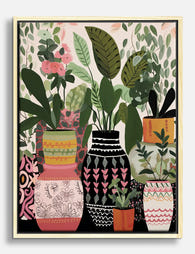
Leinwandbild Botanische Boho-Vasen
Translation missing: de.products.product.sale_price Ab €64,95€107,95 -
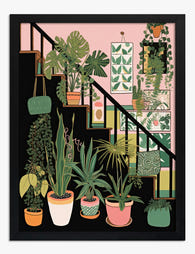
Poster Botanische Treppe
Translation missing: de.products.product.sale_price Ab €17,95€29,95 -

Poster Botanische Boho-Harmonie
Translation missing: de.products.product.sale_price Ab €17,95€29,95 -

Poster Zimmerpflanzen auf Sonnengelb
Translation missing: de.products.product.sale_price Ab €17,95€29,95 -

Poster Modernes botanisches Blattmotiv in Grün
Translation missing: de.products.product.sale_price Ab €17,95€29,95 -

Poster botanische Eleganz in Dunkelgrün
Translation missing: de.products.product.sale_price Ab €17,95€29,95 -

Leinwandbild Botanisches Grün im Heritage-Stil
Translation missing: de.products.product.sale_price Ab €64,95€107,95 -

Poster Botanische Verspieltheit in Grün
Translation missing: de.products.product.sale_price Ab €17,95€29,95 -

Poster Morris Botanisches Motiv in Grün
Translation missing: de.products.product.sale_price Ab €17,95€29,95 -

Poster Botanisches Grün von Morris
Translation missing: de.products.product.sale_price Ab €17,95€29,95 -

Poster Botanische Eleganz in Hellgrün - Vintage-Stil
Translation missing: de.products.product.sale_price Ab €17,95€29,95 -

Poster Tropische Gewächshausoase
Translation missing: de.products.product.sale_price Ab €17,95€29,95 -

Leinwandbild Botanische Oase im Vintage-Stil
Translation missing: de.products.product.sale_price Ab €64,95€107,95 -

Poster botanische Boho-Formen in Grün & Pink
Translation missing: de.products.product.sale_price Ab €17,95€29,95


Mehr aus The Frame

Vintage or Modern Kitchen Prints? How to Match ...
Most kitchen art guides tell you to "choose what you love" and leave you to it. That's not advice, that's a shrug. The real question is whether your kitchen leans...

Transform Your Kitchen Walls with Art That Work...
Most kitchen art advice is the same recycled list: lemons, herbs, a typography print telling you to "Eat, Drink, Be Merry". You deserve better, and your walls do too. This...

Room by Room: Where to Hang Botanical Prints fo...
Botanical prints are the most forgiving genre of wall art you can buy. That doesn't mean every leaf-on-paper works in every room, or that hanging them is intuitive. This guide...