
 Heute bestellen, Lieferung bis
 7 Mid-Century Modern Wall Art Rules That Get Placement Right
The exact print sizes, hanging heights, and spacing rules that turn a blank wall into a deliberate one.


Mid-century modern art lives or dies by placement. A perfect print hung 10cm too high or sized 20cm too small will look like a mistake, and that's the moment most people freeze and close the tab. This guide solves that.
1. The two-thirds rule: why your print should never be wider than your furniture
The two-thirds rule is the single most useful piece of advice in wall art. Your print (or grouping of prints) should span roughly two-thirds the width of the furniture beneath it. Not the full width, not half, two-thirds.
So what is the 2/3 rule for wall art in practice? If your sofa is 200cm wide, your art should land between 130cm and 150cm wide. A 90cm-wide print floats awkwardly above it like a postage stamp. A 200cm-wide print fights the sofa for attention.
Here's the cheat sheet for mid-century modern wall art, mapped to print sizes you can actually buy:
- 150cm sofa (loveseat, compact MCM 2-seater): one 50x70cm print, or a pair of 30x40cm prints side by side
- 180cm sofa (standard 2.5-seater): one 70x100cm print landscape, or three 30x40cm prints in a row
- 200-220cm sofa (3-seater): one 70x100cm landscape print, or a triptych of 50x70cm prints
- 240cm+ sofa (large 3-seater or sectional): a 100x150cm canvas, or a horizontal row of three 50x70cm framed prints
MCM furniture tends to be lower and longer than contemporary sofas, which means you have more vertical wall to play with above it. That changes things, which we'll get to.

2. Optimal hanging height (and why 'eye level' is bad advice if you have a sofa beneath it)
The standard advice is to hang art with its centre at 145cm (57 inches), the so-called gallery height. This works in hallways and on empty walls. It does not work above a sofa.
When there's furniture below, the rule that matters is the gap. Leave 15 to 20cm between the top of your sofa and the bottom of your frame. Any closer and the art looks crammed. Any further and it floats, disconnected from the room.
For a typical MCM sofa with a back height of around 80cm, that puts the bottom of your frame at roughly 95-100cm from the floor. A 70x100cm portrait print would then have its centre at around 145-150cm. The maths works out, which is why the rule exists.
The exception is low-profile MCM seating, where the sofa back sits closer to 70cm. Drop your art accordingly. The 15-20cm gap is what your eye reads as 'right', not any specific number from the floor.
For art above a console, sideboard, or credenza (very MCM, very common), use the same 15-20cm gap above the surface. If you've styled the surface with lamps or ceramics, measure from the tallest object.
3. Single statement print vs. gallery set of three: when to use each layout
This is where most people get stuck. Both layouts are correct mid-century modern art ideas, but they solve different problems.
Go single statement when:
- Your ceiling is high (2.6m or above) and you have vertical wall to fill
- The room is otherwise busy (patterned rug, layered textiles, plants)
- Your furniture is a clean, simple shape and you want to echo that
- You want one focal point that anchors the room
A single 70x100cm framed print or a 100x150cm canvas does the heavy lifting. Browse large wall art if this is your direction.
Go gallery set of three when:
- Your sofa is 200cm or wider and a single print would need to be enormous
- Your wall is wide but your ceiling is standard (2.4m), so horizontal beats vertical
- You want movement and rhythm, which suits geometric or abstract MCM work
- You're nervous about commitment and want flexibility (you can rearrange)
A horizontal triptych of three 50x70cm prints with proper spacing reads as one cohesive piece. Curated wall art sets take the guesswork out of pairing colours and styles.
The mistake is hanging three prints that don't relate to each other. A gallery set works when the prints share a palette, an era, or a visual language. Three random MCM prints in three different colour families look like indecision.

4. Exact spacing for horizontal gallery rows and grid layouts
Spacing is where amateur gallery walls fall apart. Too tight and the prints feel cramped. Too loose and they read as separate, unrelated objects.
The rule: 5 to 7cm between frames. That's roughly two to three inches. Closer than 5cm and the frames visually merge. Wider than 8cm and the eye stops grouping them as a set.
Calculating your total grouping width
For three 50x70cm portrait prints hung in a row with 6cm spacing:
- 3 prints x 50cm = 150cm of print width
- 2 gaps x 6cm = 12cm of spacing
- Total grouping width: 162cm
Apply the two-thirds rule: that grouping suits a sofa between 220cm and 250cm wide. Sized correctly.
For a 2x2 grid of four 30x40cm prints with 6cm spacing:
- Total width: (2 x 30) + 6 = 66cm
- Total height: (2 x 40) + 6 = 86cm
That grid suits a console of around 100cm wide. Compact, deliberate, very MCM.
Mixing sizes
If you're mixing print sizes (one 50x70 with two 30x40, for instance), align either the tops or the centres of the frames, never the bottoms. Aligning bottoms creates a heavy line that fights the eye. Centre alignment reads as intentional and balanced.
5. Which print size for which wall: from 30x40cm to 70x100cm
The biggest mistake in mid-century modern wall art is going too small. MCM interiors tend to be open, with low furniture and clean lines, which means walls read bigger. A 30x40cm print on a 3-metre-wide wall looks like an apology.
30x40cm
Best for: narrow walls between doorways, hallway galleries, above a small bedside table, as part of a multi-print grid. Almost never works as a solo print in a lounge.
50x70cm
The workhorse size. Strong as a solo print above a desk, narrow console, or armchair. Excellent in a triptych above a standard sofa. Pairs well above a queen bed (two side by side).
70x100cm
The proper statement size. Solo above a 180-220cm sofa, fireplace, or king bed. This is where MCM prints really sing, particularly bold geometric or abstract work where scale matters. Available framed and unframed in our mid-century modern art prints collection up to this size.
100x150cm canvas
The largest size we offer, canvas only. For wide sectionals, statement walls in open-plan spaces, or above oversized furniture. Goes far without the weight of a large frame.
The 'go bigger than you think' principle is real for MCM specifically. The aesthetic was built around generous proportions, low horizontal lines, and confident scale. Timid sizing fights the style.

6. Framed vs. unframed vs. canvas: how each option changes the feel
Each format gives you a different relationship with the wall. None is objectively best. Each suits a different room.
Framed prints
A thin black, walnut, or natural oak frame is the MCM-friendly choice. The frame should be quiet, around 2cm wide, with no ornamentation. Chunky gold frames or elaborate mouldings kill the look immediately.
We use solid FSC-certified wood (no MDF, no veneers) with UV-protective acrylic glaze instead of glass. That matters in MCM rooms because they often have big windows and direct light, which fades cheaper prints quickly. The acrylic also means no glare across the print at sofa-eye-level. Framed prints arrive ready to hang with fixtures already attached. Worth browsing the framed art prints collection if you want polish without the weight of glass.
Unframed prints
Just the giclée print on thick matte paper, no frame. Cleaner, lighter, more casual. Works beautifully in a relaxed MCM space, especially clipped into a hanger or pinned. The trade-off: more vulnerable to humidity and handling. Unframed suits bedrooms and studies, less so kitchens and bathrooms.
Canvas prints
Hand-stretched poly-cotton canvas over a solid FSC wood frame, with mirrored edge wrapping so the main image isn't cropped. Canvas reads as warmer and more painterly, which suits abstract MCM work (think Rothko-inspired colour fields) better than crisp geometric prints. Lighter than a framed print of the same size, which matters for the 100x150cm format.
Canvas also handles humid rooms better than framed prints, so it's the better choice for kitchens, bathrooms, or bright sunrooms. The matte finish means no glare.
The honest trade-off: framed prints look more polished and gallery-like, canvas looks more relaxed and lived-in. Pick based on how formal the room is, not which is 'better'.
7. Step-by-step: hanging your mid-century modern print in under 10 minutes
You need: a tape measure, a pencil, masking tape, a spirit level (or your phone's level app), and a hammer with a picture hook or two.
Step 1: Measure the gap, not the height (1 min)
Mark a horizontal line 15-20cm above the top of your sofa, console, or bed. This is where the bottom of your frame will sit. Forget the 145cm rule when there's furniture below.
Step 2: Find the centre of your furniture (1 min)
Measure the width of your sofa and mark the centre point on the wall with a pencil tick. For art above a credenza or fireplace, centre on the furniture, not the wall. Furniture wins.
Step 3: Make a paper template (2 min)
Cut a piece of paper or newspaper to the exact dimensions of your print. Tape it to the wall using the marks from steps 1 and 2. Stand back. This is the moment to find out if the size is wrong, before you put a hole in the wall.
For a gallery set, cut a template for each print and arrange them with 5-7cm spacing. Live with the templates for an hour if you're unsure. Move them around. The right placement is obvious once you see it.
Step 4: Mark the hanging point (2 min)
Flip your frame over and measure from the top edge to the hanging fixture (the D-ring or sawtooth). Most of our framed prints have the fixture about 5-8cm from the top. Transfer that measurement onto your paper template, marking where the hook will go.
Step 5: Hammer in the hook and hang (2 min)
Pierce the template at your mark, hammer the picture hook through it, then tear the template away. Hang the frame. Use the spirit level to straighten.
Step 6: Step back (1 min)
Walk to the opposite side of the room and look. If it feels off, it probably is. Trust your eye over the tape measure for the final adjustment.

The placement rules that matter most
Get the size right first, then the height, then the spacing. In that order. A correctly sized print hung 5cm too high still looks intentional. A too-small print hung at perfect height always looks like a mistake.
For mid-century modern specifically: go bigger, leave a 15-20cm gap above furniture, keep frames thin and quiet, and trust the two-thirds rule. The blank wall stops being scary the moment you have actual numbers to work with.

In diesem Blog vorgestellte Fab-Produkte
-

Poster moderne geometrische Formen in neutralen Erdtönen
Translation missing: de.products.product.sale_price Ab €16,95€23,95 -

Poster Bauhaus geometrische Komposition
Translation missing: de.products.product.sale_price Ab €16,95€23,95 -

Poster Minimalistischer Halbmond
Translation missing: de.products.product.sale_price Ab €16,95€23,95 -

Poster Minimalistische Balance – Geometrisch in Schwarz-Beige
Translation missing: de.products.product.sale_price Ab €16,95€23,95 -

Leinwandbild Minimalistischer Halbmond
Translation missing: de.products.product.sale_price Ab €64,95€92,95 -
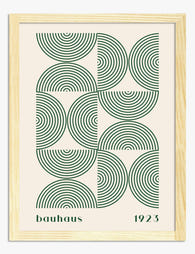
Poster Moderne Bauhaus-Geometrie in Grün
Translation missing: de.products.product.sale_price Ab €16,95€23,95 -

Poster Minimalistisches Bauhaus-Design in Grün und Creme
Translation missing: de.products.product.sale_price Ab €16,95€23,95 -

Leinwandbild Bauhaus: Moderner Minimalismus und geometrische Formen
Translation missing: de.products.product.sale_price Ab €64,95€92,95 -

Poster moderne Bauhaus-Geometrie in Beige und Schwarz
Translation missing: de.products.product.sale_price Ab €16,95€23,95 -

Poster Bauhaus-Geometrie in Schwarz auf Beige
Translation missing: de.products.product.sale_price Ab €16,95€23,95 -

Leinwandbild Halbmond – Moderne, minimalistische Geometrie
Translation missing: de.products.product.sale_price Ab €64,95€92,95 -

Poster Bauhaus Minimalistische Geometrie
Translation missing: de.products.product.sale_price Ab €16,95€23,95 -

Poster Abstrakte geometrische Formen in Erdtönen
Translation missing: de.products.product.sale_price Ab €16,95€23,95 -

Poster Moderne geometrische Formen in Gelb und Grün
Translation missing: de.products.product.sale_price Ab €16,95€23,95 -

Leinwandbild Mid-Century-Oase – geometrisch und botanisch
Translation missing: de.products.product.sale_price Ab €64,95€92,95 -

Poster kubistische Skulptur in sanften Naturtönen
Translation missing: de.products.product.sale_price Ab €16,95€23,95 -

Poster im Bauhaus-Stil – Schwarze Formen auf Beige
Translation missing: de.products.product.sale_price Ab €16,95€23,95 -

Poster Moderne Geometrie im Bauhaus-Stil
Translation missing: de.products.product.sale_price Ab €16,95€23,95 -

Poster Moderne Geometrie im Bauhaus-Stil
Translation missing: de.products.product.sale_price Ab €16,95€23,95


Mehr aus The Frame

Why Do Most Travel Gallery Walls Look So Clutte...
Most travel gallery walls fail for the same reason: they try to show everything. Every trip, every favourite shot, every poster picked up at a museum gift shop, all crammed...

Why Graphic Prints Work Better in Pairs Than Solo
Graphic prints have a reputation for being the difficult guests of the art world: loud, opinionated, hard to seat next to anyone else. That reputation is mostly wrong. With one...

The Only Motivational Wall Art Guide You Need f...
Most motivational wall art goes wrong for the same reason: people choose the quote first and worry about how it looks second. The result is a hot pink "BOSS BABE"...