
 Lächeln garantiert
 Heute bestellen, Lieferung bis
 William Morris and Nature: How Butterflies, Birds, and Botanicals Shaped His Most Iconic Designs
The truth about Morris's insect motifs, his philosophy of nature as a system, and how to choose between birds, butterflies, and botanicals for your walls.


Search for "William Morris butterfly print" and you'll find thousands of products. Search Morris's actual archive of wallpapers and textiles and you'll find almost none. The story of how nature shaped his work is far stranger and more interesting than the marketing suggests.
Morris's lifelong obsession with the natural world
William Morris grew up roaming Epping Forest on the edge of London, learning the names of birds and wildflowers before he could properly read. By the age of seven he had reportedly worked his way through Sir Walter Scott's novels and a copy of Gerard's Herball, the 1597 illustrated guide to plants that became one of the most formative books of his life. That Herball mattered. It was not a botanical taxonomy in the modern sense but a richly illustrated, slightly wandering account of plants and the creatures that lived among them.
This is the lens Morris kept for the rest of his career. He saw plants not as specimens to be pinned and labelled but as living things tangled up with birds, insects, weather, and seasons. While wealthy Victorians filled their conservatories with exotic orchids and ferns shipped in from the colonies, Morris went the other way. He drew from the hedgerows, kitchen gardens, and meadows of the English countryside: honeysuckle, willow, marigold, strawberry, blackthorn, jasmine.
That choice was political as well as aesthetic. Morris despised industrial production and the Victorian appetite for novelty. Native British plants felt honest to him, rooted in place and accessible to anyone who looked carefully at their own garden.

How butterflies and insects fit into his design philosophy
Here is the bit that surprises most people. Despite the flood of products marketed as william morris butterfly patterns, butterflies were not a central motif in Morris's authentic body of work. He rarely drew them. They appear occasionally in later Morris & Co. designs by other hands, and frequently in modern reinterpretations, but if you are looking for a wallpaper Morris himself designed centred on butterflies, you will be looking for a long time.
What he did design, repeatedly and with real affection, were birds and the smaller insects of the English garden. His very first wallpaper, Trellis, completed in 1862, includes flying insects and perching birds drawn by his friend and architectural collaborator Philip Webb. Webb was the better draughtsman of fauna, and the partnership set a precedent: Morris designed the framework of plants and pattern, Webb populated it with creatures.
So why are there so many butterfly products labelled as Morris today? Because modern designers have extrapolated. Morris's broader nature philosophy, with its love of small wild things and layered habitats, lends itself naturally to butterflies even though he did not draw them himself. The result is a category of william morris butterfly design products that are genuinely inspired by his sensibility but are not, strictly speaking, his.
That distinction matters if you care about authenticity, and it is worth knowing before you buy. It does not make modern butterfly prints in his style any less beautiful. It just means you are buying an interpretation, not an original.
The role of nature in the Arts and Crafts movement
The Arts and Crafts movement, which Morris effectively led from the 1860s onward, was a reaction against industrialisation. Mass-produced furniture, cheap printed wallpapers, and machine-made textiles were flooding Victorian homes, and Morris and his circle saw this as a moral as well as an aesthetic disaster. They believed that beauty came from skilled human hands working with honest materials, and that nature was the only proper teacher.
Within this philosophy, nature was not decoration. It was a worldview. The arts and crafts movement butterflies, beetles, birds, and beasts that appear across the work of Morris, Webb, Voysey, and others were a deliberate counterpoint to the smooth, gilded, factory-finished surfaces of mainstream Victorian taste. They were small, alive, slightly wild, and unmistakably British.
Morris also believed something he stated often: that a designer should not literally imitate nature. He argued instead for stylised depictions that captured nature's essence with, in his words, "beauty, imagination and order." A pattern, for Morris, was not a window onto a real meadow. It was a structured, rhythmic shorthand for one.
Key butterfly and insect motifs across Morris's wallpapers and textiles
Look closely at his actual designs and the small fauna are everywhere, just not always where you expect.
Trellis (1862)
Morris's first wallpaper, based on the rose trellis in the garden of Red House, his Bexleyheath home. Webb added sparrows perched on the lattice and small flying insects scattered through the roses. It is the foundational Morris pattern, and it tells you everything about his approach: a structure of plants, real birds, real insects, all coexisting.
Strawberry Thief (1883)
Probably his most beloved textile. Morris designed it after watching thrushes steal ripe strawberries from his kitchen garden at Kelmscott Manor in Oxfordshire. Rather than chasing the birds away, he made them the heroes of the pattern. Two thrushes face each other across rows of strawberry plants, beaks full of fruit. It took him years to perfect the indigo-discharge dyeing technique it required.
Bird and Anemone (1881)
A printed cotton featuring a single stylised bird among trailing anemones, repeated in mirrored pairs. Quieter than Strawberry Thief, but the same instinct: the bird belongs to the plant, the plant belongs to the bird.
Honeysuckle, Pimpernel, Blackthorn, Willow Bough
These are botanical-led designs without prominent fauna, but they reward close looking. The leaves move as if in wind. The flowers nod at different angles. There is almost always a sense that something living has just passed through.

Why Morris designed nature as a system, not a specimen
Victorian science loved a specimen. Pin the butterfly, label the beetle, press the fern, file it away. Morris found this approach hollow. A pinned butterfly is not a butterfly, it is a corpse with information attached.
His designs do the opposite. A bird in a Morris pattern is always doing something: stealing fruit, hiding among leaves, perching on a branch that bears its own flowers and berries. A plant is never alone. It is part of a tangle. There are layers of foreground and background, of stems crossing other stems, of fruit at different stages of ripeness.
This is what people respond to without quite knowing why. A Morris print on your wall does not feel like a botanical illustration. It feels like a small contained ecosystem. The eye keeps moving through it because there is genuinely more to see, and the design rewards looking at it for years rather than seconds.
It also explains why his patterns work so well at scale. A specimen study gets boring once you have understood it. A system stays interesting because the relationships between elements keep revealing themselves.
How nature-inspired Morris prints translate to modern rooms
This is where Morris becomes surprisingly modern. His patterns were designed for cluttered, layered Victorian interiors, but they translate beautifully to pared-back contemporary rooms because the patterns themselves carry so much depth. You do not need a busy room around them. You can let one large print do the work.
A few principles we think hold up reliably.
Scale up rather than down. Morris designs are dense. A small print on a big wall reads as fussy. A 70x100cm framed print or a 100x150cm canvas reads as confident. If you are nervous about pattern, go bigger, not smaller.
Let the colours guide the room, not the other way round. Morris's palettes are earthy: indigo, madder red, olive, ochre, soft cream, deep forest green. Pick one colour from the print and echo it in a cushion, a throw, or a lampshade. Do not try to match everything.
Pair with plain walls. Morris on Morris wallpaper can work in a maximalist scheme, but for most homes a single framed Morris print on a plain wall in chalk white, sage, clay, or deep navy lets the design breathe.
Mix with modern furniture. A Strawberry Thief print over a low mid-century sideboard looks better than the same print over a reproduction Victorian cabinet. The contrast is the point.
For format, framed prints feel more formal and suit living rooms, hallways, and bedrooms where you want a finished, considered look. Our framed art prints come on thick matte giclée paper in solid FSC-certified wood frames with UV-protective acrylic glaze, which matters for Morris designs because the indigos and reds are exactly the kind of historic pigments you do not want fading in a sunny window. Canvas works better in kitchens, bathrooms, and humid spaces, and gives the pattern a softer, more textile-like presence which is fitting given that many Morris designs began life as fabrics.

Choosing between butterfly, bird, and botanical Morris prints for your space
Different motifs do different work in a room. Here is how we would think about it.
Choose bird prints for living rooms and bedrooms
william morris bird art prints like Strawberry Thief or Bird and Anemone bring narrative energy. The eye finds the birds first, then unpacks the surrounding pattern. This makes them ideal for rooms where you spend time and want something to look at: above a sofa, above a bed, in a reading nook. They also pair beautifully with deep wall colours like dark green, oxblood, or navy.
Choose botanical prints for hallways, dining rooms, and home offices
Pure botanical art prints in the Morris style, think Willow Bough, Pimpernel, Blackthorn, are quieter. They function more like wallpaper compressed into a single frame. This makes them excellent in transitional spaces and working spaces where you want pattern without distraction. A row of three botanical prints down a hallway is one of the most reliable wall art moves there is.
Choose butterfly-inspired prints for lighter, more playful rooms
Modern butterfly designs in Morris's spirit, even if not from his own hand, work well in children's rooms, conservatories, dressing rooms, and lighter bedrooms. They carry a different mood from the birds: gentler, more decorative, less narrative. Just go in with your eyes open about authenticity. If a print is described as "Morris-style butterfly," it is almost certainly a contemporary interpretation rather than a historic design.
A note on mixing
You can absolutely mix Morris motifs in one room, but we would limit it to two designs in conversation rather than three or more competing. A bird print and a botanical from the same era will share a palette and rhythm. Two very different Morris designs at full size in a small room will fight each other.
If you want to go deeper on his full body of work, our william morris art prints collection covers the authentic designs and the modern interpretations side by side, which makes it easier to compare.

What to take away
Morris was not a butterfly designer. He was a systems designer who happened to love birds, insects, and the unglamorous plants of the English countryside more than almost anyone before or since. The reason his patterns still feel alive 150 years later is that they were never meant to be specimens on a wall. They were meant to be small worlds.
When you choose a Morris print, choose the motif that matches how you want the room to feel: birds for narrative, botanicals for calm, butterflies for lightness. Hang it large, on a plain wall, with one colour echoed elsewhere. Then leave it alone and let it do what Morris designs have always done, which is reveal a bit more of themselves every time you look.

In diesem Blog vorgestellte Fab-Produkte
-
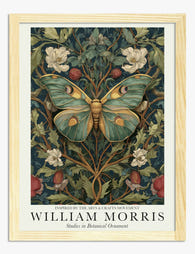
Poster Botanischer Schmetterling – inspiriert von William Morris
Translation missing: de.products.product.sale_price Ab €16,95€23,95 -

Poster Botanischer Schmetterling im Stil von William Morris
Translation missing: de.products.product.sale_price Ab €16,95€23,95 -

Poster Schmetterling mit floralem Design von William Morris
Translation missing: de.products.product.sale_price Ab €16,95€23,95 -

Poster Schmetterlings-Eleganz im Stil von William Morris
Translation missing: de.products.product.sale_price Ab €16,95€23,95 -

Poster Botanischer Schmetterling im William-Morris-Stil
Translation missing: de.products.product.sale_price Ab €16,95€23,95 -

Poster Goldbeflügelter Schmetterling – William Morris
Translation missing: de.products.product.sale_price Ab €16,95€23,95 -

Leinwandbild Botanischer Schmetterling im William-Morris-Stil
Translation missing: de.products.product.sale_price Ab €64,95€92,95 -

Poster Schmetterling mit floralen Ornamenten von William Morris
Translation missing: de.products.product.sale_price Ab €16,95€23,95 -

Leinwandbild William Morris: Schmetterling & florales Motiv
Translation missing: de.products.product.sale_price Ab €64,95€92,95 -

Poster Schmetterling und Blüten von William Morris
Translation missing: de.products.product.sale_price Ab €16,95€23,95 -
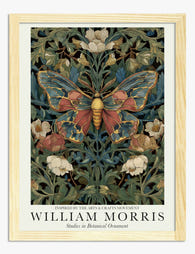
Poster Botanischer Schmetterling im William-Morris-Stil
Translation missing: de.products.product.sale_price Ab €16,95€23,95 -

Poster Botanisches Schmetterlingsmotiv – inspiriert von William Morris
Translation missing: de.products.product.sale_price Ab €16,95€23,95 -

Poster Botanische Schmetterlinge im William-Morris-Stil
Translation missing: de.products.product.sale_price Ab €16,95€23,95 -

Poster Schmetterling auf weißer Blüte im Stil von William Morris
Translation missing: de.products.product.sale_price Ab €16,95€23,95 -

Leinwandbild Botanischer Schmetterling im Stil von William Morris
Translation missing: de.products.product.sale_price Ab €64,95€92,95 -
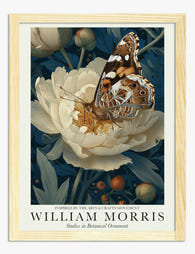
Poster Schmetterling auf Blüte – inspiriert von William Morris
Translation missing: de.products.product.sale_price Ab €16,95€23,95 -

Leinwandbild Botanischer Schmetterling im William-Morris-Stil
Translation missing: de.products.product.sale_price Ab €64,95€92,95 -

Poster Weißer Schmetterling von William Morris
Translation missing: de.products.product.sale_price Ab €16,95€23,95 -
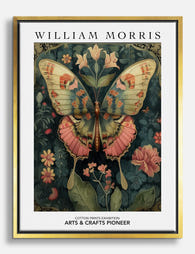
Leinwandbild Schmetterling im William-Morris-Stil
Translation missing: de.products.product.sale_price Ab €64,95€92,95 -

Poster Botanischer Schmetterling im William-Morris-Stil
Translation missing: de.products.product.sale_price Ab €16,95€23,95


Mehr aus The Frame

How to Style Vintage City Prints Without Lookin...
Vintage city prints are the easiest art category to get wrong. They're widely available, instantly recognisable, and almost designed to read as filler when hung without thought. This guide is...

Why Impressionist Art Looks Incredible in Moder...
There's a quiet contradiction in how we decorate now. We chase clean lines and quiet palettes, then hang 150-year-old paintings of poppy fields above the sofa. It works, beautifully, and...

How to Build a Floral Gallery Wall Around Bouqu...
You bought a bouquet print. You hung it up. You love it. And now the wall around it looks emptier than before. This guide is for that exact moment, with...