
 Smiles Guaranteed
 Order today for delivery by
Arts and Crafts Movement Prints: The Handmade Aesthetic Your Walls Are Missing
A practical guide to William Morris, Victorian florals, and the most enduring design movement Britain ever produced.


The Arts and Crafts movement gave us some of the most beautiful, walkable-into wallpaper and pattern design ever made. More than a century later, its prints still hold their own on contemporary walls, sitting comfortably next to oak floors, plaster pinks and second-hand sofas. This guide will help you recognise the style, understand why it endures, and use it in your home without your lounge resembling a National Trust gift shop.
What the Arts and Crafts movement actually stood for (and why it matters for your walls)
The Arts and Crafts movement emerged in Britain in the 1860s and ran through to roughly 1920, born as a direct rebellion against the cheap, mass-produced output of the Industrial Revolution. Its founders, chief among them William Morris, John Ruskin and Philip Webb, believed that beautiful, handmade objects should be part of everyday life rather than locked away in galleries. Their philosophy boiled down to three things: honest materials, visible craftsmanship, and design rooted in nature.
That matters for your walls because the prints produced during this period were never meant to feel precious or untouchable. They were designed to live with, to wallpaper a hallway, line a stairwell, soften a bedroom. They are the original "art for the home", which makes them surprisingly easy to integrate into modern interiors that prize warmth, texture and a bit of personality over showroom polish.

William Morris: the beating heart of Arts and Crafts design
You can't talk about Arts and Crafts prints without talking about William Morris. He was a poet, a socialist, a textile designer and the founder of Morris & Co., and his patterns are the closest thing the movement has to a visual signature. If you've ever seen a wallpaper of densely packed leaves and birds and thought "that looks vaguely Victorian but in a good way", you were almost certainly looking at Morris.
A handful of his designs have become genuinely iconic. Strawberry Thief (1883) shows thrushes stealing fruit from a garden, mirrored in pairs across a deep indigo ground. Trellis (1862) was his very first wallpaper, a climbing rose pattern based on the garden at Red House. Willow Bough (1887) is calmer and more architectural, all sweeping silver-green leaves on cream. Acanthus (1875) is the maximalist of the bunch, large curling leaves in olive, wine and ochre that swallow a wall whole.
What makes Morris work as wall art rather than just wallpaper is the level of detail. His designs reward close looking. A single Strawberry Thief print contains dozens of small decisions about colour, line and rhythm, which is why our William Morris botanical prints tend to look better the closer you stand to them.
Key visual hallmarks: flat pattern, organic form, handcrafted texture
If you want to identify Arts and Crafts prints in the wild, four characteristics give the game away.
Flat pattern. Morris and his contemporaries rejected the Victorian fashion for three-dimensional, photo-realistic florals. Their leaves and flowers are stylised, often outlined, sitting on a single plane. There's no shading meant to fool the eye into thinking a rose is bursting out of the wall.
Organic, asymmetric form. Stems curl. Leaves overlap. Birds are tucked into hedges. Compared to the rigid geometry that came before and the strict grids that came after, these designs feel grown rather than drawn.
Earthy, vegetable-dyed colour palettes. Think indigo, madder red, weld yellow, walnut brown, olive and slate. Morris was obsessed with reviving traditional dye techniques, and the resulting palette is deep, slightly muted, and reads as warm rather than bright. Anything aggressively neon or pastel is almost certainly not period.
Visible handcraft. Even in printed form, you can usually see evidence of the woodblock or hand-drawn line. Edges are softer than digital vector work. Repeats aren't mathematically perfect.
Worth knowing: Japanese woodblock prints had a huge influence on the movement. The flat perspective, the love of natural motifs, the willingness to let a branch run off the edge of the composition. If a Morris pattern feels surprisingly modern, that's part of the reason.
Beyond Morris: other Arts and Crafts artists worth knowing
Morris dominates the conversation, but he was part of a much larger circle, and several of his contemporaries are worth seeking out if you want depth in your collection.
Walter Crane was an illustrator and book designer whose work bridges children's book illustration and serious decorative art. His patterns are slightly more whimsical than Morris's, with figures and storytelling tucked into the foliage.
Kate Faulkner designed wallpapers and gesso work for Morris & Co. and is finally getting recognition after a century of being overshadowed. Her patterns are lighter and more delicate than Morris's heavier compositions.
C.F.A. Voysey worked at the later end of the movement and pushed the style toward something simpler and more graphic. His bird and tulip designs feel like a bridge to twentieth-century modernism.
Charles Rennie Mackintosh ran the Scottish wing of the movement, where the aesthetic took a more architectural, geometric turn. His rose motifs are instantly recognisable: long stems, square petals, a stark elegance that feels almost Art Nouveau.
Speaking of which: people often ask whether Arts and Crafts and Art Nouveau are the same thing. They're not, but they overlap. Arts and Crafts came first and is more rooted in honest craftsmanship and rural English motifs. Art Nouveau, which emerged in the 1890s, is more theatrical, more curvilinear, more urban and continental. Some historians treat A&C as the root of Art Nouveau. Others treat them as cousins with different priorities. Both views are defensible.

Victorian floral design vs modern botanical prints
This is where a lot of shoppers get confused, because "floral print" covers an enormous range of styles. If you're searching for victorian floral art prints and ending up with something that doesn't quite scratch the itch, here's why.
Level of detail and density. Victorian and Arts and Crafts florals are dense. Pattern fills the entire surface. Modern botanical prints, by contrast, tend to feature a single specimen, often centred, with significant negative space around it.
Background treatment. A Morris design has no real "background" in the modern sense. The pattern is the background. A modern botanical print usually sits on plain white or cream, treating the flower as a subject against a void.
Colour approach. Victorian florals use rich, layered, slightly desaturated palettes built from natural dyes. Modern botanicals lean toward either crisp scientific illustration (white background, true-to-life colour) or muted Scandi neutrals (dusty pink, sage, off-white).
Intended function. A Victorian floral was designed to clothe a room. A modern botanical is designed to be a single decorative object on a wall. Knowing which you actually want will save you a lot of scrolling.
If you want maximalism, drama and a wall that talks back, go Victorian. If you want quiet, considered, gallery-style, go modern. There's no wrong answer, just different briefs.
How to style Arts and Crafts prints in a contemporary home
The fear with this style is obvious: you don't want your house to feel like a costume drama set. Avoiding that is mostly about restraint and contrast.
Don't recreate a Victorian room. A Morris print does not need to be paired with mahogany, dado rails and a wingback chair. It looks better, frankly, against plain plaster walls, simple modern furniture, and a single statement antique. The contrast is what makes the pattern sing.
Mind the scale. Morris designs were created for full walls, so when you scale them down to a single print, size matters. A 30x40cm Strawberry Thief looks fussy and cluttered. The same image at 70x100cm reads as confident and architectural. If you love the pattern, go bigger than your instinct suggests.
Pull one colour into the room. Find the deepest tone in the print, an indigo, a wine red, a moss green, and echo it once elsewhere. A single cushion, a lamp base, a throw. That's enough to tie the print into the room without theming it to death.
Mix with genuinely modern pieces. A Morris print over a Bauhaus-style sofa works beautifully. So does Morris next to a piece of contemporary abstract art. The Victorian-on-Victorian look is what tips into pastiche.
Don't be precious about the room it goes in. These designs were made for hallways, kitchens, bathrooms, bedrooms. They're not formal living room art. Some of the best placements are unexpected: a single large Acanthus print in a downstairs loo, or a pair of Willow Bough prints flanking a kitchen window.
Choosing between framed prints and canvas for an Arts and Crafts look
Both work, but they create quite different impressions, and we have a view.
For most Arts and Crafts prints, framed wins. The style was born as printed pattern on paper, and a flat, glazed framed print honours that origin. The crisp edge of a frame also gives the dense pattern somewhere to stop, which prevents it from overwhelming the wall. Solid wood frames in oak or walnut suit the aesthetic perfectly. Black works for Mackintosh. Avoid anything plastic, ornate or gilded, which fights the movement's whole anti-fuss philosophy.
A note on glass versus acrylic: our framed prints use a UV-protective acrylic glaze rather than glass, which means no glare and no fading even in a sunny hallway. Given how much these designs depend on rich, deep colour, that protection actually matters. The inks themselves are rated to last hundreds of years.
Canvas works better in two specific cases. First, for bathrooms, kitchens or anywhere humid, where canvas handles moisture more comfortably than paper. Second, for very large statement pieces (we go up to 150x100cm) where you want the print to feel architectural rather than gallery-like. A huge Acanthus on canvas feels like a tapestry, which is arguably closer to how Morris originally imagined his patterns living.
What you don't want is a poorly fitted frame, warped board, or a print that arrives separately from its frame and needs assembly. That's the most common failure in this category. Everything we ship arrives properly fitted, ready to hang, in a single box.

Building a gallery wall with an Arts and Crafts theme
Gallery walls and Arts and Crafts prints have a complicated relationship. The patterns are already busy, so cramming six of them together can read as visual soup. Done with restraint, though, it's one of the most rewarding wall arrangements you can build.
Stick to a tight palette. Choose three or four prints that share at least two dominant colours. All-indigo. All-olive-and-ochre. The colour discipline is what holds a busy gallery wall together.
Mix pattern density. Pair a maximalist Morris with a sparser Voysey or Mackintosh. Even a piece of typography or a botanical line drawing can act as a "rest" between denser prints.
Match your frames. This is the rule we'd break least often. Inconsistent frames on Arts and Crafts prints look chaotic. Pick one wood and one finish and commit.
Don't go fully symmetrical. The movement loved organic asymmetry. A grid of identically sized prints feels at odds with the spirit of the work. Stagger sizes. Let one print sit slightly proud of the others.
Anchor with one large piece. A single 70x100cm framed print as the visual centre, with two or three smaller pieces orbiting it, almost always works better than four equally sized prints. Browse our floral art prints and full William Morris collection to mix and match within a coherent palette.

A few last things worth saying
Arts and Crafts design endures because its core idea, that beautiful patterns rooted in nature should be part of ordinary life, never really went out of fashion. The current fashion-house collaborations and Morris-print revivals are just the latest chapter.
Start with one print you genuinely love rather than building a themed scheme. Go larger than you think. Frame it properly, hang it somewhere unexpected, and let the pattern do the work.

Fab products featured in this blog
-

Morris Botanical Vase Art Print
Translation missing: en.products.product.sale_price From €16,95€23,95 -

William Morris Floral Elegance Art Print
Translation missing: en.products.product.sale_price From €16,95€23,95 -

William Morris Floral Bird Art Print
Translation missing: en.products.product.sale_price From €16,95€23,95 -

William Morris Floral Elegance Art Print
Translation missing: en.products.product.sale_price From €16,95€23,95 -

Morris Botanical Birds Art Print
Translation missing: en.products.product.sale_price From €16,95€23,95 -

William Morris, Original Floral Pattern Art Print
Translation missing: en.products.product.sale_price From €16,95€23,95 -

William Morris Acanthus Art Print
Translation missing: en.products.product.sale_price From €16,95€23,95 -
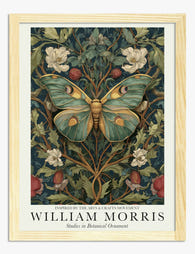
William Morris Botanical Butterfly Art Print
Translation missing: en.products.product.sale_price From €16,95€23,95 -

Morris Botanical Leaves Art Print
Translation missing: en.products.product.sale_price From €16,95€23,95 -

William Morris Autumn Florals Art Print
Translation missing: en.products.product.sale_price From €16,95€23,95 -

William Morris Countryside Art Print
Translation missing: en.products.product.sale_price From €16,95€23,95 -

William Morris Wallflower Canvas Print
Translation missing: en.products.product.sale_price From €64,95€92,95 -

William Morris Floral Elegance Canvas Print
Translation missing: en.products.product.sale_price From €64,95€92,95 -

William Morris, Original Flower Garden Art Print
Translation missing: en.products.product.sale_price From €16,95€23,95 -

William Morris Jasmine Floral Vase Art Print
Translation missing: en.products.product.sale_price From €16,95€23,95 -

William Morris Roses Art Print
Translation missing: en.products.product.sale_price From €16,95€23,95 -

William Morris Autumn Botanicals Art Print
Translation missing: en.products.product.sale_price From €16,95€23,95 -

William Morris Botanical Pattern Art Print
Translation missing: en.products.product.sale_price From €16,95€23,95 -

William Morris Floral Elegance Art Print
Translation missing: en.products.product.sale_price From €16,95€23,95 -

William Morris Cray Floral Art Print
Translation missing: en.products.product.sale_price From €16,95€23,95


More from The Frame

How to Decorate a Hallway With Art (And Finally...
Hallways are the rooms you walk through without thinking, until guests arrive and you suddenly notice the bare walls. This guide is for anyone staring at an empty corridor wondering...

Building an India Travel Gallery Wall: Layouts,...
India might be the most photogenic country on earth, which is exactly why most travel gallery walls inspired by it end up feeling like visual chaos. Pink palaces fight with...

Styling William Morris Prints in Modern Homes W...
Morris prints carry baggage. Mention them and people picture floral wallpaper in a Cotswolds B&B, dark wood sideboards, and a doily under every lamp. That reputation is unfair, and easily...