
 Order today for delivery by
 Room by Room: Where to Hang Botanical Prints for Maximum Impact
A practical, room-by-room playbook for getting size, height, and placement right the first time.


Botanical prints are the most forgiving genre of wall art you can buy. That doesn't mean every leaf-on-paper works in every room, or that hanging them is intuitive. This guide tells you exactly what size to buy, how high to hang it, and what to watch out for in each space.
Living room: the statement piece above the sofa
The wall above your sofa is the single most-looked-at surface in your home, which makes it the most common place people get botanical art wrong. They go too small. A 30x40cm print floating above a three-seater looks like a postage stamp on a parcel.
The rule we use: your art should span roughly two-thirds to three-quarters of the sofa's width. For a standard 200cm sofa, that means a single print at 70x100cm, or a pair of 50x70cm prints hung side by side with a 5-8cm gap. Centre the bottom edge 15-25cm above the sofa back so the art feels connected to the furniture rather than drifting toward the ceiling.
For botanical prints for living room walls, we'd push you toward larger, more graphic botanicals: a single oversized fern, a monstera leaf study, a vintage palm illustration. Detailed Victorian-style line drawings get lost from across the room. Save those for the hallway.

If your living room gets strong afternoon sun, this is the room where UV-protective glazing actually earns its keep. Standard glass lets prints fade noticeably within a few years in direct light. The acrylic glaze on our framed prints blocks UV, which is the difference between a print that looks like new in a decade and one that's gone pink and washed out.
Common mistakes in the living room
Going too small is the biggest one. The second is hanging too high. Eye level for a standing adult is around 150-160cm, but in a living room you're seated most of the time, so the centre of the artwork should sit closer to 145cm from the floor. Trust the relationship between the art and the sofa, not the empty ceiling space above.
Bedroom: calming botanicals and where to place them
The bedroom is where you should lean into the softer, more atmospheric end of the botanical art prints spectrum. Pressed-flower studies, watercolour ferns, muted eucalyptus, anything with sage green, dusty pink, or soft cream. Save the punchy banana leaves and high-contrast prints for elsewhere.
Above the bed, the same two-thirds rule applies. For a standard double (135cm wide), aim for a single print around 60x80cm or a pair of 40x50cm prints. For a king (150cm), step up to 70x100cm or a triptych of three 30x40cm prints with even spacing.
Hang the bottom edge 15-20cm above the headboard. If you've no headboard, treat the bed itself as the anchor and aim for the bottom of the frame to sit roughly 75-80cm above the mattress.
There's solid professional consensus in interior design that green tones lower visual stimulation, which is part of why botanicals feel right in bedrooms. You're not decorating for impact here, you're decorating for the moment you open your eyes in the morning. Choose accordingly.
Beyond above the bed
The wall opposite your bed is the second prime spot, because it's the first thing you see when you wake up. A pair of medium botanical prints for bedroom walls hung above a dresser or chest of drawers works beautifully here, around 50x70cm each, hung with 8-10cm centred above the furniture.
Hallway: first impressions with large botanical prints
Hallways are narrow, which fools people into buying small art. The opposite is usually correct. Because you view hallway art from close range and at an angle as you walk past, detail and scale both matter more, not less.
For a hallway wall longer than 2 metres, consider a series: three or four 40x50cm prints in matching frames, evenly spaced, hung at a consistent centre height of 150cm. Botanical line drawings, vintage botanical plates, and pressed-fern illustrations all suit this format because their detail rewards the close viewing distance.

For shorter hallways or end-of-corridor walls, go big with a single statement piece: 70x100cm, vertical orientation. A tall botanical, like a palm or a flowering stem, draws the eye down the corridor and makes the space feel longer.
For hallway wall art in rental properties, command strips will hold framed prints up to around 3kg, which covers most prints up to 50x70cm. Anything heavier needs a proper fixing.
Sight lines matter
Walk through your hallway and note where your eye naturally lands. That's where the centre of your art should sit, not necessarily the geometric centre of the wall. Doorways, light switches and radiators all break up the available space, and the art should respond to what's actually there.
Kitchen and dining: botanical art that holds its own near food
Kitchens are tricky because they're often the most cluttered visual environment in the house: open shelving, appliances, hanging utensils, tile patterns. Botanical art works here precisely because it reads as organic and calming against all that hardware.
In the kitchen itself, smaller is fine. A 30x40cm or 40x50cm herb print above a coffee station, or a pair of citrus illustrations flanking a window, adds warmth without competing with the existing visual noise. Lean toward edibles: lemons, figs, olives, herbs, mushroom studies. They feel intentional in a food space.
The dining area is where you can go larger and more dramatic. Above a dining table or sideboard, scale to the furniture. A 180cm sideboard wants a single 60x90cm print or a horizontal pair. Hang the centre 145-150cm from the floor, treating the sideboard as the anchor.
We'd avoid hanging unprotected prints directly above the hob or a kitchen sink. Grease and steam settle on everything within a metre or so, and even with acrylic glazing you'll be wiping the frame regularly. A few steps removed from the action is fine.
Dining room gallery walls
For formal dining rooms, a symmetrical grid of botanical prints reads more grown-up than an organic cluster. Six matching 30x40cm prints in identical frames, three by two, with 5cm gaps, looks deliberate and elegant. Use the same botanical family for cohesion: six different ferns, or six citrus varieties.
Bathroom: tropical leaves and humid-room considerations
Yes, you can put botanical prints in a bathroom. No, they won't immediately disintegrate. But there are real considerations.
Canvas tends to handle humidity better than paper because there's no glass to trap condensation against the print surface. A hand-stretched canvas botanical can live happily in a well-ventilated bathroom for years. Framed paper prints are also fine, as long as the bathroom has a working extractor fan or a window that gets used. Sealed frames with proper backing (which is what you should be getting from any reputable maker) prevent moisture from creeping in behind the print.

Tropical leaves are the obvious choice here: monstera, palm, banana leaf, philodendron. The scale of those leaves suits the often-tight wall space, and the spa-like associations are baked in. Stick to one or two prints maximum, this isn't a room that benefits from a gallery wall.
Avoid hanging anything directly above a shower or bath where it'll be hit with steam plumes. The wall opposite the bath, or above a vanity, is safer.
Home office: why botanical prints actually help you focus
There's genuine research on this, attributed to environmental psychologists studying biophilic design: exposure to natural imagery during cognitive tasks reduces mental fatigue and supports sustained attention. Practically, this means a botanical print on your office wall is doing more than looking nice.
The trick is choosing botanicals that calm rather than energise. High-contrast tropical prints can be distracting in a workspace. Softer studies, single-stem illustrations, herbarium plates, work better in the peripheral vision.
Position the art so it's visible from your desk but not directly in your sightline when you're looking at your screen. The wall to the side of your monitor, or behind it at a slight angle, is ideal. A 40x50cm or 50x70cm print at seated eye level (around 115-125cm centre height when you're at a desk) lets you rest your eyes on it during the inevitable thinking pauses.
Avoid harsh fluorescent overhead lighting reflecting off any glazed art. If you're stuck with strip lighting, canvas removes the glare problem entirely.
Size cheat sheet: the right print dimensions for every room
Here's the quick-reference version, assuming the art is the focal point of the wall rather than part of a busy arrangement.
Above a 2-seater sofa (160-180cm): single print 50x70cm, or pair of 40x50cm
Above a 3-seater sofa (200-220cm): single print 70x100cm, or pair of 50x70cm
Above a 4-seater sofa (240cm+): single print 100x150cm canvas, or triptych of 50x70cm
Above a double bed (135cm): single 60x80cm, or pair of 40x50cm
Above a king bed (150cm): single 70x100cm, or triptych of 30x40cm
Above a dresser/sideboard (120-180cm): single 50x70cm or 60x80cm
Above a console table (80-100cm): single 40x50cm or 50x70cm
Hallway statement wall: single 70x100cm vertical, or series of 3-4 at 40x50cm
Bathroom feature wall: single 40x50cm or 50x70cm
Home office: 40x50cm or 50x70cm at seated eye level
A useful test before you commit: cut newspaper or kraft paper to the print's exact dimensions and blu-tack it to the wall for 48 hours. Live with it. You'll know within a day whether it's the right size.
How lighting changes everything (and how UV-protective glazing helps)
The same botanical print can look like two different artworks depending on the light hitting it. North-facing rooms get cool, even, soft light, which tends to flatter muted and watercolour botanicals but can mute high-contrast prints. South-facing rooms get warm, direct light that brings out yellows and oranges but will fade unprotected prints over time.

For any room with direct sunlight at any point in the day, UV-protective glazing isn't optional, it's the difference between art that lasts and art that fades. Our framed prints use UV-protective acrylic rather than glass, which blocks the wavelengths that cause fading while also being lighter and safer than glass on plaster walls or in homes with kids.
Warm artificial light (2700-3000K, the standard for living rooms and bedrooms) brings out the warm tones in botanicals: terracotta, ochre, olive. Cooler light (3500-4000K, common in kitchens and offices) sharpens cool greens, blues, and crisp whites. Match the print's colour temperature to the room's lighting and the art will feel like it belongs.
If a print looks great in the shop or on screen but flat on your wall, lighting is almost always the culprit before anything else. A small picture light or a repositioned floor lamp transforms how art reads.
Where to start
If you only do one thing differently after reading this: measure your sofa and your bed, and buy art that's bigger than you think it should be. Undersized art is the single most common mistake in home decorating, and botanicals are particularly unforgiving of it because their subject matter rewards scale.
Get the size right, hang it at the right height, and respect the light in the room. The rest is just choosing which leaf you like best.

Fab products featured in this blog
-

Houseplants on a Step Stool Art Print
Sale price From €16,95€23,95 -

British Botanical View Art Print
Sale price From €16,95€23,95 -

Boho Botanical Vases Art Print
Sale price From €16,95€23,95 -
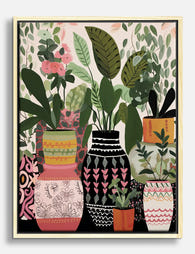
Boho Botanical Vases Canvas Print
Sale price From €65,95€93,95 -

Botanical Stairway Canvas Print
Sale price From €65,95€93,95 -

Plants in the Sink Bathroom Canvas Print
Sale price From €65,95€93,95 -

Boho Botanical Haven Art Print
Sale price From €16,95€23,95 -
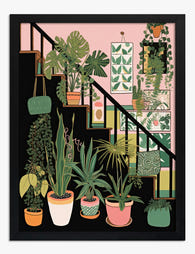
Botanical Stairway Art Print
Sale price From €16,95€23,95 -

Les Formes Botaniques Canvas Print
Sale price From €65,95€93,95 -

Big Cream Bloom on Green Art Print
Sale price From €16,95€23,95 -

Mediterranean Plant Parade Canvas Print
Sale price From €65,95€93,95 -

Boho Botanical Harmony Art Print
Sale price From €16,95€23,95 -

Les Formes Botaniques Art Print
Sale price From €16,95€23,95 -

Houseplants on a Black Step Stool Art Print
Sale price From €16,95€23,95 -

Boho Vases and House Plants Canvas Print
Sale price From €65,95€93,95 -

Sunlit Botanical Room, Matisse-Inspired Art Print
Sale price From €16,95€23,95 -

Les Formes Botaniques Canvas Print
Sale price From €65,95€93,95 -

Eclectic Potted Greens Canvas Print
Sale price From €65,95€93,95 -

Modern Green Botanical Burst Art Print
Sale price From €16,95€23,95


More from The Frame

The Biggest Dog Wall Art Mistake and How to Fix It
The biggest mistake with dog wall art is treating it as a category unto itself. You wouldn't dedicate a whole wall to "human portraits" or "pictures of buildings", so why...

The Complete Guide to Creating a Sophisticated ...
A cat gallery wall lives or dies by its mechanics, not its subject matter. Frame consistency, precise spacing, and a considered anchor piece will do more for your composition than...

Our Favourite Bird Gallery Wall Sets in Six Frames
Six is the sweet spot for a bird gallery wall. Enough frames to feel considered and substantial, few enough that you can hang the whole thing in an afternoon without...