
 Order today for delivery by
 Who Did Klimt Actually Paint? The Real People in His Most Famous Portraits
The Viennese socialites, lovers, and mystery women behind the most famous faces in art history.


Gustav Klimt painted some of the most recognisable women in art, but most people couldn't name a single one of them. The faces draped in gold and pattern were real people with real lives, scandals, and tragedies. Knowing their stories changes what it feels like to hang one of these portraits on your wall.
Adele Bloch-Bauer: the woman painted twice (and stolen by the Nazis)
Adele Bloch-Bauer is the only person Klimt ever painted twice. She was the wife of Ferdinand Bloch-Bauer, a Viennese sugar magnate, and ran one of the city's most influential intellectual salons. Writers, composers, and socialists gathered in her drawing room. She was 25 when Klimt started the first portrait. It took him three years and over 100 preparatory sketches.
Look closely at both paintings and you'll notice she always holds her hands in an unusual, interlocked pose. The story goes that she was self-conscious about a disfigured finger and asked Klimt to hide it. It's a small, human detail that makes the gold leaf feel suddenly intimate.
Whether they were lovers is one of art history's longest-running debates. The evidence is circumstantial: the obsessive return to her face, the unusual decision to paint her twice, the fact that she also modelled (almost certainly) for his Judith I. Her husband seems to have known and tolerated whatever the relationship was. Adele died of meningitis at 43, leaving instructions that the portraits should eventually go to the Belvedere in Vienna.
That request never had a chance. After the Anschluss in 1938, the Nazis seized the Bloch-Bauer collection. The first portrait was rebranded as "The Woman in Gold" to scrub her Jewish identity from the painting. It hung in the Belvedere for decades. After a long legal battle led by Adele's niece Maria Altmann, the painting was returned to the family in 2006 and sold to Ronald Lauder for $135 million. It now hangs in the Neue Galerie in New York. The second portrait sold at auction shortly after for $87.9 million.

Emilie Flöge: Klimt's lifelong companion and creative equal
If anyone has a claim on Klimt's heart, it's Emilie Flöge. They met when she was 17 and he was 29, and the relationship lasted 27 years until his death. He wrote her over 400 letters and postcards. His final words, after suffering a stroke in 1918, were reportedly "Get Emilie."
And yet there is no convincing evidence they were ever physically involved. Klimt fathered at least 14 children with various working-class models, none of them with her. Their bond seems to have been something rarer: a genuine creative partnership between two artists who refused to fit Vienna's tidy categories for relationships.
Emilie was not a muse in the passive sense. She ran the Schwestern Flöge salon with her sisters, designing reform dresses that rejected the corseted silhouettes of the time. The loose, embroidered robes you see in some Klimt paintings are her work. She photographed the designs in the gardens of their summer home at Lake Attersee, with Klimt often appearing in the background in his painter's smock.
When Klimt died, he left no will. Emilie inherited half his estate alongside his family. She kept a "Klimt room" in her flat full of his drawings and personal effects until 1945, when Allied bombing and Soviet looting destroyed almost all of it. The famous painting of her, Portrait of Emilie Flöge from 1902, survives in the Wien Museum. She apparently disliked it. She said it didn't look like her.
Judith: biblical heroine or Viennese socialite?
Judith I, painted in 1901, is officially a depiction of the biblical heroine who seduced and beheaded the Assyrian general Holofernes to save her people. Officially. Look at the painting and the religious framing falls apart almost immediately.
The woman is half-undressed, lips parted, eyes heavy-lidded in something between ecstasy and triumph. The severed head is shoved into the bottom corner of the frame, almost an afterthought. This is not piety. This is a portrait of desire dressed up in scripture.
And the face is, almost certainly, Adele Bloch-Bauer's. The same long neck, the same dark hair, the same elaborate gold choker she wears in her formal portrait. That choker matters. It belonged (the rumour goes) to Ferdinand Bloch-Bauer, gifted to his wife, and now sat on a biblical seductress holding a severed head. If you wanted to make a statement about an affair without quite confirming it, you could hardly do better.
The painting caused a small scandal when it was first exhibited. People kept calling it "Salome," because the eroticism didn't fit their idea of Judith. Klimt insisted on the original title. He was making a point.
The unnamed women: Klimt's mysterious later portraits
The famous portraits, the ones with names attached, are only part of the story. Klimt also painted dozens of women whose identities have slipped out of the historical record entirely. Some were commissioned and then never claimed. Others were started and abandoned. A few exist only as preparatory sketches of faces nobody has been able to match to a name.
There's a class story here. The wealthy women, the Bloch-Bauers and the Lederers and the Primavesis and the Wittgensteins, paid enormous sums for their portraits. A formal Klimt commission could cost 10,000 crowns at a time when a Viennese schoolteacher earned around 1,200 crowns a year. Their names are preserved because their families had archives, lawyers, and eventually restitution claims.
The working-class models Klimt slept with and sketched obsessively, the women who appear in his red-pencil nudes by the hundred, are mostly anonymous. He fathered children with several of them. None of those children were acknowledged in his lifetime in any formal way. The split between who got immortalised with gold leaf and who got immortalised in a quick sketch tells you something about Vienna in 1905.

His later portraits, painted after he abandoned the gold leaf around 1909, are looser, more colourful, and frequently of women we can barely identify. The patterns explode into flowers, fans, and Asian motifs. The faces emerge from chaos. Some of these paintings sit in the Gustav Klimt portrait collection as quiet counterpoints to the famous gold pieces, and they're often the ones people end up living with the longest. They don't shout. They reveal themselves slowly.
Portrait of a Lady: the painting hidden beneath another painting
The strangest story in Klimt's portrait catalogue belongs to Portrait of a Lady, painted around 1916-1917. We don't know who she was. We may never know.
In 1996, an Italian student examined the painting with X-rays and discovered something extraordinary. Underneath the visible portrait was another portrait, of a different woman, that Klimt had painted over. The accepted theory is that the original sitter died young, and Klimt, devastated, reworked the canvas into a new face rather than abandon it or sell it as a memorial. Nobody knows who either woman was.
A year later, in February 1997, the painting was stolen from the Ricci Oddi Gallery in Piacenza, Italy. The thieves apparently lifted it through a skylight. It vanished for 22 years. The case became one of the great unsolved art crimes of the late twentieth century.
In December 2019, a gardener trimming ivy on the exterior wall of the same gallery noticed a metal panel set into the stone. Behind it was a black bin bag. Inside the bag was Klimt's Portrait of a Lady, in remarkably good condition. The painting had apparently been hidden in the wall of the gallery it was stolen from, for years, possibly decades. Two men later claimed they had stolen it as a prank and returned it to the wall as a stunt. The full story has never been confirmed.
The painting is back on display in Piacenza. We still don't know her name. We still don't know who the woman beneath her was. If you're drawn to Klimt portrait paintings, this is the one with the most unresolved questions hanging off it, and that's part of why it's so quietly haunting.
How knowing the story changes the way you see the art on your wall
Here's the practical bit. There's a difference between hanging "a Klimt" and hanging a portrait of Adele Bloch-Bauer, with the salon and the affair rumours and the Nazi theft and the $135 million sale and the disfigured finger she tried to hide. The image doesn't change. Your relationship to it does.
This matters more than people admit when they're shopping for art. A print on a wall becomes part of the daily texture of your home. You see it every morning. You stop noticing it for a while. Then a guest asks about it, or the light hits it differently, and you find yourself looking again. Art with a story behind it gives you something to come back to.
It also makes Klimt prints unusually good gifts. There's a reason people give books with inscriptions instead of generic objects. A framed portrait of Emilie Flöge, given to someone who knows she was a self-made fashion designer running her own business in 1904 Vienna, lands very differently to a "pretty picture of a woman in gold." If you're choosing from our famous art prints for a gift, the Klimt portraits carry more narrative weight than almost anything else in the catalogue.
A few practical notes on living with these pieces. The gold leaf paintings (the first Adele, Judith I, The Kiss) need decent light to do their thing. They're built for warmth, candlelight, lamp light, late afternoon sun. The acrylic glaze on our framed prints protects against fading even in direct sunlight, which matters because Klimt's deep reds and ochres are exactly the colours that suffer most from UV damage on lesser reproductions.

The later, looser portraits, the ones with explosions of pattern and softer faces, tend to sit better in busier rooms. They have enough internal chaos to hold their own against patterned wallpaper, full bookshelves, or layered textiles. The gold-period portraits prefer calmer walls. A muted sage, a deep navy, a warm off-white. Give them space and they fill the room.
For sizing, the Adele Bloch-Bauer composition is almost square, so it lives happily at 70x70cm or larger above a sofa or sideboard. The vertical portraits (Emilie Flöge, Judith, Portrait of a Lady) work at 50x70cm in a hallway or 70x100cm as a single statement piece. Canvas works well for the looser later portraits where you want texture; framed prints with our solid FSC wood frames suit the gold-period works where the precision of the line matters.

If you want to go deeper into the genre, our wider portrait art prints collection covers faces from across art history, but Klimt remains the rare painter whose portraits feel like both decoration and biography at once.
The women in these paintings were not symbols or types. They were specific people with specific lives, who sat for years in a studio in Vienna while a man with a beard and a smock tried to get their hands right. Knowing that doesn't make the paintings more beautiful. It makes them harder to look away from.

Fab products featured in this blog
-
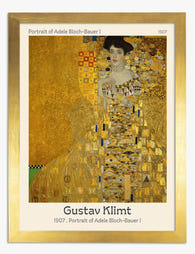
Adele Bloch-Bauer I by Gustav Klimt Art Print
Sale price From €16,95€23,95 -

Adele Bloch-Bauer I by Gustav Klimt Canvas Print
Sale price From €65,95€93,95 -

Lady in Fur Hat and Boa by Klimt Art Print
Sale price From €16,95€23,95 -

Lady in Fur Hat and Boa by Klimt Canvas Print
Sale price From €65,95€93,95 -

Klimt Floral Woman Art Print
Sale price From €16,95€23,95 -

Fritza Riedler by Gustav Klimt Canvas Print
Sale price From €65,95€93,95 -

Portrait of Helene Klimt by Gustav Klimt Canvas Print
Sale price From €65,95€93,95 -

Portrait of Helene Klimt by Gustav Klimt Art Print
Sale price From €16,95€23,95 -

Fritza Riedler by Gustav Klimt Art Print
Sale price From €16,95€23,95 -

Lady in White by Gustav Klimt Canvas Print
Sale price From €65,95€93,95 -

Lady in White by Gustav Klimt Art Print
Sale price From €16,95€23,95 -
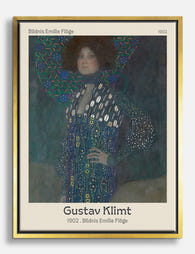
Bildnis Emilie Flöge by Gustav Klimt Canvas Print
Sale price From €65,95€93,95 -

Hermine Gallia by Klimt Canvas Print
Sale price From €65,95€93,95 -

Bildnis Emilie Flöge by Gustav Klimt Art Print
Sale price From €16,95€23,95 -
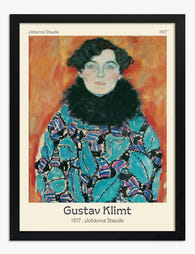
Johanna Staude by Klimt Art Print
Sale price From €16,95€23,95 -
Wild Flowers by Gustav Klimt Canvas Print
Sale price From €65,95€93,95 -

Klimt Art Nouveau Bloom Exhibition Canvas Print
Sale price From €65,95€93,95 -

Klimt Inspired Cat & Woman Art Print
Sale price From €16,95€23,95 -

Klimt-Inspired Poppy Field Exhibition Poster Canvas Print
Sale price From €65,95€93,95 -

Madame Kisling by Modigliani Art Print
Sale price From €16,95€23,95


More from The Frame

Every Famous Flower Painting by Van Gogh, Expla...
Van Gogh painted flowers more than almost any other subject. Not because they were pretty, but because they were cheap, patient, and gave him something to say when words failed....

Sunflower Art for Kitchens: The Prints, Sizes, ...
Sunflower prints are one of the most requested motifs for kitchens, and one of the most badly hung. This guide gives you exact measurements, three foolproof placements, and a straight...

From Van Gogh to Modern Botanical: Every Style ...
Sunflower art is everywhere, but almost nobody explains the difference between a vintage botanical plate, a post-impressionist reproduction, and a modern photographic close-up. This guide fixes that. By the end...