
 Order today for delivery by
 Klimt's Golden Phase Portraits: The Story Behind the Gold
The Ravenna mosaics, the salon hostess he painted twice, and why this nine-year burst of gold still defines modern portraiture.


Gustav Klimt's Golden Phase lasted less than a decade, but it produced the most recognisable portraits in modern art. Before you hang one on your wall, it's worth knowing what you're actually looking at. The gold isn't decoration. It's argument, biography, and one trip to Italy that changed everything.
What was Klimt's Golden Phase and when did it happen?
The Golden Phase runs roughly from 1901 to 1909, the period when Klimt began applying real gold and silver leaf directly onto his canvases. Pallas Athena (1898) is usually cited as the bridge work, the moment gold started creeping into his palette before he fully committed. By 1901 the commitment was total. By 1909 it was over.
The phase produced his most famous portraits: Judith I (1901), Portrait of Adele Bloch-Bauer I (1907), and the work that sits adjacent to portraiture in everyone's mind, The Kiss (1907-1908). These weren't experiments. They were Klimt at the height of his confidence, painting Vienna's wealthiest patrons with techniques borrowed from sixth-century Byzantium and contemporary Japan.
Two biographical details matter here. First, Klimt's father Ernst was a gold engraver, so handling gold leaf wasn't a flourish picked up in middle age. It was a material Klimt had watched being worked since childhood. Second, by 1901 Klimt had already broken with Vienna's academic establishment via the Secession movement, which gave him both the freedom and the patrons to attempt something this technically ambitious.

The Adele Bloch-Bauer portraits: the woman behind the gold
Adele Bloch-Bauer was 25 when Klimt started painting her in 1903. She was the wife of Ferdinand Bloch-Bauer, a wealthy Viennese sugar industrialist, and she ran one of the most influential salons in the city. Intellectuals, politicians, and artists gathered at her table. She was educated, restless, and by most accounts unhappy in her marriage.
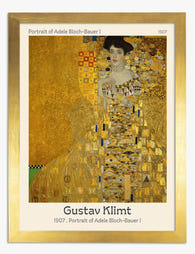
She is the only woman Klimt painted twice. Portrait of Adele Bloch-Bauer I was completed in 1907 after four years of work and more than 100 preparatory sketches. The painting is dense with gold leaf, silver leaf, and intricate gesso work, and Adele herself almost disappears into the surrounding pattern. Look closely and you'll notice her hands. Her right finger is slightly bent and held in a particular way, a detail Adele used in life to hide a disfigurement she was self-conscious about. Klimt painted it accurately rather than flattering her, which tells you something about how well he knew her.
Whether Klimt and Adele were lovers has never been confirmed, though most historians treat it as likely. The intimacy of the second portrait, painted in 1912 after the Golden Phase ended, supports the theory. That second painting is worth seeing precisely because it isn't gold. It's colour, pattern, and a more naturalistic Adele, and it functions as the perfect before-and-after for understanding what changed in Klimt's work after 1909.
The first portrait's later history is its own film. Confiscated by the Nazis in 1938, restituted to Adele's niece Maria Altmann in 2006 after a long legal battle, and sold to Ronald Lauder for the Neue Galerie in New York for what was then a record price. You can see it there today, alongside other works in the same room.
If portraits are what draw you to Klimt, our Gustav Klimt portrait collection is the place to start.
Judith and Holofernes: when gold meets danger
Judith I (1901) often gets pushed aside by Adele and The Kiss, which is a shame because it's the painting where the Golden Phase truly begins. The biblical story is grim: Judith, a young Jewish widow, seduces the Assyrian general Holofernes, gets him drunk, and beheads him to save her city. For centuries, artists painted her as a virtuous heroine, sword raised, looking either resolute or appropriately horrified.
Klimt's Judith is something else entirely. She's half-undressed, flushed, eyes heavy-lidded, mouth parted. Holofernes' severed head is tucked into the bottom right corner, almost an afterthought. This isn't a religious painting. It's an erotic painting using a religious story as cover, and the gold background turns the whole scene into something like a Byzantine icon gone wrong.
The model is widely believed to have been Adele, painted four years before her formal portrait. The choker around her neck is the same kind worn by Vienna's wealthy women. The implication, that this dangerous, sexual Judith might be your friend's wife, was scandalous in 1901 and is still part of what makes the painting magnetic.
If you want the erotic, charged side of the Golden Phase rather than the decorative one, Judith is the portrait to hang.
Byzantine mosaics, Japanese prints, and the real influences behind the style
In December 1903, halfway through the Adele portrait, Klimt travelled to Ravenna in northern Italy. He went specifically to see the sixth-century Byzantine mosaics inside the Basilica of San Vitale. The mosaic of Empress Theodora, the wife of Emperor Justinian, depicts her covered in jewels, crowned, surrounded by attendants, her body almost flattened into the gold tesserae behind her. She doesn't exist in three-dimensional space. She exists as a pattern.
Klimt came back transformed. Look at Adele I and you can see Theodora's logic everywhere. The figure dissolves into ornament. The space behind her isn't space, it's surface. Her dress, the chair, the wall, everything is treated with equal decorative weight. This isn't Western portraiture trying to create the illusion of depth. It's Byzantine portraiture trying to create the illusion of eternity.
The Japanese influence is the second half of the equation. Klimt collected Japanese prints and screens, and what he took from them was the comfort with flatness, the use of pattern as primary content, and the willingness to crop and compose asymmetrically. Judith's tight composition, with the head shoved into the corner, owes more to Japanese woodblock prints than to anything in the Western tradition.
These twin influences also explain why Klimt's work sits so naturally inside the broader Art Nouveau movement, which was busy absorbing the same Japanese sources across Europe at the same time.

Why the Golden Phase ended and what came after
By 1909 Klimt had largely abandoned gold leaf. There's no single reason. He'd travelled to Paris and Madrid and seen what younger artists like Matisse and the Fauves were doing with pure colour. He was also restless, and the gold had become, by his own implicit admission, a finished idea.
His later portraits, including the second Adele in 1912, replace gold with riotous colour and Asian-inspired pattern. The figures still flatten into their backgrounds, but the backgrounds are now made of painted textiles, flowers, and abstract decorative motifs. These works are sometimes called his tapestry phase, and they're stranger and more difficult than the gold ones. They sell less. They photograph less well. But they're where Klimt was heading.
The Golden Phase, then, is a window. Nine years where one painter combined an inherited craft, a religious art tradition from 1,400 years earlier, and a contemporary Asian aesthetic, and used the combination to paint Vienna's salon women as if they were Byzantine empresses. It couldn't last, and it didn't need to.
How Klimt's gold portraits translate to print: what to look for in quality
This is where most articles stop being useful. If you're hanging Klimt at home, the original is in Vienna or New York and you're looking at a print, so the question is what makes one reproduction worth living with and another not.
Three things matter.
The gold. Real gold leaf can't be reproduced. No print can. What a good print does instead is render the warmth, depth, and tonal variation of the gold accurately, without the metallic shine becoming flat yellow or muddy brown. This is mostly a function of printing technology. Museum-grade giclée printing on thick matte paper captures the subtle shifts in Klimt's gold far better than glossy stock, which throws glare and crushes the mid-tones. Matte paper also reads as more painterly, which suits the source.
The detail. Adele I contains hundreds of small motifs: eyes, spirals, rectangles, Egyptian-style triangles. A low-resolution print loses these entirely and turns the gold field into a vague glow. You want a print that holds detail when you stand 30cm away, not just from across the room. High-resolution giclée handles this well.
The framing. This is where most Klimt reproductions fail. The painting's composition relies on a tight border around the figure, and a cheap frame, particularly one shipped separately and assembled at home, can warp or sit unevenly and throw the whole image off. A properly fitted frame on solid FSC-certified wood, with the print already mounted under UV-protective acrylic, arrives ready to hang and stays flat. Acrylic glazing also matters more than people realise: Klimt's gold tones can fade under direct sunlight over years, and UV protection is what stops that.
Browse the full Gustav Klimt print collection if you want to compare formats side by side.

Our favourite Golden Phase Klimt portrait prints to hang at home
A few opinions, since this is the part where most guides go vague.
Portrait of Adele Bloch-Bauer I is the obvious choice and the right one for most rooms. It's vertical, dense, and the gold reads warm in almost any light. We think it works best at 50x70cm or 70x100cm, framed in natural oak or black. Sage green walls, deep terracotta walls, or warm off-whites all flatter the gold. Avoid cool greys, which fight the warmth. Hang it as a single statement piece rather than part of a gallery wall, because the painting is itself a wall.
Judith I is a stronger choice for rooms that already have personality. The composition is tighter, the mood darker, and the gold is offset by Judith's pale skin and the green of her stole. It looks excellent in a study, a bedroom, or a dining room with deep wall colour. A 60x80cm framed print does the painting justice. Avoid going too small. The face is the whole point and it needs scale.
Pallas Athena is the contrarian's pick. Earlier, less famous, more architectural, with armour rather than dresses. If you want Klimt's gold but you're tired of seeing Adele in every interiors magazine, this is the one. It also pairs well in a two-print arrangement with Judith, since both feature single female figures against gold and were painted within three years of each other.
Portrait of Adele Bloch-Bauer II belongs in a room that already has colour confidence. It's not gold, it's pattern, and it works alongside other colour-heavy art in a way the Golden Phase portraits don't. Hang it where you want energy, not gravitas.
If gold across multiple artists interests you more than Klimt specifically, our gold art print collection gathers metallic-toned work from across periods.

A final note on living with the gold
The thing nobody tells you about hanging Klimt is that the gold changes with the light. Morning sun makes Adele's dress glow warm and shallow. Evening lamplight pulls the depth out and the figure forward. South-facing rooms will give you the painting's full range across a day. North-facing rooms will give you a quieter, more constant version.
Pick the wall first, watch how the light moves across it for a day, then choose the portrait. Klimt spent four years on a single figure. You can spend an afternoon working out where she should live.

Fab products featured in this blog
-

Adele Bloch-Bauer I by Gustav Klimt Canvas Print
Sale price From €54,95€91,95 -
Adele Bloch-Bauer I by Gustav Klimt Art Print
Sale price From €14,95€24,95 -

Fulfillment by Gustav Klimt Canvas Print
Sale price From €54,95€91,95 -

Klimt-Inspired Golden Birch Forest Art Print
Sale price From €14,95€24,95 -

Klimt-Inspired Golden Bloom Exhibition Art Print
Sale price From €14,95€24,95 -

Citrus Garden by Gustav Klimt Canvas Print
Sale price From €54,95€91,95 -

Fulfillment by Gustav Klimt Art Print
Sale price From €14,95€24,95 -

The Kiss by Gustav Klimt Art Print
Sale price From €14,95€24,95 -

Golden Botanical Studies by Gustav Klimt Art Print
Sale price From €14,95€24,95 -

The Kiss by Gustav Klimt Canvas Print
Sale price From €54,95€91,95 -

Klimt Golden Birch Forest Exhibition Poster Art Print
Sale price From €14,95€24,95 -

Golden Botanical Studies — Klimt Inspired Canvas Print
Sale price From €54,95€91,95 -

The Kiss by Gustav Klimt Art Print
Sale price From €14,95€24,95 -

Klimt Art Nouveau Bloom Exhibition Art Print
Sale price From €14,95€24,95 -
Golden Forest after Klimt Canvas Print
Sale price From €54,95€91,95 -

Klimt Golden Bloom Forest Exhibition Poster Canvas Print
Sale price From €54,95€91,95 -

Klimt-Inspired Golden Birch Forest Canvas Print
Sale price From €54,95€91,95 -

Klimt Serene Pathway Exhibition Poster Canvas Print
Sale price From €54,95€91,95 -

Golden Botanical Studies by Klimt Art Print
Sale price From €14,95€24,95 -

Klimt-Inspired Golden Bloom Exhibition Canvas Print
Sale price From €54,95€91,95


More from The Frame

Coffee Prints for the Kitchen: Exactly Where to...
Coffee art has a bad reputation, and it's mostly earned. Too many kitchens end up looking like a rustic cafe theme park, with three "But First, Coffee" signs and a...

Botanical Bedroom Ideas: How to Use Plant Print...
Botanical prints belong in bedrooms more than any other room in the house. The trick is choosing the right subjects, sizing them properly, and understanding how a printed leaf on...

Why Kew Gardens Became the World's Most Famous ...
Kew Gardens holds around 200,000 botanical illustrations, the largest collection of its kind anywhere. Behind that number is a story of royal ambition, global exploration, and artists sent to the...