
 Order today for delivery by
 How to Build a Tropical Bird Gallery Wall That Actually Looks Intentional
Turn a flock of parrot prints into a curated display, not a chaotic aviary on your living room wall.


Tropical bird prints are some of the most rewarding gallery wall subjects you can choose, and also some of the easiest to get wrong. The colours are loud, the species are wildly different, and without a plan you end up with something that looks like a primary school project on rainforest biodiversity. This guide walks you through the layout, sizing, framing and species decisions that separate a curated display from a random zoo wall.
Why tropical birds make the best gallery wall subject
Most gallery wall subjects are quietly boring. Botanical prints repeat themselves, abstract art can feel cold in groups, and family photos look messy without serious styling. Tropical birds give you saturated colour, real character, and enough visual variety to hold a wall on their own.
They also work in a surprising range of rooms. A gallery of parrot art prints brings warmth to a neutral lounge, energy to a hallway, and personality to a bedroom that's gone a bit too beige. The challenge is that this same vibrancy is what makes them hard to group. Get it right and the wall feels like a collection. Get it wrong and it feels like a clearance bin.
The trick is treating bold colour as a design constraint, not a decorative free-for-all. Once you accept that you cannot just pick eight birds you like and stick them up, the rest of this article is straightforward.

Choosing a layout: grid, salon hang, or asymmetric cluster
There are three layouts that actually work, and the right one depends on how chaotic your prints are and how formal your room is.
The grid
A grid is two, three or four rows of identically sized prints with even spacing. It looks tailored and architectural, and it's the most forgiving layout for loud subjects because the rigid structure calms the colour down. If you're nervous about mixing species, a grid is your safest bet. We recommend a 2x3 or 3x3 of uniform 30x40cm framed prints for most living rooms.
The salon hang
Salon hangs are the dense, mismatched clusters you see in old European drawing rooms. They mix sizes, sometimes orientations, and the prints sit close together in a roughly rectangular shape. This works beautifully for tropical birds because the abundance feels deliberate, like a Victorian naturalist's study. It needs more prints (usually seven to eleven) and more planning than a grid.
The asymmetric cluster
The middle ground. You start with one large anchor print, position it off-centre, and build outward with smaller pieces. The overall shape is irregular but balanced. This is the layout most interior designers reach for, and it suits modern interiors where a strict grid would feel too formal.
For most readers, we'd point you at the asymmetric cluster. It hides minor mistakes, accommodates prints of different sizes, and looks intentional without looking precious.
How many prints you actually need (and which sizes to mix)
The honest answer is: more than you think, but fewer than you'd be tempted to buy.
A gallery wall needs at least five pieces to read as a gallery rather than a "few prints I happened to hang near each other." Below five, it looks accidental. Above eleven, it tips into chaos unless you're committing to a full salon wall.
Here are three combinations that consistently work:
- The compact cluster (5 prints): one 50x70cm anchor, two 30x40cm, two 21x30cm. Fits a wall around 1.5 metres wide.
- The standard gallery (7 prints): one 70x100cm anchor, two 50x70cm, four 30x40cm. Fits most lounge feature walls.
- The full salon (9 to 11 prints): one 70x100cm anchor, three 50x70cm, the rest 30x40cm and 21x30cm mixed. Needs a wall of at least 2.5 metres.
The anchor concept matters. Your largest print is the visual centre of gravity, and it should sit slightly off-centre rather than dead in the middle. Position it first, then arrange everything else around it.
If you're shopping in pre-curated sets, the sizing decisions are made for you, which removes the most painful part of this process.
Picking a frame finish that ties everything together
If you take one rule from this article, take this one: your frames must match. Not "coordinate." Match.
Tropical bird prints already carry enormous visual weight from the colour and detail. Mixing frame finishes adds a second layer of variation that the eye reads as noise. The cohesion you want comes from the frames being identical and the prints being free to be different.

Three finishes consistently work for tropical bird galleries:
- Black: the most flattering for vibrant plumage. The high contrast makes reds, blues and yellows pop without competing. Our default recommendation.
- Natural oak or ash: softer, warmer, suits boho and Scandi interiors. Best when your prints lean botanical or vintage rather than photographic.
- White: clean and modern. Works in minimal interiors but can wash out paler bird species, so check your prints before committing.
Avoid mixing wood tones, avoid metallics with tropical birds (they fight the warmth), and avoid ornate or distressed frames unless you're going for a deliberately maximalist salon wall.
A second trick worth mentioning: a wide white or cream mount inside the frame. Mounting calms a loud print considerably, gives the eye somewhere to rest, and makes the whole wall feel more gallery and less Pinterest. Our framed prints come with proper FSC-certified solid wood frames and UV-protective acrylic glaze, so colour stays accurate even if your wall catches direct sun.
Mixing parrot species and tropical bird types for variety
This is where most tropical bird gallery walls fall apart. Without a curatorial logic, you end up with what we politely call Zoology 101: a macaw next to a toucan next to a hummingbird next to a cockatoo, all shouting at once.
Pick one of these three organising principles and stick to it.
Group by colour family
Choose two or three dominant colours and only buy prints that fit. A "blue and green" gallery might include hyacinth macaws, scarlet-chested parrots, quetzals and Amazon parrots. A "red and yellow" gallery leans into scarlet macaws, sun conures and toucans. This is the easiest way to make a wall feel intentional, and the most flattering in colour-led interiors.
Group by region
All Amazonian birds. All Australasian. All Central American. The species vary, but the visual language stays consistent because birds from the same biome tend to share palette and habitat cues. This is our favourite approach for slightly more sophisticated walls.
Group by single species
Six different macaws. Or six different cockatoos. Or six toucan variants. This reads as a deliberate study rather than a random selection, and it's almost impossible to get wrong. If you're new to gallery walls, this is the lowest-difficulty option.
What you should not do is mix art styles. Vintage botanical illustrations next to modern abstract parrots next to photographic prints is a guaranteed disaster. Pick one style of tropical bird art and commit. Browse bird art prints filtered by style if you want to see this in practice.
Spacing, height, and alignment rules that work every time
The technical rules are simple, and they're the same ones used by professional curators.
Spacing
Prints in a gallery wall should sit 5 to 8cm apart (roughly 2 to 3 inches). Closer than that and the wall reads as cluttered. Further apart and the prints stop reading as a group. Keep this spacing consistent across the entire wall, including diagonally.
Height
The centre of your gallery wall (not the centre of any individual print, but the centre of the whole arrangement) should sit at roughly 145 to 152cm from the floor. This is standard gallery eye level. If you're hanging above a sofa or sideboard, leave 15 to 20cm between the top of the furniture and the bottom of the lowest print.
Alignment
You need an alignment logic, even in an asymmetric layout. Pick one of these:
- A consistent top line across the highest prints
- A consistent bottom line across the lowest prints
- A central horizontal axis that runs through the middle of the arrangement
Without one, the wall drifts.
The paper template trick
Cut paper rectangles the size of each frame, label them, and tape them to the wall with masking tape before you put a single nail in. Move them around for a day. Look at them in different light. This takes twenty minutes and saves you patching holes later.

The biggest gallery wall mistakes and how to avoid them
A few specific failures come up again and again with tropical bird walls.
Too many species. If you can't name your organising principle in one sentence, you have too many. Strip it back.
Competing backgrounds. A print with a dark navy background next to one with a pale botanical illustration next to one on cream paper looks broken. Backgrounds should harmonise even if subjects don't.
Hanging too high. This is the most common rookie mistake in any gallery wall. When in doubt, hang lower. Furniture should anchor your wall, not float beneath it.
Frames shipped separately from prints. This is one of the biggest reasons gallery walls go wrong. Prints arrive warped, mounts shift, frames don't match the print sizing properly, and the whole thing looks amateur. Order framed prints that ship pre-fitted in one box, ready to hang.
Ignoring visual weight. A bright scarlet macaw on a black background carries far more visual weight than a soft pastel parakeet on cream. Distribute your heaviest prints across the wall rather than clustering them. If your anchor is dramatic, balance it with quieter pieces in the outer positions.
Going full rainbow. Embracing every colour at once almost never works. Limit yourself to a palette of two or three dominant hues across the wall, even if individual prints contain more. This is the single biggest difference between an intentional wall and a chaotic one.
Our recommended starter sets for a tropical bird gallery wall
If you want concrete starting points, here are three configurations we've seen work repeatedly.
The minimalist trio
Three prints in a horizontal line, each 50x70cm, all featuring a single species (we'd suggest macaws) on a consistent background. Black frames, white mounts. Hung above a sideboard or sofa. Total wall width: around 1.8 metres. The simplest possible "gallery wall" and almost foolproof.
The classic seven
One 70x100cm anchor in the centre-left position, two 50x70cm flanking, four 30x40cm filling the outer corners. Mixed Amazonian species in a green and blue palette. Oak frames throughout. This is the configuration we recommend for most living rooms.
The full salon
Eleven prints, mixed sizes, hung in a tight rectangular cluster. One species family (we like cockatoos for this because the white-and-coloured plumage gives a unified palette). Black frames with generous white mounts. This needs a feature wall of at least 2.5 metres and is best for hallways, stairwells, or above a long dining table.
For all three, we'd push you toward framed prints rather than unframed. The polish a consistent frame brings to a tropical bird display is genuinely transformative, and the UV-protective acrylic glaze means the colour holds up over time even on a sunlit wall.
A few final things worth doing
Take photographs of the wall on your phone before committing to nails. The camera flattens the arrangement and shows you imbalances your eye missed. Live with the paper templates for at least a day. Buy one extra small print you can swap in if a position isn't working.
And resist the urge to keep adding. The best tropical bird galleries we've seen are the ones that stopped one print earlier than the owner wanted to.


Fab products featured in this blog
-

Tropic Bird by John James Audubon Canvas Print
Translation missing: en.products.product.sale_price From €54,95€91,95 -

Tropic Bird by John James Audubon Art Print
Translation missing: en.products.product.sale_price From €14,95€24,95 -
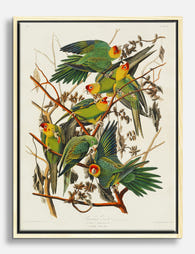
Carolina Parrot by Audubon Canvas Print
Translation missing: en.products.product.sale_price From €54,95€91,95 -

Carolina Parrot by Audubon Art Print
Translation missing: en.products.product.sale_price From €14,95€24,95 -

Tropical Flamingo Vibes Canvas Print
Translation missing: en.products.product.sale_price From €54,95€91,95 -

Vintage Birdsong Reverie Canvas Print
Translation missing: en.products.product.sale_price From €54,95€91,95 -

William Morris Parrot Exhibition Poster Canvas Print
Translation missing: en.products.product.sale_price From €54,95€91,95 -

Beach Bonfire and Marshmallows Art Print
Translation missing: en.products.product.sale_price From €14,95€24,95 -

Tropical Escape Canvas Print
Translation missing: en.products.product.sale_price From €54,95€91,95 -

William Morris Parrot Exhibition Poster Canvas Print
Translation missing: en.products.product.sale_price From €54,95€91,95 -

Botanic Garden, Rio de Janeiro Art Print
Translation missing: en.products.product.sale_price From €14,95€24,95 -

Longwood Gardens Pennsylvania Travel Poster Canvas Print
Translation missing: en.products.product.sale_price From €54,95€91,95 -

Flamingo Dreamscape Canvas Print
Translation missing: en.products.product.sale_price From €54,95€91,95 -

Tropical Garden Gathering Art Print
Translation missing: en.products.product.sale_price From €14,95€24,95 -

Two Birds on Asanoha by Hokusai Art Print
Translation missing: en.products.product.sale_price From €16,95€23,95 -

Tropical Garden Gathering Canvas Print
Translation missing: en.products.product.sale_price From €54,95€91,95 -

Vintage Garden Bird Art Print
Translation missing: en.products.product.sale_price From €14,95€24,95


More from The Frame

The Strawberry Thief: Everything You Need to Kn...
Strawberry Thief is the William Morris design people search for by name. It's also the one most often bought badly: wrong size, wrong colourway for the room, wrong print quality...

Our Favourite Jungle Prints for Every Room: The...
Jungle prints have a reputation problem. Done badly, they tip a room into themed-restaurant territory faster than almost any other trend. Done well, they add depth, movement and a sense...

Thrushes, Hares, and Peacocks: The Animals in W...
Why Morris put animals at the centre of his designs William Morris wasn't decorating walls with cute creatures. He was making a quiet argument. While Victorian factories churned out cheap,...