
 Smiles Guaranteed
 Order today for delivery by
Birds, Rabbits, and Thrushes: The Complete Guide to Animals in William Morris's Art
A complete visual guide to every creature in his work, from the famous Strawberry Thief to the lesser-known foxes and hares.


Why William Morris was obsessed with animals and nature
William Morris (1834-1896) grew up roaming Epping Forest as a child, and the wildlife he saw there shaped almost everything he designed as an adult. He believed pattern should bring "a glimpse of the field and the wood" into the home, especially for people living in industrialised Victorian cities choked with coal smoke and concrete.
His animals were never decorative afterthoughts. They were the whole point. Morris saw the natural world as the antidote to mechanised, mass-produced ugliness, and he filled his wallpapers, textiles and tapestries with the birds, mammals and insects he encountered in his own gardens at Red House and Kelmscott Manor.
What's often missed is how local his vision was. While many of his Victorian contemporaries borrowed exotic imagery from India, Japan and the Ottoman world, Morris stuck almost entirely to species native to Southern England. Thrushes, hares, foxes, ravens, peacocks (kept domestically by then), woodpeckers. He drew what he could observe.

The birds: thrushes, woodpeckers, peacocks and songbirds
Birds appear more often in Morris's work than any other creature, and they're usually the easiest entry point if you're new to his animal designs.
Thrushes
The song thrushes in Strawberry Thief (1883) are the most recognisable birds in British design history. Morris drew them from life after watching them raid the strawberry beds at Kelmscott Manor every summer. He found their thievery charming rather than annoying, which says quite a lot about him as a person.
Woodpeckers
The Woodpecker tapestry (1885) is one of Morris's rare solo animal designs, woven for Clouds House in Wiltshire. A single green woodpecker sits among acanthus leaves and fruiting trees, with a verse Morris wrote himself running along the borders. It's quieter than Strawberry Thief and arguably more painterly.
Peacocks
Peacocks turn up in Peacock and Dragon (1878), a heavyweight woven wool curtain fabric, and again in The Forest tapestry. Morris loved their structural tail feathers because they gave him an excuse to draw repeating eye-shaped motifs without inventing anything.
Smaller songbirds
The Bird pattern (1878), used in the drawing room at Morris's own Kelmscott House in Hammersmith, features paired songbirds among scrolling foliage. Bird and Anemone (1882) is gentler and more domestic, with smaller birds tucked into flowering stems. If you want a Morris pattern that reads as floral first and animal second, this is the one.
For a wider look at his bird work specifically, our bird art prints collection includes several Morris designs alongside other naturalist illustrators worth knowing.
The mammals: rabbits, foxes and deer in Morris's tapestries
Mammals are rarer in Morris's repeating wallpaper patterns and far more common in his large narrative tapestries, where there's room to draw them at proper scale.
The Forest tapestry (1887)
This is the one to know. Morris designed the dense millefleurs background of flowers and foliage, but the five animals at the centre were drawn by his close friend and collaborator Philip Webb. From left to right: a lion, a hare, a peacock, a fox and a raven. The original is held at the Victoria and Albert Museum in London and remains one of the most popular Morris & Co. designs ever produced.
Brer Rabbit (1882)
Named after the American folk tale character (Morris was reading Joel Chandler Harris's Uncle Remus stories at the time), this printed cotton features pairs of rabbits facing each other through a lattice of leaves and berries. It's playful and a bit unusual within his catalogue, where most animals appear singly.
Hares and deer
Hares appear in The Forest and in several smaller tapestry studies. Deer feature in some of John Henry Dearle's later Morris & Co. tapestries, designed after Morris's death but in his style. If you specifically want a hare print, look closely at the cropped detail prints sold from The Forest, where the hare is often offered as a standalone image.

Strawberry Thief: the story behind the most famous animal design
Strawberry Thief deserves its own section because no other Morris animal design comes close in cultural reach.
The pattern was registered in May 1883, after years of Morris struggling to get the indigo-discharge printing technique to work at his Merton Abbey works. Indigo discharge involves dyeing fabric blue first, then bleaching out the pattern and overprinting with red, yellow and green. It was technically demanding and required separate printing blocks for each colour.
The result was the most expensive pattern Morris ever produced. It was also the one his customers wanted most. The full design shows pairs of song thrushes pecking at strawberries, framed by acanthus leaves and small white flowers, with the whole thing arranged on a deep indigo ground.
The story attached to the pattern is genuine, not invented marketing. Morris really did watch thrushes stealing fruit from his kitchen garden at Kelmscott Manor in Oxfordshire. His daughter May recorded that her father refused to net the strawberries because he wanted the birds to keep coming.
As wall art, Strawberry Thief works best at scale. The pattern is dense and rewards size. A 50x70cm or 70x100cm print gives you enough surface area to actually see the thrushes and the strawberries clearly, rather than reading the whole thing as a blue blur.
How Morris's animals differ from Victorian natural history illustration
This is the bit most articles miss, and it matters if you're choosing a Morris print over, say, a vintage Audubon or a Victorian botanical study.
Morris was working at the same time as the great Victorian natural history illustrators. John Gould was producing his hand-coloured bird lithographs. Audubon's followers were everywhere. Scientific accuracy was the prevailing ideal, with each feather, vein and claw rendered as precisely as possible.
Morris rejected this entirely. He wrote that "exact imitations of nature" were neither possible nor desirable in pattern design. What he wanted was the essence of a thrush, the gesture of a fox, the silhouette of a hare. He simplified. He flattened. He stylised.
The result is animals that read instantly as themselves but never feel like museum specimens. A Morris thrush has the right speckled breast and the right alert posture, but it isn't trying to be a textbook diagram. It's trying to be a thrush in a pattern, which is a different problem with a different solution.
This is why Morris animal prints work in modern interiors in a way that Victorian natural history plates often don't. They're decorative by design, not scientific drawings repurposed as decoration.
The best William Morris animal prints for your walls
If you're trying to narrow down which design to actually buy, here's how we'd rank the options for use as wall art specifically. This isn't about historical importance. It's about what looks good on a wall in a real home.
Strawberry Thief. The default choice for a reason. Works in almost any room, reads as both pattern and picture, and the deep indigo ground anchors a wall without needing other art around it.
The Forest. Better as a single statement piece than as part of a gallery wall. The horizontal composition suits above-sofa and above-bed positions, and the five animals give you something to look at over time.
The Woodpecker. The connoisseur's choice. Vertical, painterly, more restrained than Strawberry Thief. Works in narrow walls, hallways and between windows.
Brer Rabbit. Charming in nurseries and children's rooms without being childish. The repeating rabbits are gentle rather than cartoonish.
Bird. The quietest of the lot. Good in bedrooms and studies where you want pattern but not drama.
You can browse our full William Morris animals art prints collection to see how each design looks at different sizes, framed and unframed.

How to choose between bird, forest and mixed-animal designs
A few practical questions to ask before you commit.
How much pattern can the room handle?
Strawberry Thief and Brer Rabbit are dense, repeating patterns. They behave more like wallpaper than like a single image, which means they need a calm wall and not too much competing visual noise around them. If your sofa already has a print and your rug is patterned, choose The Woodpecker or Bird instead, which read more like single pictures.
What's the dominant colour in the room?
Strawberry Thief is fundamentally a blue print with red and green accents. The Forest is olive, gold and deep red. The Woodpecker leans green and ochre. Match the print to your room's existing palette rather than hoping the rest of the room will adjust around it. Most of these designs are also available in alternative Morris & Co. colourways if the original tones don't suit.
Bird only, or animals plus florals?
If you want clear animal imagery, choose The Forest, The Woodpecker or Strawberry Thief. If you want florals first with animals tucked in as detail, choose Bird and Anemone or Brer Rabbit. The distinction matters more than people expect once the print is actually on the wall.
For broader options beyond animals specifically, the full William Morris art prints collection shows how the animal designs sit alongside his pure floral and foliage work.
Where to hang William Morris wildlife art for maximum impact
Morris designed for domestic interiors, so his work behaves best in rooms people actually live in. A few specific recommendations.
Dining rooms
Strawberry Thief was originally designed as a furnishing fabric for curtains and chair covers, but the pattern works extraordinarily well as a single large framed print over a sideboard or dining table. The deep indigo holds its own under warm dining lighting.
Lounges and sitting rooms
The Forest is the obvious choice above a sofa. Aim for a print width of roughly two-thirds the width of the sofa below it. For a standard three-seater, that means a 100x70cm landscape print, which fits well within the size range we offer for framed Morris designs.
Bedrooms
Bird, Bird and Anemone, or a pair of smaller Strawberry Thief prints either side of the bed. Morris patterns are restful in bedrooms because the colours are inherently muted and the repeating rhythms are easy to look at last thing at night.
Hallways and stairs
Vertical designs like The Woodpecker suit narrow halls. A series of three smaller animal prints climbing a staircase wall also works, ideally at 30x40cm with consistent framing throughout.
Kitchens and bathrooms
Canvas is the better format for humid rooms because there's no glazing to mist up and the stretched cotton handles temperature changes well. A canvas Strawberry Thief or Brer Rabbit in a kitchen feels appropriate to Morris's original domestic intent.
For a wider lens on naturalistic wall art beyond Morris specifically, our nature art prints collection groups his work alongside other artists working in the same observational tradition.

A final note on framing
Morris designs are dense and detailed, which makes framing matter more than usual. A poorly fitted frame, a warped mount or a print that bubbles inside its glazing will ruin a Strawberry Thief faster than it'll ruin a minimalist line drawing, because there's nowhere for the eye to escape to.
Look for prints that ship fully assembled in one piece, with the frame fitted around the print rather than supplied as a flat-pack accessory. Solid wood frames hold their shape better than MDF over the long term, and acrylic glazing weighs less than glass and won't shatter, which matters if you're hanging anything large above a sofa or bed.
Pick the design that suits your room first, the size second, and the framing last. Get those three right and a Morris animal print will outlast almost anything else you put on the wall.

Fab products featured in this blog
-

Morris Botanical Birds Art Print
Translation missing: en.products.product.sale_price From €14,95€24,95 -

Morris Botanical Birds Art Print
Translation missing: en.products.product.sale_price From €14,95€24,95 -

William Morris Floral Bird Art Print
Translation missing: en.products.product.sale_price From €14,95€24,95 -

William Morris Birds Art Print
Translation missing: en.products.product.sale_price From €14,95€24,95 -
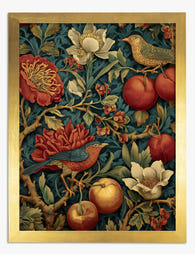
Morris Botanical Birds Art Print
Translation missing: en.products.product.sale_price From €14,95€24,95 -

William Morris Bird with Strawberries Art Print
Translation missing: en.products.product.sale_price From €14,95€24,95 -

William Morris Botanical Birds Art Print
Translation missing: en.products.product.sale_price From €14,95€24,95 -

William Morris Botanical Birds Art Print
Translation missing: en.products.product.sale_price From €14,95€24,95 -

William Morris Bird & Berries Art Print
Translation missing: en.products.product.sale_price From €14,95€24,95 -

Morris Bird & Berry Art Print
Translation missing: en.products.product.sale_price From €14,95€24,95 -

Morris Birds & Flowers Art Print
Translation missing: en.products.product.sale_price From €14,95€24,95 -

William Morris Botanical Bird Art Print
Translation missing: en.products.product.sale_price From €14,95€24,95 -

Morris Birds & Blossoms Art Print
Translation missing: en.products.product.sale_price From €14,95€24,95 -

Whimsical Rabbit by Morris Art Print
Translation missing: en.products.product.sale_price From €14,95€24,95 -

William Morris Red Bird Art Print
Translation missing: en.products.product.sale_price From €14,95€24,95 -

William Morris Strawberry Thief Bird Art Print
Translation missing: en.products.product.sale_price From €14,95€24,95 -

William Morris Bird & Berry Art Print
Translation missing: en.products.product.sale_price From €14,95€24,95 -

William Morris Rabbit Bunny Art Print
Translation missing: en.products.product.sale_price From €14,95€24,95 -

Morris Inspired Vintage Bird Illustration Art Print
Translation missing: en.products.product.sale_price From €14,95€24,95 -

William Morris Botanical Bird Art Print
Translation missing: en.products.product.sale_price From €14,95€24,95


More from The Frame

The Peacock in William Morris's Work: Why It Be...
William Morris designed hundreds of patterns across his career, but he kept circling back to one bird. The peacock appears in his textiles, tapestries, embroideries, carpets and wallpapers across more...

William Morris and Nature: How Butterflies, Bir...
Search for "William Morris butterfly print" and you'll find thousands of products. Search Morris's actual archive of wallpapers and textiles and you'll find almost none. The story of how nature...

Butterflies in Art Nouveau and Arts and Crafts:...
Butterflies have been quietly fluttering through Western decorative art for over 150 years, surviving every shift in taste from Victorian parlours to mid-century minimalism to whatever you'd call the current...