
 Order today for delivery by
 Building a William Morris Gallery Wall: Layouts, Sizes and Combinations That Work
Specific layouts, exact dimensions and the pattern-mixing rules that make a Morris gallery wall work first time.


Gallery walls go wrong when people guess. With William Morris prints, where every design is already busy with leaves, vines and birds, guessing gets expensive. This guide gives you specific layouts, sizes and combinations that work, so you can hang once and stop second-guessing.
Why William Morris designs are perfect for gallery walls (and some aren't)
Morris designed his patterns as repeating wallpapers, which means they were built to sit next to each other without competing. The motifs share a visual language: trailing stems, scrolling leaves, flat planes of muted colour. That shared DNA is exactly why a wall of Morris prints feels cohesive in a way that, say, four random posters never will.
The arts and crafts movement botanical art tradition Morris helped invent also obeyed strict rules of scale and rhythm. Even his most maximalist designs are built around symmetry. Hang them together and your eye reads them as one composition rather than four shouting voices.
That said, not every Morris design plays nicely in a group. Very dark designs (think the inkier colourways of Pimpernel or Bachelors Button) can look like black holes next to lighter prints. Hyper-detailed florals at small sizes turn into visual mush from across the room. And anything with a strong directional pattern, like Willow Bough running vertically, needs a counterweight or it tilts the whole wall.
If you're new to this, start with the leaf-led designs. They're the easiest to combine because the colour palettes are quieter and the patterns less narrative. Browse the William Morris leaves collection for a sense of which work as a base layer.

The 3-print layout: our recommended starting point
If you've never built a gallery wall before, three prints is the right answer. It's enough to feel intentional, not so much that you'll panic about spacing. The rule of odd numbers exists because odd compositions feel dynamic and balanced, while even ones (especially four) read as a rigid grid.
Here's the layout we recommend for a first attempt:
The horizontal trio. Three prints in matching 50x70cm portrait frames, hung in a row at the same height, with 8cm of wall between each frame. Total wall span: roughly 166cm. This works above a sofa (typically 200-220cm wide), a sideboard or a bed.
Pattern logic: pick one bolder design as the centre anchor (Strawberry Thief, Acanthus or Snakeshead work beautifully) and flank it with two quieter leaf prints in related colours. The eye lands on the centre, then drifts outward. Done.
The off-centre stack. One large 70x100cm landscape print on the left, two smaller 30x40cm portrait prints stacked on the right with 5cm between them. The big print and the stack should occupy roughly equal visual weight. This layout suits awkward walls, alcoves and anywhere a symmetrical row would feel too formal.
Whichever you choose, lay it out on the floor first. Tape the frames into position on the carpet, step back, photograph it on your phone, and live with it for a day before you put a single nail in the wall.
The 5-print salon wall: mixing leaf, floral and animal prints
Once you're comfortable with three, five opens up. A salon-style wall (loosely arranged, varied sizes, anchored by one large piece) is where Morris really sings, because you can layer leaf, floral and animal designs without anything feeling crowded.
Our suggested 5-print formula:
- One hero piece: 70x100cm, one of the bolder florals or an animal print like Strawberry Thief
- Two mid-sized supporters: 50x70cm, both leaf-focused designs in related greens
- Two smaller accents: 30x40cm, one floral, one detail-heavy or graphic
Arrange them with the hero piece slightly off-centre, supporters flanking it at varying heights, and accents tucked into the gaps. Maintain consistent spacing of 5-7cm between every adjacent frame. Inconsistent gaps are the single fastest way to make a salon wall look amateur.
The mixing logic matters. Leaf prints act as visual rest. Floral prints add colour energy. Animal prints (Strawberry Thief, the various bird and rabbit designs) add narrative interest. You want all three categories represented but in unequal amounts: roughly 40% leaf, 40% floral, 20% animal. That ratio stops the wall tipping into either monotony or chaos.
If you're collecting your prints from across the William Morris collection, pick your hero first and build outward from its colour palette. Don't pick five favourites and try to force them together.

Choosing a consistent frame colour across multiple prints
This is where most gallery walls quietly fall apart. Mixed frame colours fragment the wall, drawing your eye to the frames rather than the art. With patterned prints, where the art is already complex, frame consistency does even more heavy lifting.
Three frame choices we'd actually recommend for Morris prints:
Natural oak. The default for a reason. Warm, light, and it picks up the earthy tones in most Morris palettes without competing. Works in nearly any room.
Black. Sharper, more graphic. Best when your Morris prints lean dark or saturated, or when the room itself is high-contrast (white walls, dark floors). Black frames make the patterns pop but can feel heavy in a soft, neutral space.
White. Quietest option. Disappears into pale walls and lets the prints breathe. The right call if you've chosen busier designs and want the wall to feel calm rather than gallery-formal.
What you absolutely shouldn't do: mix all three. Pick one frame colour and commit to it across every print. The visual cohesion you gain is worth more than any individual frame choice.
A practical note on frame quality. Cheap frames warp, and warping shows brutally on a wall of five. Solid wood (FSC oak in our case) holds its shape over years and through humidity changes. UV-protective acrylic glaze beats glass for safety and weight, especially when you're hanging multiples.
Size combinations that create visual balance (with dimensions)
Scale is the lever most people don't pull hard enough. A wall of five identically-sized prints reads flat. Mixed sizes create rhythm.
Here are size combinations we know work, with exact dimensions:
Three-print row (matching): 3x 50x70cm portrait, 8cm spacing. Total span 166cm. Hang centre of composition at 145-150cm from floor (gallery standard eye level).
Three-print asymmetric: 1x 70x100cm landscape, 2x 40x50cm portrait stacked. Total span around 130cm. The stack sits to one side of the large print.
Five-print salon: 1x 70x100cm hero, 2x 50x70cm supporters, 2x 30x40cm accents. Plan for a total area of roughly 180cm wide by 130cm tall.
Symmetrical pair plus centre: 2x 50x70cm portrait on the outside, 1x 70x50cm landscape in the middle. Hang the landscape print so its centre lines up with the centres of the two portraits. A clean, formal option above a console table.
A scale principle worth knowing: pair delicate, fine-pattern designs (Jasmine, Willow Bough) with bolder ones (Strawberry Thief, Acanthus). If everything is delicate, the wall reads as fussy. If everything is bold, it reads as loud. Contrast in pattern density is what makes the eye move comfortably across the wall.
For positioning, the centre of your gallery wall composition should sit at roughly 145-150cm from the floor. Above a sofa or sideboard, leave 15-25cm between the top of the furniture and the bottom of the lowest frame. Any closer and the art looks like it's resting on the furniture; any further and it floats away.

Common gallery wall mistakes with patterned art and how to avoid them
Too many busy designs. Five maximalist florals on one wall is exhausting. Aim for at least 40% of your prints to be quieter (leaf-led, single-colour-dominant, or with more negative space). The eye needs places to rest.
Inconsistent spacing. Random gaps between frames look careless. Pick one number (we like 5cm for tight salon walls, 8cm for rows) and apply it ruthlessly to every adjacent edge.
Mismatched scale ratios. A 30x40cm print next to a 70x100cm print needs a mid-sized 50x70cm somewhere on the wall to bridge them. Without the bridge, the small print looks lost.
Too many nail holes. Cut paper templates to your exact frame sizes, tape them to the wall with masking tape, and adjust until the layout looks right. Then mark hanging points through the paper. One hole per frame, no regrets.
Hanging too high. This is the most common mistake by a mile. People hang at standing-eye-level when most of the time you're sitting down. Centre the composition at 145-150cm from the floor, not 170cm.
Forgetting the breather. If your Morris collection feels relentless, slot in one non-Morris print: an abstract botanical line drawing, a quiet monochrome, or a piece with significant negative space. It gives the eye somewhere to rest and, paradoxically, makes the Morris prints look better. The wider floral art prints collection has plenty of less-pattern-heavy options that pair well.
How to order a set: getting colour consistency right
This is the bit no one warns you about. Order Morris prints from different shops, or even the same shop at different times, and you can end up with subtly different greens, mismatched paper tones, and frames that don't quite match. On a single print no one notices. On a gallery wall it's all you'll see.
A few rules to avoid this:
Order all your prints in one go. Same supplier, same order. Made-to-order printing means each batch is colour-matched to the next, so a single order virtually guarantees the greens and reds will sit together properly.
Stick to one print medium. Don't mix framed art prints with canvas prints on the same gallery wall. Paper and canvas reflect light differently, and the textures fight each other at close range. Pick one and commit.
Choose framed if you want zero hassle. Framed prints arrive ready to hang with fixtures attached, properly fitted, no warping. For five prints going up in one afternoon, that matters. Unframed is the budget-friendly route if you're building the wall gradually and plan to add frames later.
Check your frame colour is consistent across sizes. Some suppliers use slightly different finishes on different frame sizes. Worth confirming before you order five at once.
If your gallery wall is leaning into the storytelling side of Morris (birds, rabbits, the more figurative pieces), browse the animal print collection alongside the leaf prints to see how the palettes line up before committing.

Final thought
The best William Morris prints for gallery walls aren't necessarily the most famous ones. They're the ones that work together: shared palette, varied scale, mixed pattern density, consistent frames. Choose your hero, build outward, lay it out on the floor before you touch the wall, and trust the patterns to do the rest. Morris already did the hard part over a century ago.

Fab products featured in this blog
-
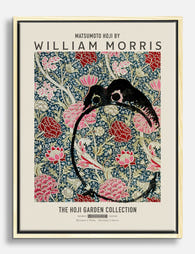
William Morris Garden Blooms Canvas Print
Translation missing: en.products.product.sale_price From €54,95€91,95 -

William Morris Floral Pattern Canvas Print
Translation missing: en.products.product.sale_price From €54,95€91,95 -

William Morris Botanical Pattern Art Print
Translation missing: en.products.product.sale_price From €14,95€24,95 -

William Morris Floral Canvas Print
Translation missing: en.products.product.sale_price From €54,95€91,95 -

William Morris Floral Elegance Canvas Print
Translation missing: en.products.product.sale_price From €54,95€91,95 -
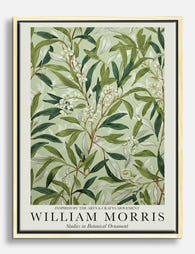
William Morris Botanical Leaves Canvas Print
Translation missing: en.products.product.sale_price From €54,95€91,95 -

William Morris Botanical Art Print
Translation missing: en.products.product.sale_price From €14,95€24,95 -

William Morris Wallflower Canvas Print
Translation missing: en.products.product.sale_price From €54,95€91,95 -

William Morris, Original Floral Pattern Art Print
Translation missing: en.products.product.sale_price From €14,95€24,95 -

William Morris, Original Flower Garden Art Print
Translation missing: en.products.product.sale_price From €14,95€24,95 -
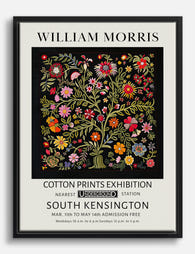
William Morris Botanical Canvas Print
Translation missing: en.products.product.sale_price From €54,95€91,95 -

William Morris Tree of Life Art Print
Translation missing: en.products.product.sale_price From €14,95€24,95 -

William Morris, Daisy Pattern Original Art Print
Translation missing: en.products.product.sale_price From €14,95€24,95 -

William Morris Tree of Life Art Print
Translation missing: en.products.product.sale_price From €14,95€24,95 -

William Morris Wallflower Art Print
Translation missing: en.products.product.sale_price From €14,95€24,95 -

Morris Botanical Vase Art Print
Translation missing: en.products.product.sale_price From €14,95€24,95 -

William Morris Floral Elegance Art Print
Translation missing: en.products.product.sale_price From €14,95€24,95 -

William Morris Botanical Leaves Canvas Print
Translation missing: en.products.product.sale_price From €54,95€91,95 -

William Morris Botanical Bloom Canvas Print
Translation missing: en.products.product.sale_price From €54,95€91,95 -

William Morris Floral Bird Art Print
Translation missing: en.products.product.sale_price From €14,95€24,95


More from The Frame

What to Buy the Mum Who Has Everything: Why Wal...
She's competent. That's the problem. She buys what she needs the moment she needs it, which means by the time her birthday rolls around, the cupboards are stocked, the kitchen...

Wall Art Trends: What's Actually Worth Hanging ...
Most trend articles are written for algorithms, not people. They list twelve aesthetics, present them as equally valid, and leave you no closer to deciding what should actually go above...

Where and How to Hang Abstract Art: Placement R...
Most hanging advice stops at "eye level" and leaves you holding a hammer. This guide gives you the actual numbers: the 2/3 rule with the maths worked out, the spacing...