
 Order today for delivery by
 Why Klimt Painted Forests: The Story Behind His Landscape Period
How a Viennese scandal, a summer lake and a borrowed telescope produced some of the most quietly radical paintings of the 20th century.


The Vienna scandals that made Klimt crave the countryside
By 1900, Gustav Klimt was the most talked-about painter in Vienna for reasons he had not chosen. He had been commissioned to paint three ceiling panels for the Great Hall of Vienna University, allegorical works titled Philosophy, Medicine and Jurisprudence. When he unveiled them between 1900 and 1903, eighty-seven professors signed a petition demanding their removal. Critics called them pornographic. The Ministry of Culture refused to display them.
For an artist who had spent his early career as a decorator-for-hire producing handsome, respectable interior commissions, the public mauling was a shock. Klimt eventually returned the state's money, bought the paintings back, and never accepted another public commission. Something in him closed. Something else opened.
That something else was the forest. From around 1900 onwards, Klimt began spending long summers at Lake Attersee in the Austrian Salzkammergut, and there, away from the press and the petitions, he produced a body of work that few people associate with his name. If you only know the gold portraits, his landscape paintings will look like the work of a completely different artist. They are not. They are the same artist breathing out.
Lake Attersee: where the forest paintings began
Klimt spent nearly every summer from 1900 to 1916 on the western shore of the Attersee, mostly with his lifelong companion Emilie Flöge. The routine was rigorous and unglamorous. He woke before six, walked the woods and meadows around the lake, rowed out onto the water, and painted outdoors in a smock the locals found amusing enough that they nicknamed him the Waldschrat, the forest demon. He liked the nickname.

These summers were not a side project. Of roughly 230 surviving Klimt paintings, around 55 are landscapes, almost all of them made at Attersee. He produced them in concentrated bursts during the holiday months, then returned to Vienna in autumn and went back to the figures and the gold. The forests were his private practice. They were also, increasingly, his most experimental work.
The relationship with Flöge mattered here. She ran a successful fashion house in Vienna and was the closest person to him for nearly thirty years. The summers at Attersee were a shared life, not just a working retreat, and the calm of those paintings has something to do with the calm of the place he made them in.
What Klimt borrowed from Japanese woodcuts and pointillism
The standard line on Klimt's landscapes is that they were influenced by Impressionism and pointillism. That is true and also misleading. Klimt was not interested in what Monet was interested in. He did not care about capturing fleeting light, or the optical mixing of complementary colours, or the time of day. He cared about pattern.
From the Japanese woodblock prints that flooded into Vienna in the late nineteenth century, he took three specific things. First, the high horizon line or the complete elimination of sky, which pushes everything towards the picture plane. Second, the treatment of the canvas as a decorative surface rather than an illusionistic window. Third, the willingness to crop a composition unexpectedly, as if you had wandered into the middle of it.
From the pointillists he borrowed the dotted, stippled mark, but he used it the way a textile designer uses a repeating motif. Look closely at a Klimt forest floor and you will see thousands of small touches of colour arranged less like flickering light and more like embroidery. His earlier career as a decorative artist, producing murals and ornamental schemes for grand Viennese buildings, never really left him. It just migrated into the trees.
A closer look at Beech Forest I and Birch Forest
Beech Forest I (1902) is the painting that announces what he was up to. You are standing on a carpet of orange-brown leaves looking at a stand of slender, vertical beech trunks. There is no sky. There is no horizon in any normal sense. The trees do not get smaller as they recede. The composition is almost a square, which he favoured throughout the landscape period.
The effect is strange the longer you look at it. Your eye cannot settle. The vertical trunks act as a kind of beat, regular and percussive, while the speckled leaf-litter and the dappled foliage create a busy, all-over texture. There is no obvious focal point. The painting refuses to tell you where to look, which is precisely why it holds your attention.
Birch Forest (1903) does something similar with white-barked trees against a russet floor. When this painting sold at auction in 2022, it went for over 104 million dollars, more than double its 2006 price. Collectors have caught up with what these paintings are doing, which is something quieter and arguably more radical than the gold portraits ever attempted.

If you want to see the range of this work in one place, Klimt's forest art prints collect the key paintings from the period together.
Why Klimt flattened perspective and what it does to the viewer
Klimt used two tools to achieve the curious closeness of his forest paintings. The first was a telescope, which he used to look at distant trees and compress them visually onto a single plane. The second was an opera glass or viewfinder, which he used like a camera, framing a fragment of the world and ignoring everything outside the rectangle.
Both tools collapse depth. When you look through a telescope at a far-off birch, the foreground and background flatten into a single shallow space. Klimt then painted what he saw through the lens, which is why his forests feel like tapestries rather than vistas. You are not looking into the painting. You are looking at it.
This connects to a concept art historians sometimes apply to his work: horror vacui, the fear of empty space. Klimt fills every square centimetre. There are no resting points, no patches of plain sky or empty foreground. Every surface is worked, dotted, patterned. The result, paradoxically, is calm rather than busy, because nothing competes for hierarchy. Everything is equally important, so your eye stops searching and simply settles.
The decision to leave people out of these paintings is also deliberate. There is no figure to identify with, no narrative, no anecdote. Some critics have called this a kind of mystical pantheism, the sense that nature itself is the subject and the divine is distributed evenly throughout it. Whatever you call it, the effect on a wall is unusual. The painting does not ask anything of you.
The Tree of Life and how it connects to the landscape work
Most people meet Klimt through The Tree of Life, the central panel of the Stoclet Frieze he designed for a private house in Brussels between 1905 and 1911. It is the gold-and-spiral one, with the swirling branches and the embracing couple to the side. It looks nothing like the beech forests, and yet it is doing exactly the same thing.
The Tree of Life is Klimt's most explicit statement of the philosophical project that runs through the entire landscape period: nature as a continuous, decorative, pattern-making force that connects everything to everything else. The spirals are not just ornament. They are the same impulse that produced the stippled leaf-litter in Beech Forest, scaled up and made symbolic.
If you read the forest paintings alongside the Tree of Life works, you start to see them as two sides of the same coin. The forests are the observed version. The Tree of Life is the abstracted, symbolic version. Both are about growth, repetition, continuity and the refusal to separate figure from ground. This is the answer to anyone searching for klimt forest artwork meaning. The paintings are about pattern as a worldview.
This is also why the forest paintings feel modern when you live with them. They are not landscapes in the romantic, view-from-a-hilltop sense. They are diagrams of how nature actually works: dense, layered, rhythmical, indifferent to human scale.
Why these 'quiet' Klimt paintings are having a moment in interiors
Interior design has caught up with Klimt's landscapes for reasons that have very little to do with art history. Three trends in particular are pulling them back into homes.
The first is biophilic maximalism, the move towards rooms layered with plants, natural textures, and nature-based imagery at scale. A large framed Birch Forest print above a sofa does something a houseplant cannot. It brings the rhythm of a real woodland indoors without asking you to water it. Pair it with a deep green wall and a few well-chosen ceramics and the room feels enclosed in a calm, forested way.

The second is pattern-on-pattern layering, sometimes called the grandmillennial trend, where florals, stripes, and decorative motifs are stacked together intentionally. Klimt's forests work surprisingly well here because they read as pattern first and image second. Hang one above a patterned rug or next to a printed armchair and they hold their own without clashing.
The third is the slow but steady rejection of the bare, beige, gallery-wall aesthetic. Rooms are getting more saturated, more textured, more personal. A Klimt beech forest at 70x100cm has the kind of immersive scale that empty white walls cannot provide. We think the framed version works best here, because the solid wood frame and matte paper give the print the visual weight it needs to anchor a busier room. Canvas can work too, particularly in a lighter, more minimal setting where you want the mirrored-edge wrap to disappear into the wall.
A practical note on hanging. These paintings reward proximity. They were made to be looked at closely, and the dense, dotted surface only reveals itself within a metre or two. Hang them where people actually sit, not in a corridor you walk past. Above a sofa, opposite a reading chair, at the end of a long dining table. They need to be lived with, not glanced at.
If you are drawn to the mood but not specifically to Klimt, the wider category of nature art prints covers similar territory with different artists and palettes.
What to take from all this
Klimt's forests are not a footnote to the gold portraits. They are the same artist working on the same questions in a quieter register, away from the people who had spent three years telling him he was indecent. They are paintings about pattern, repetition and the refusal of hierarchy, made by someone who needed to remember that art could be private before it was public.
If you are choosing one for a room, look for the scale that lets the surface do its work, around 60x80cm at the minimum and ideally larger. Hang it close to where you actually spend time. Give it a wall that isn't competing for attention. The painting will do the rest, in the way it has been doing the rest in living rooms, libraries and museums for over a hundred years.


Fab products featured in this blog
-

Golden Forest Abstract Art Print
Sale price From €16,95€23,95 -
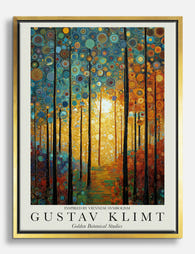
Golden Botanical Studies by Gustav Klimt Canvas Print
Sale price From €65,95€93,95 -

Klimt Floral Symphony Exhibition Print Art Print
Sale price From €16,95€23,95 -
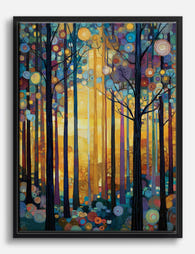
Klimt-Inspired Sunlit Forest Canvas Print
Sale price From €65,95€93,95 -
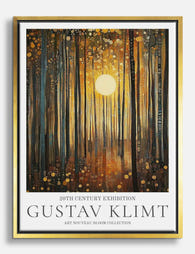
Sunlit Forest by Gustav Klimt Canvas Print
Sale price From €65,95€93,95 -

Klimt Enchanted Forest Exhibition Poster Art Print
Sale price From €16,95€23,95 -

Golden Botanical Studies by Gustav Klimt Art Print
Sale price From €16,95€23,95 -

Klimt Lush Landscape Exhibition Poster Canvas Print
Sale price From €65,95€93,95 -
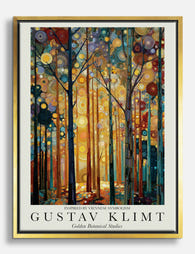
Golden Forest after Klimt Canvas Print
Sale price From €65,95€93,95 -

Golden Botanical Studies by Gustav Klimt Canvas Print
Sale price From €65,95€93,95 -

Sunlit Forest by Gustav Klimt Art Print
Sale price From €16,95€23,95 -
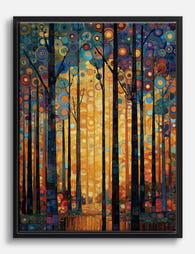
Klimt-Inspired Sunlit Forest Canvas Print
Sale price From €65,95€93,95 -

Klimt-Inspired Golden Forest Art Print
Sale price From €16,95€23,95 -

Golden Botanical Studies by Klimt Art Print
Sale price From €16,95€23,95 -

Gustav Klimt Sunset Forest Art Print
Sale price From €16,95€23,95 -

Klimt Sunlit Forest Exhibition Poster Canvas Print
Sale price From €65,95€93,95 -
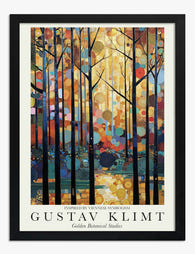
Golden Botanical Studies — Klimt Inspired Art Print
Sale price From €16,95€23,95 -
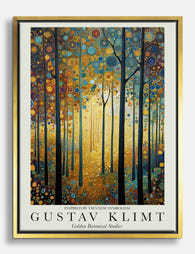
Klimt-Inspired Golden Forest Canvas Print
Sale price From €65,95€93,95 -

Sunlit Forest by Gustav Klimt Canvas Print
Sale price From €65,95€93,95


More from The Frame

Audubon vs John Gould: which antique bird print...
Audubon and Gould are the two giants of 19th-century ornithological illustration, and their work still dominates the vintage bird print market almost two centuries on. But which one actually belongs...

Famous Paintings of Rome: From Piranesi Ruins t...
Search for "famous paintings of Rome" and you'll get a muddle: Caravaggios housed in Roman churches, Pompeian frescoes made by ancient Romans, and generic modern prints of the Colosseum at...

Ancient Roman Frescoes Explained: The Four Styl...
For roughly three centuries, wealthy Romans covered their walls in painted illusions: fake marble, fake windows, fake gardens, fake temples floating in mid-air. When Vesuvius buried Pompeii and Herculaneum in...