
 Order today for delivery by
 Why Do Garden Gallery Walls Fail Without a Proper Plan?
The difference between a curated garden gallery wall and a chaotic Pinterest fail comes down to six specific decisions.


Most garden gallery walls fail for the same reason: people buy prints they love individually, then hope they'll work together. They almost never do. This guide walks you through the actual decisions, with real dimensions and ratios, so your wall ends up looking curated rather than cluttered.
Why garden art makes the best gallery wall subject
Garden and botanical art is uniquely suited to gallery walls because the source material already has internal cohesion. Leaves, petals, stems, and soft natural palettes recur across hundreds of years of botanical illustration and contemporary floral work, which means even disparate styles share a visual vocabulary.
That gives you permission to mix more freely than you could with, say, abstract prints or portraits. A 19th century fern illustration genuinely sits well next to a loose watercolour peony and a moody cottage garden scene, because the eye reads them all as "plants." The theme does heavy lifting that other gallery walls have to manufacture.
The other advantage is colour. Most botanical prints for wall display lean green, cream, and earth tones, with floral accents in pinks, blues, and yellows. This palette flatters almost every interior style: classic, modern, rustic, Scandi, even maximalist. You're starting from an easier place than you would be with, say, neon pop art.

The three gallery wall layouts that actually work
Forget the 47 layout variations on Pinterest. Three work reliably for garden art, and the rest are variations of these.
The grid (formal, calm)
A grid uses identical frame sizes, identical spacing, and clean alignment. For garden art, the grid suits scientific botanicals, vintage seed packet illustrations, or matched pressed-flower studies. Six prints in a 3x2 configuration at 30x40cm each, with 5cm spacing, occupies a wall area of roughly 100cm wide by 85cm tall. Nine prints in a 3x3 grid at the same size gives you 100x130cm.
Grids look intentional and tailored. The downside: they read as formal, which can feel cold in a relaxed lounge.
The salon hang (eclectic, layered)
A salon hang mixes sizes and orientations within a defined rectangle. The trick is to anchor it with one or two larger pieces, typically 50x70cm or 60x80cm, then fill around them with smaller 30x40cm and 21x30cm prints. Aim for between five and eleven prints depending on wall size.
Salon hangs handle mixed styles brilliantly, which is why they're our default recommendation for garden walls that combine cottage scenes, botanicals, and florals.
The staggered asymmetric (modern, breathing)
This sits between a grid and a salon hang. You use three to five prints of varied sizes, but place them on an invisible diagonal or off-centre axis rather than packing them tightly. Spacing widens to 8-10cm. The result feels modern and gives each print room to be seen.
Best for narrower walls or for people who find salon hangs too busy.
Mixing cottage garden prints, botanicals, and florals without visual chaos
Most "botanical" gallery walls fail because they treat botanical as one category. It isn't. There are at least four distinct styles within garden art, and how you mix them determines whether the wall looks curated or random.
The four styles to know:
- Scientific botanical illustration: precise, often on cream or aged paper, with Latin names. Quiet visual weight.
- Cottage garden scenes: painterly, busy, full of colour and movement. Heavy visual weight.
- Loose watercolour florals: single blooms or small arrangements on white. Light, modern, airy.
- Pressed and silhouette work: minimalist, often a single specimen on a plain background. Very quiet.
Our recommended ratio for a mixed gallery wall of six to nine prints: 40% botanical illustration, 30% loose florals, 20% cottage garden, 10% pressed or silhouette. Cottage garden prints are visually dominant, so you need fewer of them. Botanicals are quieter and form the connective tissue.
Background colour is the second decision. If your prints sit on a mix of white, cream, and aged paper backgrounds, the wall will feel patchy. Pick two background tones at most. White plus cream works. Aged paper plus deep ivory works. Pure white plus saturated colour rarely does.
For colour palette cohesion, match undertones rather than exact colours. Warm-toned botanicals (mustard yellows, terracotta, sage) sit together. Cool-toned florals (lilac, dusty blue, eucalyptus) sit together. Mixing warm and cool is possible but requires one to dominate by at least 70%.

How many prints you need for common wall sizes
This is the question nobody answers properly, so here are real numbers.
1.5m wall (small alcove, narrow hallway section)
- Grid: 4 prints at 30x40cm
- Salon: 5-6 prints with one 50x70cm anchor
- Staggered: 3 prints, mixed sizes up to 50x70cm
2.4m wall (behind a standard 2-seater sofa)
- Grid: 6 prints at 30x40cm or 6 at 40x50cm
- Salon: 7-9 prints with one or two 60x80cm anchors
- Staggered: 4-5 prints, mixed sizes
3m wall (behind a 3-seater sofa, dining wall)
- Grid: 9 prints at 40x50cm
- Salon: 9-11 prints with two 60x80cm anchors
- Staggered: 5-7 prints, mixed sizes up to 70x100cm
4m+ wall (open-plan feature wall)
- Grid: 12 prints at 40x50cm
- Salon: 11-15 prints, anchored with at least one 70x100cm piece
- Staggered: 7-9 prints, mixed sizes
The total gallery wall should occupy roughly two-thirds of the wall width above a sofa or sideboard, and sit so the centre of the arrangement is at average eye level, around 145-150cm from the floor.
Pre-curated wall art sets can be a useful shortcut here, particularly for grids, because the sizing and styling work is already done.
Picking a frame finish that ties everything together
This is the single most important decision and the one most people get wrong. A consistent frame finish is what makes mixed styles look curated. It's the visual glue.
Our position: pick one finish and commit. The three that work best for garden art:
- Natural oak: warm, soft, suits cottage and Scandi interiors. Forgiving with mixed art styles.
- Black: graphic, modern, makes botanicals look like museum specimens. Works in formal and contemporary spaces.
- White: airy and gallery-like. Best for loose florals and minimalist styles, but can disappear against pale walls.
We avoid mixed-finish gallery walls for garden art unless you have strong reasons. The natural variety in the prints themselves is already doing the visual interest work, so the frames need to recede.
Solid FSC wood frames, which is what we use across our range, hold their colour and shape over time. Cheaper frames made from MDF or veneered composite tend to warp slightly in humid rooms, and the finish chips at the corners, which becomes obvious on a gallery wall where you see ten frames at once. The UV-protective acrylic glaze we use also prevents the prints fading unevenly, which is what eventually makes a gallery wall look tired.
If you're set on mixing finishes, the only combination we recommend is black and natural oak, in a 60/40 ratio, evenly distributed. Three blacks and two oaks scattered randomly looks accidental. Use one finish for the larger anchors and another for the secondary pieces.
Spacing and alignment: the 5cm rule and when to break it
The default spacing between frames on a gallery wall is 5cm. This is close enough that the prints read as a single composition, and far enough that each piece has room to breathe. It works for almost every garden gallery wall.
Break it deliberately in two situations:
Use 3cm spacing when: you want a formal, packed museum-wall feel. Suits grids of scientific botanicals or vintage illustrations. Tightens the composition and adds gravitas.
Use 8-10cm spacing when: your prints are bolder or the wall is large and you want a more contemporary, breathing feel. Suits staggered asymmetric layouts and loose floral floral garden art prints on white backgrounds.
Alignment matters as much as spacing. In a salon hang, you don't need everything aligned, but you do need at least one strong horizontal or vertical line running through the arrangement. Often this is the top edge of the top row or the centre line through the anchors. Without a single alignment axis, the eye has nothing to hold onto.
A practical method: cut paper templates to the size of each print, tape them to the wall, and live with them for 48 hours before drilling. You will move things. Everyone moves things.

Hanging tips for renters and solid walls alike
For solid walls, you have the easy version. Mark your top frame's hanging point, measure down from the wire or fixture to the top of the frame, and drill once per frame. Our framed prints arrive with the fixtures already attached, so there's no faffing with wire kits.
For renters, the rules are different but the result can be just as good.
- Heavy-duty Command strips: rated up to 7kg per pair. Work well for prints up to 50x70cm. Use two pairs per frame for anything above 40x50cm.
- Picture hanging strips: the Velcro-style ones allow small adjustments after hanging, which matters for gallery walls.
- Gallery rail systems: a brass or aluminium rail mounted with two small screws, from which prints hang on adjustable cords. Genuinely renter-friendly if your landlord allows two tiny holes, and you can swap prints endlessly without further damage.
A note on canvas versus framed for renters: canvas prints are significantly lighter than framed prints of the same size, which makes adhesive hanging more reliable. If you're mixing canvas and framed in one gallery wall (which can work beautifully), put the canvas pieces in positions that need adhesive support.
Our favourite garden gallery wall combinations right now
Three combinations that consistently work, with specific composition guidance.
The English Cottage Garden (warm, painterly, full)
Seven to nine prints in a salon hang. Two cottage garden scenes at 50x70cm as anchors, four to six botanical illustrations at 30x40cm, one or two loose florals at 21x30cm. Natural oak frames, 5cm spacing. Best behind a linen sofa in a warm-toned room.
The Modern Botanical (graphic, calm, considered)
Six prints in a 3x2 grid. Scientific botanical illustrations or pressed-leaf studies, all on cream backgrounds, all at 40x50cm. Black frames, 3cm spacing. Best in dining rooms, studies, or modern lounges with restrained palettes.
The Loose Florals (airy, light, contemporary)
Five prints in a staggered asymmetric layout. One 60x80cm watercolour anchor, two 40x50cm secondary florals, two 30x40cm small studies. White or natural oak frames, 8cm spacing. Best in bedrooms or above a sideboard in a bright room.
For more inspiration on individual pieces to build any of these, browse our wider garden art prints collection. Most of our customers find one anchor print they love first, then build the rest of the wall around its palette and style.

A practical sequence to follow
Choose your layout first, based on your room's mood and your wall size. Then pick your dominant style and palette. Then pick your frame finish. Then buy your anchors, then your secondary pieces, then the small fillers. In that order. Most failed gallery walls happen when people buy prints first and try to make a layout fit afterwards.
Live with paper templates on the wall for two days before drilling or sticking. Take a photo of the arrangement from across the room, in daylight and at night, before committing. If something feels off in the photo, it will feel off forever once it's on the wall.

Fab products featured in this blog
-

Botanical Stairway Canvas Print
Translation missing: en.products.product.sale_price From 740.00 kr1,057.00 kr -

Garden Welcome Art Print
Translation missing: en.products.product.sale_price From 185.00 kr264.00 kr -

Botanical Staircase Haven Canvas Print
Translation missing: en.products.product.sale_price From 740.00 kr1,057.00 kr -
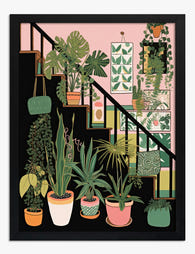
Botanical Stairway Art Print
Translation missing: en.products.product.sale_price From 185.00 kr264.00 kr -

Le Paysage - Wild Herb Garden Art Print
Translation missing: en.products.product.sale_price From 185.00 kr264.00 kr -

Houseplants on a Step Stool Art Print
Translation missing: en.products.product.sale_price From 185.00 kr264.00 kr -

Tropical Cut Outs Botanical Paradise Art Print
Translation missing: en.products.product.sale_price From 185.00 kr264.00 kr -

Blue Garden Stroll Art Print
Translation missing: en.products.product.sale_price From 185.00 kr264.00 kr -

Royal Botanic Garden, Edinburgh Canvas Print
Translation missing: en.products.product.sale_price From 740.00 kr1,057.00 kr -

Landscape by Vincent van Gogh Canvas Print
Translation missing: en.products.product.sale_price From 740.00 kr1,057.00 kr -

Garden Welcome Canvas Print
Translation missing: en.products.product.sale_price From 740.00 kr1,057.00 kr -

Flower Garden by Gustav Klimt Art Print
Translation missing: en.products.product.sale_price From 185.00 kr264.00 kr


More from The Frame

The Best Beige Art Prints for Bedrooms (And Exa...
Most guides tell you how to hang art, but not which beige prints actually suit a bedroom, or what size to buy for your specific bed. This one does both....

The Most Famous William Morris Designs, Ranked:...
William Morris designed over 50 patterns in his lifetime, and roughly six of them get all the attention. That's mostly fair, but not entirely. Here's our honest ranking of the...

Urban Jungle Interiors: Using Wall Art Instead ...
The urban jungle look is having a moment that refuses to end. But most of the people pinning those plant-drenched living rooms will never own 47 monsteras, and that's fine....