
 Commandez aujourd'hui, livré le
 How to Create a Spring Gallery Wall That Actually Looks Intentional
A tactical, no-nonsense guide for anyone staring at a blank wall with a stack of prints and zero plan.


Most spring gallery walls go wrong for the same reason: they're a pile of "spring-ish" prints hung in a vaguely pleasing shape. Intentional gallery walls follow a small set of rules that nobody bothers to write down. Here is the full method, from picking your first print to swapping pieces in March without rehanging the lot.
Why spring is the best time to start a gallery wall
Spring forces a useful constraint: lighter palettes, more daylight, and a natural reset moment in the home. That makes decisions easier. You're not trying to design a wall for every mood and season at once, you're designing one for now, with a built-in plan to evolve it later.
The other reason is practical. Spring light is the most flattering for matte prints, so any flaws in your layout become obvious quickly, which means you fix them quickly. A gallery wall that survives April sunshine will look good year-round.

Choosing a colour palette that ties everything together
The single biggest reason gallery walls look chaotic is that every print is fighting for attention. The fix is a colour thread: one or two colours that appear in every piece, even subtly. Without it, you have a collection. With it, you have a gallery wall.
For spring, three palettes consistently work:
- Soft botanical: sage green, cream, warm white, with a single accent of terracotta or mustard.
- Cool and calm: dusty blue, jade, off-white, with a hint of charcoal for grounding.
- Warm floral: blush pink, persimmon, ochre, with cream or oat as the neutral.
Pick one palette and check every print against it. If a print only works because it's "kind of springy", it doesn't make the cut. The thread runs through every piece or the wall looks random.
A useful trick: lay your shortlist on the floor and squint. If one print suddenly looks louder than the rest, it's breaking the thread. Either swap it out or move it to a different room.
Avoiding the "Easter-y" trap
Spring gallery walls slip into juvenile territory when the palette gets too sweet. Pastels en masse read as nursery, not grown-up living room. The antidote is contrast: pair your softest pinks and creams with at least one print containing a deeper tone, charcoal, ink blue, forest green, or a rich earthy brown. That single anchor of darker pigment is what stops the wall looking like a greetings card aisle.
How many prints you actually need (and what sizes to mix)
"Mix sizes" is the most useless piece of gallery wall advice ever written. Here are formulas that actually work, based on the wall you're filling.
Above a sofa or sideboard (roughly 180-220cm wide):
5 to 7 prints. One anchor at 50x70cm, two mediums at 30x40cm, and two to four smalls at 21x30cm. The anchor sits slightly off-centre to stop the layout looking like a postcard rack.
A narrow wall or hallway (under 120cm wide):
3 prints. One large at 50x70cm with two 30x40cm prints stacked alongside, or three 30x40cm prints in a vertical run.
A statement wall (over 240cm wide):
7 to 9 prints with two anchors. Two pieces at 60x80cm or 70x100cm, three mediums at 40x50cm, and the rest as smalls. Two anchors stop the wall sagging visually toward one side.
The other rule worth following is the 2/3 width rule: your gallery wall should occupy roughly two-thirds of the width of the furniture below it. Wider than that and the wall feels overstuffed. Narrower and the furniture looks oversized.
If you're starting from zero, a curated set takes most of these decisions off your plate. Our wall art sets are designed with anchor and supporting sizes already balanced, which is genuinely the fastest way to a finished wall.
The one frame finish rule that stops gallery walls looking chaotic
Here is the rule: pick two frame finishes maximum, and use one of them on at least 60% of the prints. That's it. Three or more finishes is where gallery walls fall apart.
For spring, the combinations that consistently work are:
- Natural oak with white (lightest, most airy, suits cream and sage palettes)
- Natural oak with black (more graphic, gives you that anchor of contrast)
- All natural oak (the safest option and never looks wrong)
Black frames alone tend to feel heavy for spring. All-white frames can disappear into pale walls. Oak is the workhorse because it adds warmth without competing with the prints.
A note on construction, since this is where most gallery walls go wrong before they're even hung. Cheap frames warp within months, especially in rooms that get spring humidity. Solid wood frames stay flat. Our framed prints use solid FSC-certified wood with UV-protective acrylic glaze rather than glass, which means no glare from spring light streaming through the window, and the prints don't fade even if hung opposite a south-facing pane.

Layout methods: floor planning vs. paper template on the wall
Two methods, both effective. Pick based on how committed you are.
Floor planning (faster, less precise)
Clear a floor area roughly the same size as your wall. Lay out your prints in the arrangement you're considering. Photograph it from directly above. Rearrange. Photograph again. Compare the photos. The camera flattens the layout in a way your eye doesn't, so problems jump out.
This method is fast but it ignores the relationship between the wall and the furniture below. Always step back and imagine the sofa or console table at the bottom of the photo before committing.
Paper template (slower, much more precise)
Trace each frame onto kraft paper or newspaper. Cut out the shapes, label them, and tape them to the wall with low-tack tape. Live with the layout for 24 hours before drilling anything. Move pieces around as needed.
This method takes an hour and feels excessive. It is also the single best way to avoid the "I've put fourteen holes in my plaster and it still looks wrong" outcome. For anything bigger than a three-print arrangement, do the paper template.
Visual weight balancing
As you arrange, think about visual weight, not just size. A small print with a dense, dark image carries more weight than a large print with lots of white space. Distribute the heavier pieces so the wall feels balanced when you squint at it. If everything dark is clustered on one side, the layout will look like it's tipping over.
Spacing and alignment: the 5cm rule and when to break it
Standard guidance is 5cm of space between frames (roughly 2 inches). For most gallery walls, this is correct. It's tight enough that the prints read as a group, loose enough that each piece breathes.
When to break it:
- Larger walls: push spacing to 7-8cm so the wall doesn't feel cramped.
- Tiny prints in a tight cluster: drop to 3-4cm to keep them feeling like one unit.
- Mixed orientation grids: keep spacing absolutely consistent, this is the one place rigour matters most.
For hanging height, the centre of your gallery wall (not the centre of any individual print) should sit at roughly 145-150cm from the floor. Above furniture, leave 15-20cm between the top of the sofa or sideboard and the bottom of the lowest frame. Closer than that and the art looks like it's resting on the furniture. Further and it floats off.
One alignment trick that immediately makes a wall look intentional: pick either a top line, a bottom line, or a centre line, and make sure two or three frames share it. Even an organic, asymmetric layout benefits from one invisible line your eye can follow.

Swapping prints seasonally without rehanging everything
This is the part nobody talks about, and it's the difference between a gallery wall that feels fresh year-round and one you resent by August.
The system is simple: design your wall with two or three "swap slots" baked in from day one.
Step 1: When you plan the layout, identify two or three frames that are the same size, ideally 30x40cm or 40x50cm. These are your swap slots. Everything else is a permanent piece.
Step 2: Choose the permanent pieces to be season-neutral. Think abstract shapes, muted landscapes, line drawings, anything that doesn't shout "spring" or "winter".
Step 3: Use the swap slots for seasonal pieces. In spring, that's botanicals, soft florals, fresh greens. In autumn, swap to warmer landscapes or richer abstracts. The frames stay on the wall. Only the prints change.
Step 4: Buy unframed prints for the swap slots once you've established the frame sizes. Unframed prints are cheaper to rotate and easier to store flat in a folder behind a wardrobe.
This is also where ordering matters. Frames and prints that arrive in separate boxes with no fitting instructions are how warping happens. Ours ship as one fitted piece in a single box, ready to hang, which means swapping in a new print is a two-minute job rather than a wrestling match.
Our favourite spring gallery wall combinations from the collection
A few specific combinations that hit the brief, intentional, season-appropriate, not Easter-y.
The botanical study (5 prints, soft botanical palette)
One 50x70cm pressed-flower study as the anchor, two 30x40cm leaf illustrations either side at slightly different heights, and two 21x30cm abstract botanicals at the bottom. All in natural oak. Browse botanical art prints for pieces that share a consistent illustration style, which matters more than matching subjects exactly.
The cool and calm (6 prints, dusty blue and jade)
Two 40x50cm abstracts as twin anchors, three 30x40cm landscape pieces in muted blues and greens, one 21x30cm darker piece for visual weight. Mix oak with white frames at a roughly 70/30 split. This works particularly well in north-facing rooms where the light is naturally cooler.
The warm floral (7 prints, blush and persimmon)
A central 50x70cm floral painting, two 30x40cm florals stacked on one side, two 30x40cm abstract pieces on the other, and two 21x30cm line drawings filling out the corners. The floral collection covers most of the painted styles you'll want, and pieces from the spring edit work as the abstract counterweights to stop it tipping into too-sweet territory.

A final note on starting
The single biggest mistake people make with gallery walls is buying all the prints at once and committing on day one. Buy your anchor first, live with it for a week, then build outward. A wall that grows over a month looks more intentional than one assembled in an afternoon, because each new piece gets chosen against what's already there. Start with the anchor, set the colour thread, and the rest of the wall almost designs itself.

Produits Fab présentés dans cet article
-
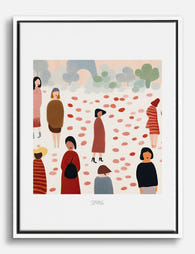
Toile rassemblement de printemps
Translation missing: fr.products.product.sale_price À partir de €64,95€92,95 -

Toile jardin printanier fleuri
Translation missing: fr.products.product.sale_price À partir de €64,95€92,95

Plus de The Frame

The Only Street Scene Gallery Wall Guide You'll...
Street photography is the trickiest genre to hang as a gallery wall. The subject matter is inherently chaotic: strangers, signage, weather, light, accidents of timing. Get the curation wrong and...

Why Multiple Ireland Art Prints Work Better Tha...
Ireland is too varied to capture in one image. The Cliffs of Moher in November fog, a Dublin doorway in primary red, sheep scattered across a Connemara hillside, these are...

Building an Amalfi Coast Gallery Wall: Sizes, S...
Most gallery wall advice stops at "mix sizes and have fun." That's not enough when you're working with five similar-looking coastal scenes that could easily turn your lounge into a...