
 Commandez aujourd'hui, livré le
 Stop Hanging Botanical Greenhouse Prints Like Generic Florals
Why conservatory scenes, glass house illustrations and Victorian botanical studies deserve smarter styling than your standard floral print.


Greenhouse botanicals are not florals. They are architectural, atmospheric, often scientific, and they ask more of a wall than a bright peony print ever will. Treat them like generic flowers and you waste everything that makes them interesting.
Why greenhouse botanicals work where generic florals don't
A standard floral print is a colour event. It throws pink, coral, or yellow into a room and asks you to enjoy it. Useful, but limited.
Greenhouse prints work differently. The palette is restrained (sage, olive, glasshouse grey, terracotta, bone), the composition often includes architecture (iron framework, panes of glass, palm houses, Wardian cases), and the mood leans towards Victorian scientific precision rather than decorative cheer. That means they read as considered rather than pretty, which is a much harder thing to pull off and a much more rewarding thing to live with.
The practical upshot: you can hang a greenhouse print in a serious room (a panelled study, a dark green lounge, a stone-floored kitchen) without it feeling twee. You cannot do that with a bouquet of watercolour roses. If you want to see the distinction in practice, our botanical greenhouse art prints sit alongside the broader botanical art prints collection precisely because they style differently.

Living room: sizing a statement print above the sofa
Above the sofa is where most people get the scale wrong. They buy a 40x50cm print, hang it dead centre above a three-seater, and wonder why the wall looks unfinished.
The rule worth following: the artwork should span roughly two-thirds of the sofa's width. For a standard three-seater (around 210cm wide), that means a single print of at least 140cm across, or a pair that totals 140cm with a small gap between them. Greenhouse prints almost always look stronger as a single large piece rather than a gallery wall, because their architectural composition needs space to breathe. A 70x100cm portrait or a 100x70cm landscape framed print is the sweet spot for most British living rooms. For larger sectionals or open-plan spaces, go to canvas at 100x150cm.
Hang the bottom edge 15 to 20cm above the back of the sofa. Any higher and the print floats away from the furniture. Any lower and you'll knock it with your head.
If you're choosing between a single statement piece and a pair, default to the single piece when the print features strong architecture (a palm house interior, a conservatory perspective shot). The composition is doing the work of a diptych already. Save pairs and triptychs for botanical studies of individual specimens, which benefit from rhythm and repetition.
Living room palettes that flatter greenhouse prints
Greenhouse prints fight with busy upholstery. They sing against:
- Off-white or bone walls with a charcoal or oak sofa
- Sage or olive walls with cream linen
- Deep forest green walls (yes, really, the contrast with the print's own greens creates depth)
- Warm plaster pink walls, which make the greens look almost emerald
Avoid hanging a muted greenhouse print on a feature wall with strong wallpaper. The print loses every detail it has.
Conservatory and garden room: leaning into the obvious (and why that's fine)
The conservatory paradox: putting a greenhouse print inside an actual greenhouse feels redundant on paper. In practice, done well, it's one of the most satisfying placements there is.
The trick is to choose prints that reference greenhouses you don't have. If your sunroom is a modern aluminium extension, hang a Victorian palm house interior, an illustration of Kew, or a Wardian case study. The print becomes a window into a different kind of glass architecture, not a mirror of the room you're already in.
Where it goes wrong is matching too closely. A modern white-framed conservatory with a modern white-framed print of a modern white conservatory is the visual equivalent of an echo. Create some friction. Old print, new room. Or new room, old room in the print.
For a conservatory or sunroom, the safest placement is the solid interior wall (the one that connects to the rest of the house), not the glazed walls. Hang at standard eye level (centre of the print 145 to 150cm from the floor) and let the print anchor the seating area rather than compete with the view outside.
When to create contrast instead
If your conservatory is already heavy with real plants, a greenhouse print will get lost in the foliage. Switch to a more architectural piece (a botanical garden ground plan, a glass house elevation drawing, a single specimen study on a pale background) that gives the eye something to focus on rather than more green to scan.
Hallway and staircase: using narrow walls to create depth
Hallways are where greenhouse prints quietly outperform every other style of botanical art. The vertical, often architectural compositions suit narrow walls, and the muted palette doesn't overwhelm a space you walk through in five seconds.
For a standard hallway wall (around 90cm to 120cm of usable width between doors and switches), a single 50x70cm or 60x80cm framed print works hard. Hang it at 150cm centre, slightly higher than living room placement, because you view hallway art standing rather than sitting.

For longer hallways, run three prints in a row at equal spacing (around 8 to 10cm between frames). Pick prints with similar palettes and the same frame to make them read as a series. This is where Victorian botanical studies work brilliantly, because their scientific consistency lends itself to repetition.
On staircase walls, follow the rise. Hang prints stepped at a consistent height above the stair nosing (around 145cm centre above each step), rather than levelling them with each other. The diagonal rhythm is the entire point of the placement.
Kitchen and dining: pairing greenhouse prints with natural materials
Kitchens get steamy, splattered, and warm. This is one of the few places where framed prints with UV-protective acrylic glaze genuinely earn their keep, both because they shrug off humidity better than glass and because they don't shatter if a pan handle clips them.
Hang greenhouse prints away from direct hob splash zones (so, on the dining wall, the breakfast nook wall, or above a sideboard) and lean into materials that share the same DNA: solid oak tables, rattan chairs, linen runners, unglazed terracotta, stoneware. The greenhouse palette of muted greens, bone whites and rust browns is already in this material story, so the print extends the room rather than decorating it.
Above a dining table, the same two-thirds rule applies as for sofas, measured against the table width. For a 180cm dining table, a 120cm wide print or pair of prints sits naturally. Hang the bottom edge around 75 to 80cm above the table surface so it clears centrepieces and decanters.
In open-plan kitchen-diners, use a single large greenhouse canvas (up to 100x150cm) on the longest unbroken wall as a horizon line. Canvas works particularly well here because the smooth matte finish doesn't reflect overhead spotlights the way framed acrylic can.
Choosing frames that complement the greenhouse aesthetic
Frame choice is where greenhouse prints get murdered. The wrong finish can make a beautiful print look like a charity shop reproduction.
Three frames worth considering, and when each works:
Natural oak. The default for most greenhouse prints. It picks up the warm undertones in Victorian botanical illustrations and bridges the print to wood furniture without competing. Best for sunny rooms, Scandinavian-leaning interiors, and anything featuring conservatory architecture in warm light.
Black. Sharper, more graphic, and surprisingly good for scientific botanical studies on pale backgrounds. The black frame mimics the dark hand-painted borders many Victorian illustrators used, so the effect is historically appropriate as well as modern. Best for darker rooms, panelled walls, and prints with a lot of negative space.
Walnut or dark wood. For richer, more atmospheric interiors. Dark walnut around a moody palm house interior, hung on a deep green wall, is one of the strongest looks in the entire category.
Avoid brass or gold for greenhouse prints. Gold suits Dutch still lifes and bright florals, not the cool restraint of glasshouse imagery. Avoid white frames in most cases too: they bleach the print's edges and make the composition feel weightless.
A note on the unglamorous stuff: the biggest visible difference between a print that looks expensive and one that looks cheap is whether the frame and print arrived properly fitted together. Frames shipped separately, then assembled at home, almost always end up with a slight gap, a wonky mount, or a print that's bowed at the corners. The fact that ours arrive in one box, fitted, fixtures attached, sounds like a small detail until you've spent twenty minutes trying to align a print yourself.

Mixing greenhouse prints with real houseplants without overdoing it
The instinct is to surround a botanical print with the actual botanicals. Resist it.
A greenhouse print with five plants clustered around it reads as a garden centre display. A greenhouse print with one large, sculptural plant nearby reads as styled. The rule: give the print one plant companion, not a chorus. A single fiddle leaf fig, a mature monstera, or an olive tree in a stoneware pot beside the sofa is enough. The plant echoes the print without duplicating it.
If you want more greenery in the room, place it on the other side of the space, not directly under the artwork. Visual breathing room matters more than thematic consistency.
The other trap is leaf-matching: hanging a print of a fern next to a real fern. It looks like a label rather than a composition. Pair different species instead. A palm house print works beautifully near a snake plant. A fern study sits well next to a rubber plant. The contrast between the species in the print and the species in the room is what makes both look intentional.
For more plant-forward looks without the redundancy, our green art prints collection includes options that lean into colour and atmosphere rather than specific botanical species, which gives you more flexibility around real plants.
Common mistakes that make botanical art look cheap
A short list, all fixable.
Too small for the wall. A 30x40cm print above a three-seater sofa is the single most common mistake. It reads as a postage stamp. Either size up or add more prints.
Too much green. Sage walls, green sofa, green print, green plants. The eye has nothing to land on. Break up green with at least two non-green anchors per room (a warm wood, a black light fixture, a cream rug, a clay-toned cushion).
Cheap white plastic frames. The fastest way to undo a beautiful print. Solid wood, even in a slim profile, looks fundamentally different from moulded plastic, and the difference is visible from across the room.
Hanging too high. Anything above 160cm centre height on most walls feels like it's drifting towards the ceiling. Pull it down.
Over-matting. A huge white mat around a small greenhouse print looks fussy and museum-shop-ish. If your print already has a printed border or generous negative space (most Victorian botanical studies do), skip the mat entirely.
Direct, intense sunlight on vintage-style prints. Modern museum-grade giclée with UV-protective acrylic handles direct sun without fading, but it's still worth thinking about glare and viewing angles. A print in a south-facing window position is harder to actually see, regardless of whether it'll fade.

Where to go from here
Pick your largest unbroken wall first. Measure it. Choose one greenhouse print that fills two-thirds of the furniture below it, in a frame finish that matches the warmest wood already in the room. Hang it at 145 to 150cm centre, with one plant nearby, not five. Everything else in the room will start arranging itself around that decision.

Produits Fab présentés dans cet article
-

Affiche serre botanique, oasis de verdure
Translation missing: fr.products.product.sale_price À partir de €16,95€23,95 -

Affiche serre tropicale paisible
Translation missing: fr.products.product.sale_price À partir de €16,95€23,95 -

Affiche serre apaisante
Translation missing: fr.products.product.sale_price À partir de €16,95€23,95 -

Toile serre tropicale verdoyante
Translation missing: fr.products.product.sale_price À partir de €64,95€92,95 -

Affiche botanique, plantes sur étagère, fond jaune
Translation missing: fr.products.product.sale_price À partir de €16,95€23,95 -
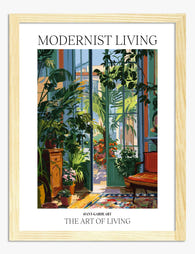
Affiche oasis botanique moderne
Translation missing: fr.products.product.sale_price À partir de €16,95€23,95 -

Affiche botanique verte Morris
Translation missing: fr.products.product.sale_price À partir de €16,95€23,95 -

Affiche botanique vert profond
Translation missing: fr.products.product.sale_price À partir de €16,95€23,95 -

Affiche vases bohèmes aux motifs botaniques
Translation missing: fr.products.product.sale_price À partir de €16,95€23,95 -

Affiche botanique bohème plantes vertes et pots
Translation missing: fr.products.product.sale_price À partir de €16,95€23,95 -

Toile serre verdoyante apaisante
Translation missing: fr.products.product.sale_price À partir de €64,95€92,95 -

Affiche botanique verte Morris
Translation missing: fr.products.product.sale_price À partir de €16,95€23,95 -

Toile escalier végétal
Translation missing: fr.products.product.sale_price À partir de €64,95€92,95 -

Affiche botanique bohème
Translation missing: fr.products.product.sale_price À partir de €16,95€23,95 -

Toile botanique vert héritage
Translation missing: fr.products.product.sale_price À partir de €64,95€92,95 -

Affiche harmonie botanique verte
Translation missing: fr.products.product.sale_price À partir de €16,95€23,95 -

Toile serre tropicale des jardins de Kew
Translation missing: fr.products.product.sale_price À partir de €64,95€92,95 -
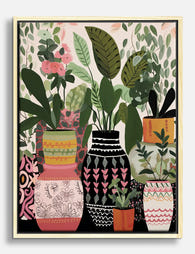
Toile vases bohèmes à motifs botaniques
Translation missing: fr.products.product.sale_price À partir de €64,95€92,95 -

Affiche botanique moderne vert éclatant
Translation missing: fr.products.product.sale_price À partir de €16,95€23,95


Plus de The Frame

Living Room Botanical Prints: The Right Way to ...
Botanical prints are one of the most forgiving categories of wall art to choose, and one of the easiest to ruin with bad framing. A warped frame, the wrong glazing,...

Why William Morris Animal Prints Work in Modern...
Morris's floral patterns get all the attention, but his animal designs are quietly the easier win. A fox or a hare gives your eye somewhere to land, which means these...

The Best Botanical Prints for Your Conservatory...
Conservatories are sun traps, and most art prints are not built for them. The same light that makes the space so lovely to sit in will cook a poorly made...