
 Commandez aujourd'hui, livré le
 How to Build a Botanical Gallery Wall That Doesn't Look Like a Mood Board Gone Wrong
The systematic approach to planning, sizing, and hanging a botanical gallery wall that looks intentional rather than accidental.


Most gallery walls fail because they're a collection of unrelated things pretending to be a composition. Botanical prints are the cheat code: nature has already coordinated the colours and unified the subject matter for you. What's left is execution, and execution is what this guide is about.
Why botanical prints make the best gallery walls
The hardest part of any gallery wall is colour cohesion. You're trying to make a portrait, an abstract, a typographic print and a landscape feel like they belong together, and usually they don't. Botanicals sidestep this entirely.
A fern, a fig leaf, a wild rose study and a pressed eucalyptus illustration share a palette by default: greens, creams, the occasional muted bloom. Even when the styles differ (vintage scientific drawings next to modern minimalist line art), the subject matter pulls everything into one conversation.
This is also why botanicals work in almost any room. A botanical print set reads as calming in a bedroom, fresh in a kitchen, and sophisticated in a lounge, all without changing a single print. The unity is built in, so your job is just arrangement.
There's a second advantage worth flagging. Because botanicals share tonal range, you can mix orientations and sizes more aggressively than you could with mixed art. A vertical palm next to a horizontal floral still feels coherent. With other subject matter, that mix often looks chaotic.

Choosing a layout: grid, salon hang, or horizontal row
Three layouts cover roughly 95% of botanical gallery walls. Pick based on your wall, your prints, and how formal you want the result.
The grid
A grid is two, three or four prints across, in equal rows, with identical sizes and frames. It's the most formal, the most foolproof, and the one to choose if you want a tailored, considered look. Grids work brilliantly with botanical sets that were designed as a series (four leaf studies, six herb illustrations) because the visual repetition reinforces the theme.
We think a 2x3 grid of 30x40cm prints is the sweet spot above a sofa or sideboard. Big enough to feel intentional, small enough not to overwhelm.
The salon hang
A salon hang is the asymmetric, layered look you've seen on every Pinterest board. Different sizes, different orientations, mounted around a central anchor piece. It looks effortless and is genuinely the hardest to pull off.
The trick is the anchor. Pick one large print (60x80cm or 70x100cm works well) and place it slightly off-centre. Everything else orbits around it. A large monstera leaf or a magnolia study makes a strong anchor because the bold shape gives the eye somewhere to rest.
The horizontal row
A single row of 3, 4 or 5 prints in matching frames, hung at the same height. Underrated, especially above long furniture like a sideboard, console table or headboard. It feels architectural and is by far the easiest to plan.
Horizontal rows favour vertical prints (think individual leaf studies, single stem illustrations). The repetition creates rhythm.
How many prints you actually need: the 3-5-7 rule
Odd numbers work. This isn't superstition, it's how the eye reads composition. Even numbers split visually into pairs, which feels static. Odd numbers force the eye to move across the arrangement, which feels alive.
Our rule of thumb:
- Small wall (under 1.5m wide): 3 prints
- Medium wall (1.5m to 2.5m): 5 prints
- Large wall (2.5m+): 7 or 9 prints
Twelve is the exception, but only in a strict 3x4 or 4x3 grid where the regularity of the layout overrides the even-number problem.
If you're doing a salon hang, always go odd. If you're doing a grid, even numbers are fine because the geometric structure does the heavy lifting. A 2x2 grid reads as a single unified block rather than four competing prints.
Picking sizes that work together: our recommended combinations
Scale variation is what separates a curated gallery wall from a print shop display. Same-size prints in a salon hang look like you couldn't make a decision. Mixed sizes look intentional.
Here are three combinations we keep coming back to:
The classic five (medium wall): One 50x70cm anchor, two 30x40cm, two 21x30cm. Place the anchor slightly left of centre, flank with the 30x40cm pieces, fill gaps with the smaller prints.
The seven-piece salon (large wall): One 70x100cm anchor, two 40x50cm, four 30x40cm. The anchor goes lower-left, the 40x50cm prints sit upper-right and lower-right, and the 30x40cm prints fill in around them.
The horizontal trio (above furniture): Three 40x50cm prints in a row, evenly spaced. Simple, effective, almost impossible to get wrong.
For grids, stick to one size throughout. A 2x3 grid of 30x40cm prints, or a 3x3 grid of 21x30cm prints, both work beautifully with botanicals because the repetition reinforces the natural subject matter.

Frame consistency: why matching frames matter more than you think
For botanicals specifically, frame consistency is non-negotiable. Here's why.
Botanical prints share a palette but vary in style: a Victorian scientific illustration looks nothing like a modern watercolour eucalyptus. The frame is what makes them visually agree. Use four different frames and you've added another layer of difference, which fights the cohesion you got for free from the subject matter.
Black frames are our default for botanicals. They sharpen the greens, give the prints definition, and work in almost any room. Natural oak is the second-best option, especially for kitchens, bedrooms, and Scandinavian-leaning spaces. Avoid mixing the two.
A note on materials: this is where most gallery walls fall apart. Frames warp, prints bubble, fixtures aren't pre-attached and you spend an evening swearing at the wall. Our frames are solid FSC-certified wood (no MDF, no veneers) with UV-protective acrylic glaze rather than glass. They arrive ready to hang with fixtures already on, and the print is properly fitted inside the frame, not shipped separately. If you've had a bad framing experience before, this is the bit that fixes it.
Should you use mounts?
Cream or off-white mounts work brilliantly with botanicals, especially vintage-style prints. The mount creates breathing room and references the paper-on-paper feel of old herbarium specimens. For modern minimalist botanicals, skip the mount and let the print fill the frame.
Spacing and the 2/3 rule for hanging height
Two measurements do most of the work here.
Between frames: 5 to 7cm (roughly 2 to 3 inches). Less than 5cm and the prints feel cramped. More than 8cm and the gallery wall stops reading as one composition and starts reading as separate pieces. Stick within that range and you can't go far wrong.
Above furniture: 20cm minimum (about 8 inches) between the top of the sofa, sideboard or headboard and the bottom of the lowest frame. Closer than that and the art looks like it's been swallowed by the furniture.
Hanging height in general: the centre of your gallery wall should sit at roughly 145cm to 150cm from the floor. This is gallery standard, calibrated for average eye level. People consistently hang art too high. If you're unsure, lower it by 5cm.
The 2/3 rule
Your gallery wall should span 60% to 75% of the width of the furniture below it. Narrower than 60% and the art looks marooned. Wider than 75% and it overhangs awkwardly. So a 2m sofa wants a gallery wall between 1.2m and 1.5m wide.
This is the rule most people break. They buy three small prints, hang them above a 2.4m sofa, and wonder why the wall still looks empty. The answer is almost always: the gallery needs to be bigger.
Step-by-step hanging guide: the paper template method
Do not start hammering. Do this first.
You'll need: brown paper or newspaper, scissors, a pencil, masking tape (the low-tack kind), a tape measure, a spirit level.
Step 1. Lay out your prints on the floor in front of the wall. Move them around until the composition feels balanced. Photograph it from above so you don't lose the layout.
Step 2. Trace each frame onto paper. Cut out paper templates the exact size of each frame.
Step 3. On each template, mark where the hanging fixture sits on the back of the frame. Measure from the top of the frame down to the hanging hook. Mark that point on your paper template with a clear cross.
Step 4. Tape the templates to the wall using low-tack masking tape. Start with your anchor piece. For a salon hang, place the anchor first, then build outward. For a grid, start centre and work to the edges. Maintain your 5 to 7cm spacing throughout.
Step 5. Step back. Look at it from across the room. Look at it from the doorway. Adjust until it feels right. Live with it for a day if you can.
Step 6. Once you're happy, hammer your nails or screws directly through the cross marked on each template. Tear the paper away. Hang the frames.
This method takes an extra hour and saves you a wall full of unnecessary holes. It's the single biggest difference between gallery walls that work and gallery walls that don't.

Gallery wall mistakes to avoid with botanical sets
A list of the things we see go wrong, in rough order of frequency.
Mixing too many plant families. A wall of ferns, palms, ivy and monstera works because it's all foliage. A wall mixing tropical leaves with English wildflowers with cacti with Japanese cherry blossoms is too much. Pick a tonal lane and stay in it. Green-toned prints tend to be the easiest starting point because the palette is so forgiving.
Identical prints next to each other. Two similar fern studies side by side look like a printing error. Vary the subject and shape between adjacent prints. A leaf next to a flower next to a stem next to a fruit reads as a curated collection. Two near-identical leaves read as a mistake.
Ignoring scale relationships. If every print is roughly the same size, the eye has nowhere to land. You need at least one piece that's clearly larger than the others. This is the anchor.
Insufficient spacing. Cramming prints too close together is the most common mistake. 5cm minimum, properly measured, every time.
Hanging too high. Already mentioned, but it bears repeating. Centre at 145cm to 150cm. Most gallery walls we see are 10 to 15cm too high.
Mismatched frames. Black frame, oak frame, white frame, gold frame: pick one and commit. Save the eclectic mix for actual eclectic art.
Going too small for the wall. Three 21x30cm prints will not fill a 3m wall. Scale up your prints or scale up your quantity.
Forgetting the room. Herbs and kitchen botanicals (rosemary, thyme, sage illustrations) belong in kitchens. Tropical foliage suits living rooms and bathrooms. Wild meadow flowers and pressed botanicals suit bedrooms. Match the subject to the function of the room. If you're after pre-curated options that already work together, browse wall art sets designed as series.

A final word on getting started
The gap between a Pinterest-perfect gallery wall and the one currently sitting on your floor is almost always planning, not taste. Lay everything out. Cut the paper templates. Measure properly. Commit to one frame finish. Trust the odd numbers and the 2/3 rule.
If you do those things, the wall will work. Botanicals will do the rest of the work for you, which is the whole reason to start here in the first place.

Produits Fab présentés dans cet article
-

Toile escalier végétal
Translation missing: fr.products.product.sale_price À partir de £44.95£74.95 -

Toile escalier végétal
Translation missing: fr.products.product.sale_price À partir de £44.95£74.95 -

Affiche botanique, plantes sur étagère, fond jaune
Translation missing: fr.products.product.sale_price À partir de £11.95£19.95 -
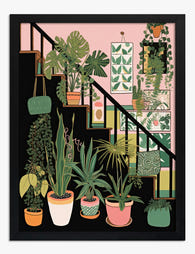
Affiche escalier botanique
Translation missing: fr.products.product.sale_price À partir de £11.95£19.95 -

Affiche jardin en découpage végétal
Translation missing: fr.products.product.sale_price À partir de £11.95£19.95 -

Toile botanique rose aux courbes fluides
Translation missing: fr.products.product.sale_price À partir de £44.95£74.95 -
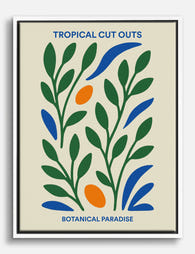
Toile paradis botanique aux formes découpées
Translation missing: fr.products.product.sale_price À partir de £44.95£74.95 -
Affiche muse botanique
Translation missing: fr.products.product.sale_price À partir de £11.95£19.95 -

Toile botanique vintage vert profond
Translation missing: fr.products.product.sale_price À partir de £44.95£74.95 -

Toile botanique vibrante
Translation missing: fr.products.product.sale_price À partir de £44.95£74.95 -
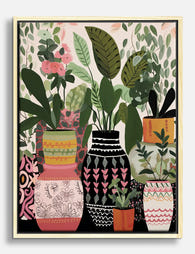
Toile vases bohèmes à motifs botaniques
Translation missing: fr.products.product.sale_price À partir de £44.95£74.95 -

Toile jungle urbaine pour salle de bain
Translation missing: fr.products.product.sale_price À partir de £44.95£74.95 -

Toile sentiment botanique
Translation missing: fr.products.product.sale_price À partir de £44.95£74.95 -

Toile harmonie botanique
Translation missing: fr.products.product.sale_price À partir de £44.95£74.95 -

Toile oasis botanique
Translation missing: fr.products.product.sale_price À partir de £44.95£74.95 -

Toile abstraite nuances botaniques
Translation missing: fr.products.product.sale_price À partir de £44.95£74.95 -

Toile botanique audacieuse
Translation missing: fr.products.product.sale_price À partir de £44.95£74.95 -

Affiche botanique moderne tons neutres
Translation missing: fr.products.product.sale_price À partir de £13.99£19.99 -

Affiche croquis botanique noir et blanc
Translation missing: fr.products.product.sale_price À partir de £11.95£19.95 -

Affiche botanique vert profond
Translation missing: fr.products.product.sale_price À partir de £11.95£19.95


Plus de The Frame

What Makes a Typography Print Worth Hanging? 6 ...
Typography prints are the most overdone, undervalued category in wall art. Most are mass-produced rubbish destined for a charity shop within a year. A few are genuinely brilliant. This guide...

Building a Bauhaus Gallery Wall: Layouts, Sizin...
Bauhaus prints look effortless on a single wall but turn chaotic the moment you start grouping them. The bold shapes, primary colours, and high contrast that make Kandinsky and his...

The Only Street Scene Gallery Wall Guide You'll...
Street photography is the trickiest genre to hang as a gallery wall. The subject matter is inherently chaotic: strangers, signage, weather, light, accidents of timing. Get the curation wrong and...