
 Ordina oggi, consegna il
 How to Build a Gallery Wall Around Mountain Art Prints
A subject-specific guide to building gallery walls that feel intentional, with copy-paste templates and honest opinions on what actually pairs with mountains.


Mountain prints are some of the most rewarding pieces to anchor a gallery wall with, and some of the easiest to get wrong. Their horizontal weight, dramatic tonal range, and strong focal point mean they need careful companions, not random ones. Here's how to build an arrangement that looks deliberate.
Start with your hero: choosing the anchor mountain print
Your anchor is the print everything else relates to. For most gallery walls, that means picking a mountain piece that's at least 50% larger than any companion you'll hang around it. A 60x80cm or 70x100cm framed mountain print sits comfortably as a hero. Anything smaller than 40x50cm starts to feel like a participant, not a centrepiece.
Decide on tone before you decide on layout. Snowy peaks and alpine scenes pull cool: greys, slate blues, soft whites. Autumn ranges run warm: rust, ochre, forest green, cedar brown. Misty or foggy mountains read as neutral and play well with almost anything. The tonal family you choose dictates every other print on the wall, so pick the mountain you genuinely love first, then build outward.
One practical note on format. Wide horizontal mountain ranges create more layout challenges than vertical or square mountain prints, because they demand vertical companions to balance them. If you're new to gallery walls, a square or portrait-format mountain piece is more forgiving.

Complementary subjects that work (and ones that clash)
This is the question almost every guide skips. What goes with mountain wall art is not "anything landscape." Some subjects elevate mountains. Others fight them.
What works:
- Forests and trees. Same palette, same mood, lower visual intensity. A misty pine forest next to an alpine peak feels inevitable.
- Lakes and water scenes. Reflective, calmer than mountains, often share the same blue-grey tones. A still lake print is the classic companion.
- Wildlife in muted tones. A stag, an eagle, a wolf, anything illustrated in earthy colours. Skip anything cartoonish or high-saturation.
- Abstract textures in mountain palettes. Think washes of slate, fog, granite. Abstracts work brilliantly because they soften a wall full of representational art.
- Botanical prints in mountain colours. Pressed ferns, eucalyptus, dried grasses. Anything you'd find at altitude. Browse botanical art prints for pieces that share the same restrained palette.
What clashes:
- Tropical and beach scenes. Palm trees and palms next to alpine peaks read as confused, not eclectic.
- Busy urban photography. Cityscapes have their own focal point mass and compete with mountains rather than support them.
- High-contrast geometric abstracts. Bold black-and-white geometry makes mountain art look muddy.
- Warm desert scenes paired with cool mountain prints. The temperature mismatch is jarring.
- Anything with a strong competing subject. Two heroes on one wall is one too many.
The rule is simple. Your companion pieces should feel like they were photographed or painted on the same trip. If they could plausibly belong to one journey, they belong on one wall. Our landscape art prints collection is a good place to find pieces with that shared atmospheric quality.
The three gallery wall layouts that always look intentional
You don't need to invent a layout. Three formats consistently work, and each suits a different room.
Linear three-piece
Three prints in a horizontal row, evenly spaced, all at the same height. Best above sofas, sideboards, and beds. Your mountain print sits in the centre, flanked by two companions of equal size. This is the most foolproof layout in existence.
Salon-style five-piece (asymmetric)
One large mountain anchor, off-centre, with four smaller pieces clustered around it at varied sizes. Reads as collected and curated. Best in living rooms with high ceilings and bedrooms with statement walls. Harder to plan, more rewarding when it lands.
Grid (six or seven pieces)
A symmetrical grid of equal-sized prints, with the mountain in the most prominent position (usually centre or top-centre). Works in hallways, stairwells, and minimalist rooms. Strict, calm, architectural.
Spacing, alignment, and the 5cm rule
The professional consensus on gallery wall spacing is remarkably consistent: 5cm between frames (sometimes called the 2 to 3 inch rule). Less and the prints look cramped. More and they stop reading as a single composition.
The cardboard trick works better than measuring tape. Cut a strip of cardboard 5cm wide and use it as a spacer between every frame as you hang. It's faster than measuring and gives a perfect gap every time.
Hanging height matters as much as spacing. The centre of your gallery wall should sit at roughly 145cm from the floor, which is standard gallery eye-level. If you're hanging above furniture, leave 15 to 20cm between the top of the sofa or sideboard and the bottom of your lowest frame. Closer than that feels squeezed, further apart and the art floats away from the furniture.
One more rule worth committing to memory: the gallery wall should span roughly two thirds of the width of the furniture below it. A 240cm sofa wants a gallery wall around 160cm wide. Wider and the art dominates. Narrower and the wall feels bare.

Mixing sizes without it looking chaotic
Mixed sizes are what makes a gallery wall look collected rather than catalogue-bought. The trick is to think in visual weight, not just dimensions.
A large dark mountain print has more visual weight than an equally sized pale abstract. To balance it, you don't need another large piece on the opposite side. You need equivalent visual mass, which might be three smaller prints clustered together.
A reliable starting ratio for a five-piece wall: one anchor at 70x100cm, two medium pieces at 40x50cm, and two small pieces at 30x40cm. The maths matters less than the rhythm. You want one clear hero, a couple of mid-weight supporters, and a few quieter notes.
Vertical companions balance horizontal mountain prints. If your hero is a wide mountain range, pair it with at least one tall portrait-format companion. Otherwise the whole wall pulls sideways and feels off-axis.
One frame finish or mixed? Our honest recommendation
Most guides hedge on this. We'll commit.
Stick to one frame finish if your art is visually varied (different styles, mediums, subjects). The matching frames create the cohesion the art doesn't.
You can mix two finishes if your art is already cohesive (all photography, all in the same palette, all the same medium). The most reliable combination is black and natural oak. It works because both are neutral and architectural. Avoid mixing more than two finishes. Three or more reads as indecision.
Skip ornate or gilded frames entirely with mountain art. Nature subjects want quiet frames. A thick gold baroque frame around an alpine landscape looks like a costume.
For most mountain gallery walls, we'd recommend a slim solid wood frame in either matte black or natural oak, with a white mount. The mount calms busy compositions and gives the eye somewhere to rest. If your mountain print is a minimalist silhouette or a modern graphic illustration, skip the mount and let the print fill the frame.
Templates you can copy: 3-print, 5-print, and asymmetric layouts
Real measurements you can mark out on the wall tonight.
The three-print linear (best above a sofa)
- Centre: mountain print, 50x70cm portrait or 70x50cm landscape
- Left: companion (forest, lake, or abstract), 40x50cm
- Right: companion, 40x50cm
- Spacing: 5cm between each frame
- Total wall span: roughly 150cm
- Hang centre of arrangement at 145cm from floor, or 18cm above sofa back
The five-print asymmetric (salon-style)
- Anchor: mountain print, 70x100cm, positioned slightly left of centre
- Top right of anchor: 30x40cm botanical or wildlife print, 5cm gap
- Bottom right of anchor: 40x50cm lake or forest print, 5cm gap
- Far right column, top: 30x40cm abstract texture
- Far right column, bottom: 30x40cm complementary photograph
- Align right edges of the right column flush with each other
- Total wall span: roughly 180cm wide, 140cm tall
The seven-print grid variation
- Top row: three 40x50cm prints, mountain print in the centre
- Bottom row: four 30x40cm companion prints, evenly spaced
- 5cm gap horizontally and vertically throughout
- Best for hallways and stairwell walls
- Works particularly well with one matching frame finish
If you'd rather not piece this together yourself, our wall art sets include curated combinations designed to hang together. And if you're starting from scratch on the hero, the mountains art prints collection covers everything from foggy peaks to autumn ranges.

Common gallery wall mistakes and how to avoid them
These are the mistakes we see most often, in rough order of frequency.
Frames shipped separately and assembled at home. This is the single biggest reason gallery walls go wrong. Cheap framing means warped paper, bubbling, prints that aren't sitting flush. If your art arrives properly framed in one box, with fixtures fitted and glazing already in place, you've avoided 80% of the problems other shoppers complain about. (Our framed prints arrive ready to hang for exactly this reason.)
Spacing that's too generous. Beginners almost always leave too much space between frames. 10cm gaps make prints look unrelated. Stick to 5cm and trust it.
Hanging too high. Eye level is 145cm, not 165cm. Most people hang gallery walls 15 to 20cm too high because they're hanging at their own eye level rather than seated eye level (which is what you'll see most of the time in a living room).
Mismatched temperatures. A warm autumn mountain next to a cool snowy peak next to a tropical leaf print is three competing temperature stories. Pick a palette and stay in it.
Too many focal points. If three prints on the wall could each be the hero, none of them are. Demote everything except the mountain.
Frames too ornate. Nature subjects want simple frames. If your frame has carving, gilding, or fussy mouldings, it's fighting the art.
Forgetting visual weight. A heavy dark print on the left and three tiny pale prints on the right is unbalanced even if the dimensions technically match. Squint at the wall. If one side feels heavier, redistribute.
Buying everything at once from one set. Sets can work, but the most interesting walls mix sources. Pair a hero mountain print with botanical pieces, an abstract texture, a piece of black and white photography. The variety is what makes it feel collected rather than ordered.

Final thought
Gallery walls fail when they're treated as decoration. They succeed when they're treated as composition. Pick a mountain print you genuinely love, choose companions that share its palette and mood, commit to one or two frame finishes, and use the 5cm rule without negotiation. Mark out your layout on the floor before you put a single nail in the wall. Then hang it once, properly, and leave it alone.

Prodotti Fab presentati in questo blog
-

Poster avvolto tra le montagne
Translation missing: it.products.product.sale_price A partire da €16,95€23,95 -

Tela ritrovo tra le montagne
Translation missing: it.products.product.sale_price A partire da €64,95€92,95 -

Poster rifugio di montagna sereno
Translation missing: it.products.product.sale_price A partire da €16,95€23,95 -

Poster paesaggio di montagna
Translation missing: it.products.product.sale_price A partire da €16,95€23,95 -

Poster ciclisti su strada di montagna
Translation missing: it.products.product.sale_price A partire da €16,95€23,95 -

Poster villaggio alpino di Zermatt con Cervino innevato
Translation missing: it.products.product.sale_price A partire da €16,95€23,95 -
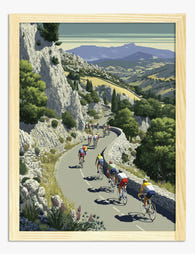
Poster ciclisti sul passo di montagna
Translation missing: it.products.product.sale_price A partire da €16,95€23,95 -

Poster fuga in montagna
Translation missing: it.products.product.sale_price A partire da €16,95€23,95 -

Poster fuga in montagna – edizione sci
Translation missing: it.products.product.sale_price A partire da €16,95€23,95 -

Poster ciclisti su strada di montagna
Translation missing: it.products.product.sale_price A partire da €16,95€23,95 -

Poster Jackson Hole in inverno
Translation missing: it.products.product.sale_price A partire da €16,95€23,95 -

Poster ciclisti su strada di montagna
Translation missing: it.products.product.sale_price A partire da €16,95€23,95 -

Poster verso le montagne
Translation missing: it.products.product.sale_price A partire da €16,95€23,95 -

Poster villaggio invernale di Chamonix
Translation missing: it.products.product.sale_price A partire da €16,95€23,95 -

Tela Zermatt e il Cervino
Translation missing: it.products.product.sale_price A partire da €64,95€92,95


Di più da The Frame

How to Create an Eclectic Gallery Wall That Loo...
You love a botanical line drawing, a moody abstract, and a vintage portrait, and you want them all on the same wall. The fear is that it'll look like a...

Kitchen Gallery Wall Ideas: How to Plan, Hang, ...
Most kitchen gallery walls fail before a single nail goes in. The prints arrive, you eyeball the layout, drill optimistically, and end up with something that feels chaotic instead of...

Building a Gallery Wall Around Matisse Street A...
Matisse's street and town scenes are some of the most rewarding pieces to build a gallery wall around, and also some of the trickiest. The fauvist blues, terracotta rooftops and...