
 Ordina oggi, consegna il
 William Morris Wallpaper vs. Art Prints: How to Get the Look Without the Commitment
How to get the rich, romantic Morris look without committing to a roll of wallpaper or a landlord's wrath.


Morris is everywhere again. Strawberry Thief on cushions, Pimpernel on lampshades, Willow Bough on tea towels in shops that didn't stock anything floral five years ago. The question is whether you commit a whole wall to it, or whether a few well-placed prints get you 90% of the way there for a fraction of the cost.
The Morris revival and why people are buying prints instead
The Cottagecore moment didn't fade, it grew up. What started as fantasy aesthetic on social media has settled into something more grown-up: warm maximalism, layered pattern, brown furniture making a comeback, and a renewed love for the Arts and Crafts movement's nature-led designs. Morris sits at the centre of all of it.
But there's a gap between loving Morris and living with him. Wallpapering a room is a decision that lasts years. Picking out an accent wall, measuring repeats, hiring a decorator (or attempting it yourself and discovering pattern matching is harder than it looks) is a commitment that doesn't suit every life stage, every rental contract, or every budget.
This is where William Morris art prints have quietly become the smarter move for a lot of people. You get the same designs, the same nature-led patterns, the same rich palette, without redecorating a single wall.

Cost comparison: a roll of Morris wallpaper vs. a framed print
Let's do the actual maths, because nobody else seems to.
Authentic Morris & Co wallpaper sits roughly between £65 and £110 a roll in the UK, depending on the design and finish. Most rooms need more rolls than you think because of pattern matching, which can waste 15-25% of each roll on offcuts.
Worked example: a standard 3.5m x 4m bedroom with one accent wall (the 3.5m wall, ceiling height around 2.4m). That's about 8.4 square metres of wall. You'd realistically need 3 rolls to allow for pattern repeat, so £195 to £330 in paper alone. Add a decorator at £150 to £300 for a small accent wall, plus paste, lining paper if needed, and you're looking at £400 to £600 for one wall. Do the whole room and you're easily past £1,000.
A trio of framed Morris prints at 50x70cm sits closer to £200 to £400 depending on framing. You get the same designer, the same patterns, museum-grade giclée printing on thick matte paper, solid FSC wood frames, and the freedom to move them next month if you change your mind.
Per-square-foot, the wallpaper works out cheaper if you cover the whole wall. But that assumes you want pattern covering every inch, which most people don't, and which often looks better in moderation anyway.
The renter's advantage: art you can take with you
If you rent, the case for prints is almost too obvious to make. No landlord approval. No deposit at risk. No stripping wallpaper at the end of the tenancy with a steamer and a swear jar. No worrying about whether the next flat has the right wall shape for the design you fell in love with.
But it goes deeper than portability. Prints let you test patterns without committing. Live with Strawberry Thief for three months before you decide whether you actually want it across an entire wall. Find out if you love the deep indigo or if you'd really prefer the lighter colourways. Discover whether dense floral patterns calm you or quietly drive you up the wall.
This is the test-drive approach, and it's the single most useful piece of advice we can give anyone considering Morris wallpaper: buy one print first. Live with it. If after a season you still love it, then by all means commit to the wallpaper. Most people find the print does the job.
There's also the peel-and-stick option to consider, which has improved dramatically in recent years. It bridges the gap for renters who want full pattern coverage, but the colour reproduction is rarely as rich as authentic Morris & Co paper, and you're still doing the labour of hanging it. A framed print gets you sharper colour, real depth, and arrives ready to hang in one box.
When wallpaper wins (and when a print is smarter)
Wallpaper wins when you own the space, you've lived with the design long enough to know you love it, and you have a wall that calls for full pattern (a chimney breast, a hallway, a downstairs loo where boldness pays off). It wins when you want immersion. There's nothing quite like a small room fully wrapped in Pimpernel.
It also wins when the architecture is doing the heavy lifting. Period properties with picture rails, cornicing, and decent ceiling height carry Morris paper beautifully because the design was originally made for those proportions.
Prints win in almost every other scenario. They win for renters. They win for anyone who likes to redecorate seasonally. They win when you want pattern without overwhelming a small or low-ceilinged room. And they win for the indecisive, because pattern fatigue is real. Dense Morris designs that thrill you at month one can start to feel claustrophobic by month eighteen. With a print, you swap it for something else. With wallpaper, you're stripping and redecorating.

How to create a wallpaper-like effect with a pair or trio of prints
The trick most people miss with arts and crafts floral prints is that you can absolutely replicate the visual density of wallpaper. You just have to be deliberate about it.
The grid layout
A 2x2 or 2x3 grid of identically framed prints creates a repeating-pattern effect that mimics how wallpaper actually behaves on a wall. Choose four designs from the same Morris family (all florals, or all leaf-based designs) and hang them in a tight grid with 5 to 7cm between frames. Step back and the eye reads it as one continuous panel rather than four separate pieces.
Use matching frames. Thin black or natural oak works best because the frame disappears and the pattern dominates. Skip the mounts, or keep them minimal, so the pattern reaches close to the frame edge.
The trio in a row
Three prints in a horizontal row, hung above a sofa or bed, gives you a sense of pattern flow without committing to a full wall. Keep them the same size (50x70cm is the sweet spot), space them around 6 to 8cm apart, and hang them at standard eye level (centre of the middle print around 145cm from the floor).
For maximum wallpaper effect, pick three designs that share a palette. Three Morris designs in the indigo and ochre family will read as a single decorative scheme. Three in clashing colourways will read as three separate things, which is fine, just a different look.
The pair, going floor to ceiling
Two large prints stacked vertically, 60x80cm or larger, create a tall column of pattern that mimics a strip of wallpaper. This works brilliantly either side of a fireplace, flanking a bed, or in a narrow hallway. The eye travels up and reads the column as a continuous design.
The key with all three approaches is repetition. Wallpaper feels like wallpaper because the pattern repeats. Single prints feel like art. Multiple prints, tightly spaced and consistently framed, sit somewhere in between, which is exactly the effect you want.
Mixing Morris prints with plain walls: palettes that work
One of the quiet advantages of prints over wallpaper is that they sit on a wall colour you've already chosen, which means you can lean into the colour story rather than letting Morris dictate everything. Here are the combinations we keep coming back to.
Sage green walls with indigo and cream Morris prints
Sage is having a long moment for a reason. It's restful, it suits north-facing rooms, and it makes the deep blues and creams in classic Morris florals sing. Strawberry Thief or Pimpernel against sage feels both modern and rooted in tradition.
Warm white walls with rich, saturated Morris designs
If you want the prints to be the event, keep the walls in a warm off-white (think a creamy white rather than a cool brilliant white) and let the prints carry all the colour. This is the easiest palette to live with and the easiest to update later.
Ochre or mustard walls with green and cream Morris designs
A more committed look. Mustard walls with Willow Bough or any of the green-led Morris leaf designs is properly maximalist and surprisingly cosy. Best in rooms with good natural light, otherwise it can tip into heavy.
Deep burgundy or oxblood walls with cream and gold Morris prints
For dining rooms, snugs, and anyone who has decided to commit fully to brown furniture and the Arts and Crafts revival. The dark walls make the cream backgrounds of Morris prints glow. Add a brass picture light above the frames and you've got an entire mood.
Plaster pink walls with green Morris florals
A softer take. Plaster pink (a warm, dusty pink, not a cool millennial pink) with green-led William Morris floral prints feels feminine without being saccharine. Works beautifully in bedrooms.

A note on quality and what you're actually buying
Not all Morris prints are equal. You'll find everything from free public domain downloads (Morris died in 1896, so most of his designs are now out of copyright) printed on whatever paper the local shop has, all the way to museum-grade reproductions on archival materials.
The difference shows up immediately. Cheap prints flatten the colour, lose the fine detail in the leaves and petals, and fade noticeably within a few years, especially in sunny rooms. The whole appeal of Morris is the density of detail and the depth of colour, so a flat reproduction misses the point entirely.
What to look for: giclée printing (a specific high-resolution process, not just inkjet), thick matte paper that doesn't reflect light, and UV-protective glazing if the print will hang anywhere near a window. Our framed prints use acrylic glaze rather than glass, which is lighter, safer, and protects against fading. The frames are solid FSC-certified wood, not MDF with a veneer that chips after a year.
This matters more with Morris than with most artists because the designs are so detail-led. The whole charm of Strawberry Thief is the tiny berries, the precise leaf veining, the slight asymmetry of the birds. Lose that and you've got a vaguely floral rectangle.

What to do if you're still torn
Buy one print. Hang it where the wallpaper would go. Live with it for three months and pay attention to how you feel about it on a Tuesday in February when the light is bad and you're tired. If you still love it, you have your answer either way: commit to the wallpaper with confidence, or add two more prints and call it done.
The Morris revival isn't going anywhere soon, and neither are these designs. They've survived 150 years already. You've got time to decide.

Prodotti Fab presentati in questo blog
-

Poster armonia botanica di William Morris
Translation missing: it.products.product.sale_price A partire da €16,95€23,95 -

Poster William Morris Wallflower
Translation missing: it.products.product.sale_price A partire da €16,95€23,95 -

Poster botanico con uccellino, stile William Morris
Translation missing: it.products.product.sale_price A partire da €16,95€23,95 -

Poster arazzo floreale ispirato a William Morris
Translation missing: it.products.product.sale_price A partire da €16,95€23,95 -

Poster farfalla in stile botanico ispirata a William Morris
Translation missing: it.products.product.sale_price A partire da €16,95€23,95 -

Poster fiori autunnali stile William Morris
Translation missing: it.products.product.sale_price A partire da €16,95€23,95 -

Poster botanico blu ispirato a William Morris
Translation missing: it.products.product.sale_price A partire da €16,95€23,95 -

Poster botanica notturna di William Morris
Translation missing: it.products.product.sale_price A partire da €16,95€23,95 -

Tela William Morris botanica al chiaro di luna
Translation missing: it.products.product.sale_price A partire da €64,95€92,95 -

Poster motivo botanico ispirato a William Morris
Translation missing: it.products.product.sale_price A partire da €16,95€23,95 -

Poster botanico fiori di magnolia e uccello ispirato a William Morris
Translation missing: it.products.product.sale_price A partire da €16,95€23,95 -

Poster botanico con uccello ispirato a William Morris
Translation missing: it.products.product.sale_price A partire da €16,95€23,95 -

Poster peonie in fiore ispirato a William Morris
Translation missing: it.products.product.sale_price A partire da €16,95€23,95 -

Poster floreale stile William Morris
Translation missing: it.products.product.sale_price A partire da €16,95€23,95 -

Poster botanico in stile William Morris
Translation missing: it.products.product.sale_price A partire da €16,95€23,95 -

Tela botanica romantica ispirata a William Morris
Translation missing: it.products.product.sale_price A partire da €64,95€92,95 -

Poster foglie botaniche William Morris
Translation missing: it.products.product.sale_price A partire da €16,95€23,95 -
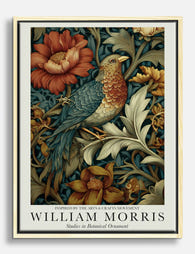
Tela William Morris con uccello tra motivi botanici
Translation missing: it.products.product.sale_price A partire da €64,95€92,95 -

Tela William Morris Wallflower
Translation missing: it.products.product.sale_price A partire da €64,95€92,95 -

Tela con farfalla botanica ispirata a William Morris
Translation missing: it.products.product.sale_price A partire da €64,95€92,95


Di più da The Frame

Arts and Crafts Animal Prints: The Victorian De...
The Arts and Crafts revival: why Victorian animal prints are trending again Scroll through any interior design hashtag right now and you'll see them everywhere: hares peering through curling foliage,...

You're Overthinking Your Arts and Crafts Galler...
Most gallery wall advice assumes you're working with clean, simple imagery. Photographs. Line drawings. Quiet little prints with breathing room baked in. Arts and Crafts prints are the opposite of...

Watercolor Painting Styles Explained: From Bota...
A quick primer on why watercolour looks the way it does Watercolour behaves unlike any other medium. Pigment suspended in water, applied to absorbent paper, with the artist controlling roughly...