
 Ordina oggi, consegna il
 The Best Botanical Prints for Your Living Room (And Exactly How to Hang Them)
Stop guessing at sizes and squinting at empty walls. Here's exactly what to buy, where to hang it, and why.


Botanical prints are the most forgiving art category in your living room. They work with almost any colour palette, never feel try-hard, and age better than abstract prints or photography. This guide assumes you're standing in front of a blank wall right now and want answers, not inspiration.
Why botanical prints are a safe bet for living rooms
Botanicals have been hanging on walls for over 300 years, which is the strongest argument for putting one on yours. They predate every interior trend you're worried about clashing with.
They're also visually quiet. Unlike a bold portrait or a saturated abstract, a fern study or a pressed wildflower print sits in the background of a room without demanding attention, which is exactly what you want above a sofa where people sit, talk, and watch television.
The other thing botanicals do well: they read as considered without reading as expensive. A good vintage botanical looks like something you inherited, not something you ordered last Tuesday. That's a useful quality in a living room, where most other furniture is obviously new.

Above the sofa: the 70x100cm rule and why smaller prints usually disappoint
The single most common mistake in living room art is buying a print that's too small. People walk into the room, see the empty wall above the sofa, panic at the price difference, and pick the 50x70cm option. Then they hang it, step back, and the wall still looks empty.
Here's the rule that actually works: your art should occupy roughly two-thirds the width of the furniture beneath it. A standard three-seater sofa is around 200-220cm wide, which means you need art that's 130-145cm wide overall. A two-seater at 160-180cm needs around 110-120cm of art width.
For a single print, that almost always means going to 70x100cm in landscape, or pairing two portraits side by side. A 50x70cm print above a three-seater sofa looks like a postage stamp on a billboard. We see this mistake constantly, and the fix is always the same: go bigger than feels comfortable.
The visual weight problem
Smaller prints disappoint because of visual weight, which is the psychological sense that an object belongs in a space. A 50x70cm print has the visual weight of a coffee table book. Your sofa has the visual weight of a small car. The proportions just don't connect.
A 70x100cm framed print, on the other hand, holds its own. It anchors the sofa rather than floating above it like an afterthought. If your budget allows for one upgrade in this guide, this is the one to make.
The floating problem (and the 10-15cm rule)
Even at the right size, a print can still feel disconnected if you hang it too high. The bottom of your frame should sit 10-15cm above the top of your sofa. Any higher and the print starts visually separating from the furniture, leaving a band of dead wall between them.
This is one of those things that looks fine on paper but obvious in person. If your art feels like it's drifting toward the ceiling, that's why. Drop it down.
For a wider selection of options sized for sofa walls, our living room art prints collection is filtered for exactly this purpose.
Above a fireplace: portrait orientation and why it works
Fireplaces are one of the few spots in the living room where we'd argue against landscape prints. The reason is simple: a fireplace is already a horizontal anchor. Adding a landscape print on top doubles up on the same shape and the eye has nowhere to travel.
A portrait orientation pulls the eye upward, drawing attention to the height of the room and giving the fireplace a vertical counterweight. For botanical subjects this works particularly well, because plants tend to grow vertically anyway. A tall fern, a single foxglove study, a palm leaf print: all of these read naturally in portrait.
Aim for a print that's around two-thirds the width of your fireplace mantel. If your mantel is 120cm wide, a 50x70cm or 70x100cm portrait print sits beautifully. Centre it carefully. The eye notices a 2cm misalignment above a fireplace much more than it does above a sofa.
If your mantel is busy with candles, vases, or clocks, lean toward a simpler botanical: a single specimen on a clean background rather than a dense vintage plate with multiple elements. The wall art shouldn't compete with the mantel objects.
Gallery wall vs single statement: our honest recommendation
We have a clear position on this: most people should start with a single statement print, not a gallery wall.
Gallery walls look effortless in photographs and are punishing in real life. You need to plan the layout, commit to multiple frames, hang everything precisely, and accept that changing one print means rebalancing the whole arrangement. They're also harder to get right with botanicals specifically, because too many leafy prints in one cluster start looking like a garden centre catalogue.
A single 70x100cm framed botanical above your sofa does most of the work a gallery wall would do, with a tenth of the effort. It's also easier to live with. You can change it in five years without dismantling an entire wall composition.
That said, gallery walls do have their moment. If your sofa is over 240cm wide, a single print starts to look lonely. If you have a long blank wall with no furniture beneath it, a gallery wall fills the space more naturally than one massive print would. And if you genuinely enjoy the curatorial process, a gallery wall is rewarding in a way a single print isn't.
When a diptych beats both
There's a middle option people forget: two matching prints hung side by side. A pair of 50x70cm portraits with 5-10cm of space between them gives you the visual weight of a 100x70cm landscape with more interest. For botanicals, this works especially well as a "his and hers" pairing of related specimens, like two ferns from the same family or two wildflower studies in matching frames.
If you like the gallery wall idea but don't want the commitment, browse wall art sets that are already balanced as pairs or trios. Most of the design work is done for you.

Vintage botanical vs modern minimalist botanical: matching your existing decor
The two big botanical styles look very different and work in very different rooms. Picking the wrong one is a more common mistake than picking the wrong size.
Vintage botanical
Vintage botanicals are the lithograph-style scientific illustrations you'd find in a 19th-century plant encyclopaedia. They feature Latin names, hand-drawn detail, often a slight cream or aged paper background, and a sense of catalogued precision. Think pressed specimens, detailed root systems, cross-sections of seed pods.
These work brilliantly in rooms with traditional or transitional furniture: leather sofas, dark wood coffee tables, persian or kilim rugs, brass or antique brass fixtures. They also pair well with country and farmhouse aesthetics. If your living room has any element of "considered, slightly old" in it, vintage botanicals will feel at home.
The visual test: if your existing furniture has any patina, dark wood, or warm metallic finishes, lean vintage. Our vintage art prints collection is the right starting point.
Modern minimalist botanical
Modern botanicals are cleaner. A single leaf, a simple silhouette, abstract foliage in muted tones, or a photographic plant study against a plain background. There's no Latin name, no scientific framing, no aged paper effect.
These suit contemporary interiors: light wood floors, fabric sofas in neutral tones, painted furniture, brushed nickel or matte black fixtures. They also work in Scandinavian and Japandi spaces where restraint is the dominant aesthetic.
The visual test: if your room is mostly light, mostly neutral, and mostly unfussy, lean modern minimalist.
Authenticity markers for vintage botanicals
Not all "vintage" botanicals are equal. Cheap reproductions look flat and printed. The good ones have visible paper texture, fine line detail that holds up close, and proper typography for the Latin names. The thick matte paper and museum-grade giclée printing matters here, because vintage botanicals live or die on detail. A cheap print of a vintage botanical looks worse than a cheap print of an abstract.
Browse botanical garden art prints for both vintage and modern options that hold detail at full size.
Frame colour guide: what actually looks best with botanical subjects
Frame colour is where botanicals get personal, but there are clear winners for clear scenarios.
Natural oak: the safest choice. Oak's warm undertone flatters green pigments and works with both vintage and modern styles. If you can't decide, pick oak.
Black: best for modern minimalist botanicals on white or pale backgrounds. Black sharpens the contrast and gives the print a graphic, gallery feel. Avoid black with vintage botanicals on cream paper, where it can feel heavy and modern in the wrong way.
White: works for modern botanicals in very light, airy rooms. We'd avoid white frames with vintage botanicals because the cream paper background tends to clash with a stark white frame.
Walnut or dark wood: pairs beautifully with vintage botanicals, especially in rooms with leather, brass, or other warm dark tones. It pushes the print toward "antique library" territory in a good way.
Gold or brass: tempting but risky. Works for very ornate vintage botanicals in formal rooms. Avoid in casual or modern spaces, where it can read as costume jewellery on the wall.
A note on matting: a wide white mat (5-7cm) makes a vintage botanical feel like a museum specimen. It also makes the print feel smaller, because the mat eats into the visual area. If you're working with a 50x70cm print and want maximum visual impact, skip the mat. If you're going to 70x100cm and want gallery polish, the mat earns its space.
How to order the right size: measuring your wall in under two minutes
Here's the actual process. You need a tape measure, masking tape, and two minutes.
Step 1: Measure the width of your sofa or fireplace mantel. Write it down.
Step 2: Multiply that number by 0.66. That's your target art width. A 200cm sofa needs about 132cm of art. A 180cm sofa needs about 120cm.
Step 3: Tape it out. Use masking tape to mark the four corners of where your print will go on the wall. For a 70x100cm landscape print in a frame, the framed dimensions will be slightly larger (usually 75x105cm with a standard frame). Tape that outline.
Step 4: Step back. Sit on the sofa. Look at it from where you actually live. The tape outline tells you everything: whether the size is right, whether the height is right, whether it floats or sits properly above the furniture.
Step 5: Adjust the height if needed. Bottom edge 10-15cm above sofa, centre of print roughly at eye level when standing (around 145-150cm from the floor for the centre).
If the taped rectangle looks too small, you have your answer. Go up a size. People rarely regret going bigger. They regularly regret going smaller.
The narrow wall problem
For the awkward strip of wall between a window and a corner, or beside a door, standard sizing rules don't apply. Measure the wall width, subtract 20cm for breathing room on each side, and pick a portrait print that fits. A 50x70cm or 30x40cm portrait botanical works on most narrow walls. A vertical diptych of two smaller prints stacked also works well here, especially with botanicals that have natural vertical compositions like ferns or grasses.


The short version
If you're standing in front of a blank wall right now: measure your sofa, multiply by 0.66, and order a 70x100cm landscape framed botanical in oak. Hang the bottom edge 10-15cm above the sofa back. Centre it on the furniture, not the wall.
That single decision will solve the problem better than any gallery wall, mood board, or hour of scrolling. Go bigger than feels safe, frame in a wood tone that matches your warmest existing finish, and trust that botanicals have been working in living rooms for three centuries for a reason.

Prodotti Fab presentati in questo blog
-
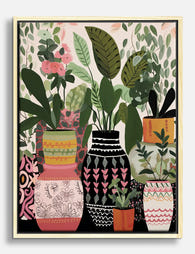
Tela vasi boho botanici
Translation missing: it.products.product.sale_price A partire da €64,95€92,95 -

Poster botanico con piante in vaso su mensola
Translation missing: it.products.product.sale_price A partire da €16,95€23,95 -

Poster vasi e piante boho
Translation missing: it.products.product.sale_price A partire da €16,95€23,95 -

Tela botanica pop moderna con foglie verdi e geometrie
Translation missing: it.products.product.sale_price A partire da €64,95€92,95 -

Poster veduta botanica inglese
Translation missing: it.products.product.sale_price A partire da €16,95€23,95 -

Tela botanica boho con foglie e toni terracotta
Translation missing: it.products.product.sale_price A partire da €64,95€92,95 -

Tela scala con piante d'appartamento
Translation missing: it.products.product.sale_price A partire da €64,95€92,95 -

Tela curve botaniche
Translation missing: it.products.product.sale_price A partire da €64,95€92,95 -

Tela botanica con foglie grandi e colori vivaci
Translation missing: it.products.product.sale_price A partire da €64,95€92,95 -

Poster botanico moderno con fiori grafici su verde intenso
Translation missing: it.products.product.sale_price A partire da €16,95€23,95 -

Poster botanico moderno nei toni neutri
Translation missing: it.products.product.sale_price A partire da €16,95€23,95 -

Tela vasi boho con motivi botanici
Translation missing: it.products.product.sale_price A partire da €64,95€92,95 -

Tela astrazione botanica soffusa
Translation missing: it.products.product.sale_price A partire da €64,95€92,95 -

Tela botanica verde heritage
Translation missing: it.products.product.sale_price A partire da €64,95€92,95 -

Poster natura morta botanica moderna con vaso in terracotta
Translation missing: it.products.product.sale_price A partire da €16,95€23,95 -

Tela botanica vibrante
Translation missing: it.products.product.sale_price A partire da €64,95€92,95 -

Poster botanico boho
Translation missing: it.products.product.sale_price A partire da €16,95€23,95 -

Poster botanico verde con maxi foglie
Translation missing: it.products.product.sale_price A partire da €16,95€23,95 -

Tela armonia botanica verde e rosa
Translation missing: it.products.product.sale_price A partire da €64,95€92,95 -

Tela botanica astratta verde e rosa
Translation missing: it.products.product.sale_price A partire da €64,95€92,95


Di più da The Frame

The Most Distinctive Art Print Styles Right Now...
Most art print guides confuse style with technique, listing lithography next to surrealism as if they're the same kind of thing. They're not. This article is about visual style, the...

The Gold Wall Art Edit: Our Curated Picks for E...
Gold art has a job to do. Done well, it warms a room, catches the light, and pulls a colour scheme together. Done badly, it looks like a hotel lobby...

7 Rules for Hanging Wall Art Prints That Look P...
Most art prints get hung too high, too small, and too far from anything else in the room. The good news: getting it right is more about a handful of...