
 Ordina oggi, consegna il
 What Size Art Should You Hang Above a Sofa?
The 2/3 rule, when to break it, and how to size art that actually looks right above your sofa.


Get the size wrong and even a beautiful print looks like a postage stamp floating above your cushions. Get it right and the whole room snaps into focus. Here's how to work out the size you actually need, plus when the standard rules deserve to be broken.
The 2/3 rule, explained properly
The starting point most designers agree on: your art should be roughly two thirds the width of your sofa. Some stretch this to 60-75%, but two thirds is the safe middle.
The maths is simple once you measure your sofa. Measure the full width including the arms, then multiply by 0.66 for your minimum target and 0.75 for your maximum.
For the three most common sofa sizes:
- 183cm (72") sofa: art between 110cm and 137cm wide
- 213cm (84") sofa: art between 140cm and 160cm wide
- 244cm (96") sofa: art between 160cm and 183cm wide
That's the total width of the piece, including the frame if you're going framed. A 100x70cm landscape framed print, for example, ends up closer to 105x75cm once you account for the frame's width.
If you're looking at a single piece, aim for the upper end of that range. Going slightly larger tends to read as confident and intentional. Going smaller almost always reads as a mistake.

Hanging height: the bit most people get wrong
The 2/3 rule gets all the attention, but height is where most living rooms come unstuck. Two specifics to remember:
Leave 15-25cm (6-10 inches) between the top of the sofa back and the bottom of the frame. Closer to 15cm if your ceiling is standard height (around 2.4m). Closer to 25cm if you've got high ceilings and want to keep the art visually tied to the sofa rather than floating off into space.
The centre of the artwork should sit around 145-152cm (57-60 inches) from the floor. This is the gallery standard for eye level, and it's why art in galleries always feels properly placed. If your sofa back is high, the eye-level rule sometimes pushes the bottom of the frame closer to the cushions than feels right. In that case, prioritise the 15cm clearance over eye level. The art needs to feel anchored to the sofa.
The most common mistake we see: art hung too high, with 40cm or more of empty wall between the sofa and the frame. It disconnects the two. The art ends up looking like it belongs to the ceiling, not the room.
Centre on the sofa, not the wall
If your sofa isn't centred on the wall (perhaps it's pushed towards a corner, or there's a side table breaking up the symmetry), centre the art on the sofa, not the wall.
The eye reads the sofa as the anchor. Anything above it gets visually paired with it. Centring on the wall when the sofa is offset creates a strange visual tension that's hard to name but easy to feel.
The exception: if you've got an architectural feature on the wall (a fireplace, a window) that demands the art aligns with it, you can centre on that instead. But the sofa wins more often than not.
Tape it out before you commit
Before you buy anything, do this. Cut newspaper or brown paper to the exact dimensions of the art you're considering. Tape it to the wall with low-tack tape. Live with it for 24 hours.
You'll know within five minutes if the size is wrong. You'll know within a day if the size is right. It's the single most useful trick in the whole sizing question, and it costs nothing.
If you're choosing between a 70x100cm and an 80x120cm canvas, tape both outlines on the wall side by side (overlapping the centre) and see which footprint your eye prefers. It's clearer than any calculator.
Gallery walls: treat them as one shape
If you're doing two, three, or more pieces above your sofa, treat the whole arrangement as a single rectangle and apply the 2/3 rule to that overall shape.
So a gallery wall above a 213cm sofa should still occupy a total footprint of roughly 140-160cm wide. Within that, you can mix sizes, orientations and frame styles, but the outer boundary should hit the same proportion as a single large piece would.
For two pieces side by side, leave 5-8cm between frames. Any wider and they start to look like two unrelated artworks rather than a pair. For a more layered gallery wall (four or more pieces), keep the gaps consistent across the whole arrangement. Inconsistent spacing is what makes gallery walls look chaotic rather than curated.
A diptych or triptych (two or three pieces designed to read together) is often the easiest way to fill a long sofa wall without committing to a single oversized piece. Browse our framed prints collection for pieces that work well in pairs.

When to break the 2/3 rule
The 2/3 rule is a starting point, not gospel. Three situations where you should deliberately go bigger or smaller:
Go oversized for drama
Contemporary and modernist interiors increasingly lean into art that takes up nearly the full width of the sofa, or even extends slightly beyond it. A 150x100cm canvas above a 213cm sofa is technically too big by the formula. In a minimalist room with high ceilings and pared-back furniture, it looks brilliant.
The rule of thumb: if your room is otherwise restrained (neutral walls, simple furniture, lots of negative space) you can push the art up to 85-90% of the sofa width. Our extra large prints are made specifically for this kind of statement.
Go smaller for intentional minimalism
The opposite move. A small piece (say 40x50cm) deliberately hung above a long sofa, with masses of negative space around it, can look incredibly considered. But it only works if it looks intentional. The art needs to be bold (high contrast, strong subject) and the rest of the room needs to support the choice. Otherwise it just reads as cheap.
Asymmetrical placements
Hanging art off-centre, weighted to one side of the sofa, is a contemporary move that works particularly well above sectionals or sofas with a side table that needs visual balance. Here the 2/3 rule barely applies. You're working with composition, not measurement.
How art style affects sizing
Two pieces of the same dimensions can look completely different in scale on the wall. A few things to consider:
Bold, high-contrast art reads bigger than it is. A 70x100cm abstract with strong black and white shapes will dominate a wall more than a 70x100cm muted landscape photograph. If your chosen piece is visually loud, you can size down a touch.
Soft, subtle work reads smaller than it is. Pale botanicals, gentle line drawings, faded photographs. These need more physical size to hold a wall. Push towards the top of your size range.
Frame style changes the maths too. A thick, dark frame adds visual weight and effectively increases the piece's perceived size. A slim, light frame (or no frame at all) makes the same image read more lightly. If you're going framed and want maximum impact, a 60x80cm print in a 4cm dark oak frame can hold space that a 70x100cm unframed canvas can't.
Tricky sofa situations
Sectionals and L-shaped sofas
Size your art to the main seating section, not the chaise or the corner. The eye treats the main run of the sofa as the anchor wall. If the chaise extends to the right, your art still centres above the main bench, sized to two thirds of that main bench's width.
If you've got a very long sectional running along one wall (3m or more) you'll usually want a gallery wall or a pair of large pieces rather than one single canvas. A single piece big enough to satisfy the formula might not exist, or might overwhelm the rest of the room.
Sofa floating in the room (not against a wall)
The 2/3 rule still applies, but your art now hangs on whatever wall sits behind the sofa from the main viewing angle. Hanging height shifts up slightly because there's no sofa back framing it from below. Aim for the centre of the piece at 152-160cm from the floor.
Windows either side of the sofa
If you've got windows flanking the sofa with only a narrow wall above, you've got two choices. Either hang a piece that fits within that narrow band (often a wide, short landscape orientation works well), or accept that this wall isn't the right wall for art and put your statement piece elsewhere.
Sloped or low ceilings
Under a sloped ceiling, follow the slope. Choose a piece sized for the lowest point of the available wall, and hang it slightly lower than usual so it doesn't crowd the ceiling. A 50x70cm or 60x80cm print usually works better here than anything larger.

Common mistakes worth naming
The five mistakes we see most often:
- Going too small. A 30x40cm print above a three-seater sofa. It looks accidental, like someone forgot to finish the wall.
- Hanging too high. The art floats off into ceiling territory and stops feeling connected to the sofa.
- Centring on the wall instead of the sofa. Especially common when the sofa is off-centre. Trust the sofa.
- Choosing the size based on what's already in the cupboard. If the art doesn't fit the wall, it doesn't matter how much you love it. Put it somewhere else.
- Buying frames and prints separately. This is where most projects fall apart. Frames warp, prints don't sit flat, mounting goes wrong. A properly fitted framed art print that arrives in one box, ready to hang, removes the entire headache.
What to do when your favourite piece is the wrong size
You've found a print you love. It's smaller than the formula wants. Three options:
Frame it generously. A wide mount (8-10cm of white space around the print) inside a substantial frame can take a 50x70cm image to a 70x90cm finished piece. This is the cheapest way to upsize.
Pair it with another piece. Find a companion print (similar palette, complementary subject) and hang them as a diptych. Two 50x70cm prints side by side fill the same space as one 100x70cm piece, and often look more interesting.
Build it into a gallery wall. Use your hero piece as the anchor and arrange smaller prints around it. The total footprint hits the 2/3 rule, but your favourite stays in the mix.
Picking the right orientation
Landscape orientation almost always works above a sofa. The horizontal shape mirrors the horizontal shape of the sofa itself, and the eye reads them as related.
Portrait orientation can work, particularly if your sofa is on the shorter side or your ceiling is high. But you usually need a wider portrait piece (say 70x100cm rather than 50x70cm) to give the sofa enough visual partner.
Square pieces are the wildcard. A single square print rarely works above a long sofa (it looks under-scaled). But two or three squares in a row often look excellent. Our art prints range includes pieces in all three orientations to play with.

The five-minute checklist
Before you buy, run through these:
- Sofa width measured (including arms): ___ cm
- Target art width (sofa width x 0.66 to 0.75): ___ cm
- Available wall width: ___ cm (leave at least 15cm clear on each side of the art)
- Ceiling height noted: standard or high?
- Taped a paper outline to the wall and lived with it for 24 hours?
- Centred on the sofa, not the wall?
- Planning 15-25cm clearance above the sofa back?
If you can answer yes to all of those, you've already avoided the mistakes most people make.
Size is the foundation, but the right piece is the one you'll still love in two years. Pick something that earns its place on the wall, then size it to fit. Not the other way round.

Prodotti Fab presentati in questo blog
-

Poster divano Togo atmosfera accogliente
Translation missing: it.products.product.sale_price A partire da €16,95€23,95 -

Poster lettura rilassata sul divano
Translation missing: it.products.product.sale_price A partire da €16,95€23,95 -

Tela gatto, divano arancione e piante verdi
Translation missing: it.products.product.sale_price A partire da €64,95€92,95 -
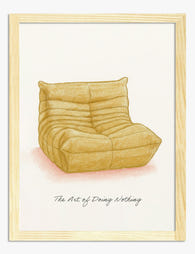
Poster relax sul divano giallo
Translation missing: it.products.product.sale_price A partire da €16,95€23,95 -

Poster natura morta con divano verde
Translation missing: it.products.product.sale_price A partire da €16,95€23,95 -

Tela lettura rilassante sul divano
Translation missing: it.products.product.sale_price A partire da €64,95€92,95 -

Tela gatto nero su divano verde
Translation missing: it.products.product.sale_price A partire da €64,95€92,95 -

Poster gatto soriano arancione su divano verde
Translation missing: it.products.product.sale_price A partire da €16,95€23,95 -

Poster labrador nero sul divano giallo
Translation missing: it.products.product.sale_price A partire da €16,95€23,95 -

Poster gatto su divano verde
Translation missing: it.products.product.sale_price A partire da €16,95€23,95 -

Tela gatto sul divano verde
Translation missing: it.products.product.sale_price A partire da €64,95€92,95


Di più da The Frame

Arts and Crafts Animal Prints: The Victorian De...
The Arts and Crafts revival: why Victorian animal prints are trending again Scroll through any interior design hashtag right now and you'll see them everywhere: hares peering through curling foliage,...

You're Overthinking Your Arts and Crafts Galler...
Most gallery wall advice assumes you're working with clean, simple imagery. Photographs. Line drawings. Quiet little prints with breathing room baked in. Arts and Crafts prints are the opposite of...

Watercolor Painting Styles Explained: From Bota...
A quick primer on why watercolour looks the way it does Watercolour behaves unlike any other medium. Pigment suspended in water, applied to absorbent paper, with the artist controlling roughly...