
 Ordina oggi, consegna il
 7 Steps to a Pink Gallery Wall That Looks Intentional
The technical playbook for pulling off a pink gallery wall that looks gallery-grade, not girlish.


Pink gets a bad rap in interiors, mostly because it's the easiest colour to execute badly. A pink gallery wall done well looks like a curated collection in a Copenhagen apartment. Done badly, it looks like a teenager's mood board, and the difference comes down to a handful of technical decisions most guides skip entirely.
Why pink makes such a strong gallery wall theme
Pink is one of the few colours that reads as a deliberate design choice the moment you commit to it. Neutral gallery walls can feel safe to the point of invisibility, but a pink tonal palette announces intent. You chose this. You meant it.
The catch is that colour amplifies mistakes. With a wall of black and white prints, slightly uneven spacing or a mismatched frame finish goes unnoticed. With pink, every misalignment becomes a visual snag because your eye is already locked onto the colour story. This is why pink gallery walls actually require more precision than neutral ones, not less.
The upside is that when you get it right, the cohesion is immediate. A unified pink palette behaves like a single large artwork, which is harder to achieve with multicoloured galleries no matter how many prints you cram in.

Choosing your pink palette: blush, dusty, hot pink, or mixed?
Before you measure anything, decide which pink family you're working in. The four useful categories are blush (pale, slightly peachy, warm), dusty pink (muted, greyed-down, slightly cool), hot pink (saturated, vivid, can lean warm or cool), and mixed (a deliberate combination across intensities).
Here's the rule that saves most pink gallery walls: stay within one temperature family. Warm pinks (blush, coral-pink, salmon) mix beautifully together. Cool pinks (dusty rose, mauve, fuchsia) mix beautifully together. Cross the streams and you get that uneasy clash where two pinks sit next to each other and look slightly wrong without you being able to explain why.
The pink temperature test takes thirty seconds. Lay your prints out on a white surface in daylight. If a pink looks like it has yellow or orange in it, it's warm. If it looks like it has blue, grey, or purple in it, it's cool. Group accordingly. If you've already bought prints across temperatures, don't panic. We'll fix that in step four.
For mixed-intensity palettes (which can look the most sophisticated), aim for one anchor saturation and two supporting intensities. For example: one hot pink piece, three dusty pinks, two blush. The ratio matters more than the count. Browse blush pink wall art if you're starting from scratch and want to commit to a single family.
How many prints you need based on your wall size
The "use five to nine prints" advice you've read everywhere is useless without your wall dimensions. Here's the actual formula.
Measure your wall width in centimetres. Multiply by 0.6 to get the ideal coverage width (this applies the two-thirds rule, which professional stylists use to determine how much of a wall a gallery should occupy relative to the furniture below it). Then divide that coverage width by your average frame width plus a 5cm gap.
A worked example: a 240cm wall above a 200cm sofa. Coverage width: 240 x 0.6 = 144cm. If your average frame is 40cm wide with 5cm gaps, you'll fit roughly 144 / 45 = 3 across. For a two or three row gallery, multiply by your row count.
As a sanity check, here are minimums and maximums:
- Small wall (under 150cm wide): 3 to 5 prints
- Medium wall (150 to 220cm): 5 to 7 prints
- Large wall (220 to 300cm): 7 to 11 prints
- Statement wall (300cm+): 9 to 15 prints
Pink palettes specifically benefit from sitting at the higher end of these ranges. Too few prints and a pink gallery wall starts to look "dotted," where each piece floats in isolation and the colour fails to read as a cohesive story. Tighter, denser arrangements are almost always more flattering with tonal palettes.
The best size combinations for a balanced pink gallery wall
Repeating frame sizes is the lazy route. Mixing sizes thoughtfully creates the rhythm that distinguishes a curated wall from a printed-and-hung-it wall.
The combinations that consistently work for pink galleries:
The classic anchor: One 70x100cm piece flanked by four 30x40cm pieces. Best when your most saturated pink is the anchor, with softer tones around it. This works for living rooms and over consoles.
The trio cascade: Three 50x70cm pieces in a horizontal row, with two 30x40cm pieces stacked at one end. Good for bedrooms above a headboard.
The grid plus: Six 30x40cm pieces in a tight 3x2 grid, with one 50x70cm piece offset to one side. Modern, slightly off-balance, very intentional.
The salon mix: A combination of 21x30cm, 30x40cm, and 50x70cm pieces with one 70x100cm anchor, arranged asymmetrically. The hardest to execute, the most impressive when right.
On anchor pieces specifically: the question of whether your largest print should be the most or least saturated pink depends on the room's energy. In a calm bedroom, anchor with the softest pink and let saturation appear in smaller pieces. In a lounge that needs more presence, anchor with the most saturated piece. We generally prefer the second approach because it gives the eye somewhere clear to land.
For ready-made combinations, wall art sets take the sizing maths out of the equation entirely.

Layout templates that work (grid, salon, horizontal row)
There are three layouts that reliably succeed, and a hundred that don't. Pick from these three.
The grid
Identical frame sizes, identical spacing, arranged in a perfect rectangle. The most disciplined and the most forgiving of busy print content. A 3x3 grid of 30x40cm prints with 5cm gaps reads as one large, coherent artwork. Works especially well with abstract pink compositions where the individual images are varied but the colour story is unified. Have a look at abstract art prints for the kind of imagery that grids well.
The salon hang
Mixed sizes, asymmetrical, but visually balanced. The trick most people miss: salon walls only work when you have a clear "centre of gravity," usually a larger anchor piece slightly off-centre, with smaller pieces orbiting it. Sketch this on paper before you commit. Salon walls succeed or fail in the planning, not the hanging.
The horizontal row
Three to five pieces in a single line, tops aligned or bottoms aligned (pick one, never alternate). Sits beautifully above a sofa, console, or low bed. Looks restrained and grown-up, which is exactly what pink galleries often need. Aim for matched frame heights even if widths vary.
What to avoid: the staircase (prints climbing diagonally), the random cluster with no anchor, and the mirror-image layout (left side identical to right). These all read as either dated or trying too hard.
Frame finishes that complement pink tones
This is where most pink gallery walls succeed or fail before a single nail goes in. Frame finish is not a neutral choice.
Blush pink + gold frames: Romantic, warm, slightly art deco. Works beautifully in classic interiors, period flats, bedrooms. Risk: can tip into "wedding aesthetic" if your prints are too soft. Balance with one or two graphic pieces.
Dusty pink + white frames: Scandinavian, calm, gallery-like. The most foolproof combination. Works in almost any room. Choose this if you're nervous about getting it wrong.
Hot pink + black frames: Modern, confident, slightly gallery-adjacent. The crispness of black gives saturated pinks the structure they need to feel intentional rather than loud. Best in contemporary spaces.
Mixed pinks + natural oak frames: Warm, tactile, slightly bohemian. Forgiving of mixed pink temperatures because the warm wood acts as a unifying neutral. Pairs well with linen, rattan, and ceramics.
What to avoid: Mixing frame finishes within a single gallery. One gold frame in a wall of black frames will pull every eye in the room straight to it. The frames should be a quiet supporting cast, not a competing element. Pick one finish and commit.
A note on frame width. Thin frames (1 to 2cm profile) feel modern and let the print and the colour do the work. Thick frames (3cm+) create a more traditional, contained feeling and can mute saturated pinks slightly. For dense salon walls, thinner is almost always better because it reduces visual weight.
We use solid FSC-certified wood for our frames rather than MDF or veneer, which matters more than you'd think for tonal palettes. Real wood holds finish without the slightly plasticky reflectivity that throws off colour perception, particularly with golds and warm woods.
Spacing and hanging: the measurements that matter
Get these numbers right and your gallery wall will look professional. Get them wrong and no print quality on earth will save you.
Centre height: The horizontal midpoint of your entire gallery should sit at 145 to 152cm from the floor (57 to 60 inches). This is gallery standard. Measure to the middle of the arrangement, not the middle of any single piece.
Spacing between frames: 5 to 7cm (2 to 3 inches). For pink tonal palettes specifically, we'd push you to the tighter end. 5cm gaps let the colour read as a continuous field. 7cm gaps start to fragment the impression. Anything over 8cm and your pink gallery starts to look "dotted."
Spacing above furniture: 15 to 25cm between the top of your sofa or console and the bottom of the lowest frame. Less than 15cm feels crowded. More than 25cm and the gallery starts to "float" away from the furniture.
The paper template method: Cut newsprint or brown paper to the exact size of each frame. Tape them to the wall with masking tape. Live with the layout for at least 24 hours, ideally 48. Pink especially needs this step because the saturation can look different in morning light versus evening light. Move templates around. Take phone photos of the wall. Use a free editing app to convert the photo to black and white. If the composition still feels balanced without colour, your layout works.
Hanging in order: start with the centre or anchor piece. Work outward from there. Use a spirit level for every single piece. Pink makes a tilted frame painfully obvious in a way that black and white art does not.
Our framed prints arrive with fixtures already attached and the print properly fitted inside the frame, which removes the two most common gallery wall disasters: warped frames that arrived separately from the print, and prints that aren't sitting flush. The whole thing ships in one box, ready to hang.

Common mistakes that make gallery walls look messy
The mistakes that pull pink galleries from sophisticated to chaotic are predictable. Avoid these.
Mixing pink temperatures without a plan. Warm and cool pinks side by side, with no bridging neutral, is the single most common failure. Fix: introduce one or two neutral prints (cream, soft taupe, off-white) to bridge clashing temperatures, or remove the outlier entirely.
Frames that compete with the prints. Heavily ornate gold frames around quiet blush prints. Chunky black frames around delicate watercolour florals. The frame should support the print, not perform alongside it.
Spacing that's too generous. This is the "dotted" effect. 8cm+ gaps make each piece feel solitary, which destroys the tonal cohesion that makes pink galleries powerful.
Hanging too high. The most common mistake in any gallery wall. If you find yourself craning to see your art, it's too high. Drop everything 5 to 10cm.
Too much pink, no resting points. If every single print is saturated pink with no breathing room, the wall starts to feel relentless. One or two prints with significant white space or a neutral element give the eye somewhere to rest.
Treating the wall as separate from the room. A pink gallery wall in a room with no other pink references can look stranded. Echo the palette somewhere else: a cushion, a vase, a throw, a candle. One or two pickups is enough.
Ignoring the light. South-facing rooms wash pinks out. North-facing rooms cool them down. Warm artificial light pushes blush pinks toward peach. Test your prints in the actual room at the actual time of day you'll be looking at them most.

For more specific palette-led inspiration, our pink gallery wall collection groups prints that already work together by temperature and intensity, which removes most of the matching guesswork.
The final check
Before you commit, stand back six metres from your paper templates and squint. If the composition reads as one balanced shape (not a scatter of individual rectangles), you're ready to hang. If your eye keeps catching on one corner or one piece, something is out of place. Trust that instinct. Move it before you pick up the hammer.

Prodotti Fab presentati in questo blog
-

Poster ritrovo al caffè rosa
Translation missing: it.products.product.sale_price A partire da £13.99£19.99 -
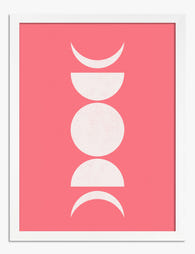
Poster fasi lunari rosa
Translation missing: it.products.product.sale_price A partire da £11.95£19.95 -

Poster armonia di blocchi rosa
Translation missing: it.products.product.sale_price A partire da £13.99£19.99 -

Poster casa a schiera rosa di Londra
Translation missing: it.products.product.sale_price A partire da £13.99£19.99 -

Tela campo da tennis rosa pastello minimalista
Translation missing: it.products.product.sale_price A partire da £44.95£74.95 -

Tela facciata di casa a schiera rosa pastello
Translation missing: it.products.product.sale_price A partire da £44.95£74.95 -

Poster gradini rosa a bordo piscina
Translation missing: it.products.product.sale_price A partire da £11.95£19.95 -

Tela fasi lunari rosa
Translation missing: it.products.product.sale_price A partire da £44.95£74.95 -

Tela nuvola rosa pastello
Translation missing: it.products.product.sale_price A partire da £44.95£74.95 -

Tela cerchi rosa stile Bauhaus
Translation missing: it.products.product.sale_price A partire da £44.95£74.95 -

Tela nuvola soffice su cielo rosa acceso
Translation missing: it.products.product.sale_price A partire da £44.95£74.95 -

Tela ritratto sognante con cappello rosa
Translation missing: it.products.product.sale_price A partire da £44.95£74.95 -

Poster armonia rosa e arancione
Translation missing: it.products.product.sale_price A partire da £11.95£19.95 -

Poster amici chic con barboncino, pareti rosa e sedie gialle
Translation missing: it.products.product.sale_price A partire da £13.99£19.99 -

Tela geometrie rosa in stile Bauhaus
Translation missing: it.products.product.sale_price A partire da £44.95£74.95 -

Tela astratta rosa ondulata
Translation missing: it.products.product.sale_price A partire da £44.95£74.95 -

Tela musa moderna in rosa
Translation missing: it.products.product.sale_price A partire da £44.95£74.95 -

Poster tipografico rosa con frase d’effetto
Translation missing: it.products.product.sale_price A partire da £11.95£19.95 -

Poster nuvola bianca su cielo rosa
Translation missing: it.products.product.sale_price A partire da £11.95£19.95 -

Poster tulipani rosa con bordo floreale blu
Translation missing: it.products.product.sale_price A partire da £13.99£19.99


Di più da The Frame

Living Room Botanical Prints: The Right Way to ...
Botanical prints are one of the most forgiving categories of wall art to choose, and one of the easiest to ruin with bad framing. A warped frame, the wrong glazing,...

Why William Morris Animal Prints Work in Modern...
Morris's floral patterns get all the attention, but his animal designs are quietly the easier win. A fox or a hare gives your eye somewhere to land, which means these...

The Best Botanical Prints for Your Conservatory...
Conservatories are sun traps, and most art prints are not built for them. The same light that makes the space so lovely to sit in will cook a poorly made...