
 Ordina oggi, consegna il
 Klimt's Portrait Style: How Gold, Pattern, and the Human Figure Became One
Why a Klimt portrait looks like nothing else on a wall, and how he engineered that effect on purpose.


The collision of decoration and realism in Klimt's figures
Stand in front of a Klimt portrait and your eyes do something strange. They dart. They settle on a face, then get pulled sideways by a spiral, then back to a hand, then up into a field of gold rectangles. You don't take the painting in all at once. You assemble it.
That is the Klimt portrait style in one sentence: a deliberate collision between hyper-realistic skin and flat, ornamental pattern. Researchers using eye-tracking have actually demonstrated this assembling effect, showing that viewers process a Klimt figure piece by piece rather than as a unified whole. It is the reason his work feels instantly recognisable from across a room, and the reason it still looks radical more than a century later.
Most portraitists of his era, John Singer Sargent and Giovanni Boldini included, were chasing a kind of fluid realism. Klimt did something stranger. He kept the realism for the parts that matter most, the face and the hands, and then dissolved everything else into decoration.

Where the gold came from: Byzantine mosaics and Klimt's Italian trip
The gold did not arrive by accident. In December 1903, Klimt travelled to Ravenna in northern Italy and stood inside the Basilica of San Vitale, surrounded by 6th-century Byzantine mosaics of the Empress Theodora and her court. He described their "unprecedented splendour." Within months it had changed his work.
What Klimt took from Byzantine art was not just gold leaf as a material. It was an entire visual logic. Byzantine mosaics flatten their figures into icons, surround them with shimmering gold backgrounds, and refuse the illusion of depth. The figure becomes sacred rather than realistic, suspended in a space that has nothing to do with the physical world.
Klimt brought this home to Vienna and pointed it at portraiture, which traditionally was the most worldly, status-driven genre in Western painting. The result is the "Golden Phase" of roughly 1899 to 1910, which produced the Portrait of Adele Bloch-Bauer I and The Kiss. Wealthy Viennese women, painted as if they were Byzantine empresses.
His father had been a gold engraver, which is the detail everyone mentions, and it is true that Klimt understood the material intimately. But the trip to Ravenna is the actual hinge. Before it, gold appears occasionally. After it, gold becomes the structural logic of his portraits.
How Klimt painted skin vs. everything else
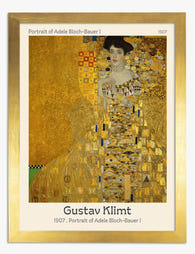
Look closely at a Klimt face and the technique is almost academic. Soft modelling, careful shadow, a sense of breath under the skin. The face of Adele Bloch-Bauer could have been painted by a 19th-century salon portraitist. So could her hands, those long, slightly nervous fingers that recur across his female sitters.
Then look at her dress. Gold rectangles, spirals, all-seeing eyes, triangles. Pure pattern. No volume, no shadow, no attempt to suggest the body underneath the fabric. The dress is not clothing. It is a second painting laid on top of the first.
This is the technical differentiation that makes the Klimt portrait style work. He used two completely incompatible visual languages in the same image and made no attempt to reconcile them. The face says "this is a real woman who sat in front of me." The dress says "this is an icon, a goddess, a symbol."
The effect is intimate and otherworldly at the same time. You feel like you know her, and like she is unreachable. That tension is the whole point.
His process supported it. Klimt sketched obsessively, hundreds of preparatory drawings for a single portrait, always working from a live model. The face required observation. The pattern required invention. Some portraits took years to complete because he was running two different paintings in parallel.
The role of pattern in Klimt's portraits of women
The patterns are not just decoration. They carry meaning, and once you learn to read them, his paintings with people start to feel less mysterious and more like a vocabulary.
In The Kiss, the man's robe is covered in black and white rectangles, hard-edged and angular. The woman's dress is covered in coloured circles, oval flowers, soft curving shapes. Rectangles read as masculine, circles as feminine. The two patterns interlock at the moment of the embrace, which is the actual subject of the painting, not the kiss itself but the meeting of two decorative systems.
The Adele Bloch-Bauer portrait does something similar with the "eye" motif, an ancient symbol of protection and watchfulness scattered through her gown. The triangles reference fertility. The spirals echo Mycenaean and Egyptian art that Klimt had been studying.
His sitters were almost exclusively women, and this was a conscious choice rather than a market accident. After his early career, in which he painted some male portraits, he stopped almost entirely. Vienna at the turn of the century was a city obsessed with women, with female sexuality and psychology, with the figure of the "femme fatale." Klimt's portraits sit inside that obsession but also push back on it. His women are decorated, yes, but they are not passive. They look directly out. They are the subject, not the object.
Emilie Flöge, his lifelong companion and a pioneering Viennese fashion designer, is part of this story too. She designed loose, flowing reform dresses that broke with the corseted shapes of the era, and many of the garments you see in Klimt's portraits echo her work. There is a real argument that Klimt's painted dresses and Flöge's actual dresses were in conversation, each pushing the other further into pattern.

Klimt's influence on Art Nouveau and beyond
By the time Klimt died in 1918, his visual language had already escaped the canvas. The flowing lines, the flat decorative panels, the fusion of figure and ornament, all of it fed directly into Art Nouveau and Jugendstil across Europe. Designers, illustrators, jewellers and architects all borrowed from him, often without realising they were borrowing.
You can trace the line forward from Klimt through Egon Schiele, his protégé, who kept the linear intensity but stripped out the gold. You can trace it sideways into the poster art of the Vienna Secession, the movement Klimt co-founded in 1897. You can trace it forward again into 1960s psychedelic design and into contemporary illustration, where flat decorative pattern wrapped around realistic faces is now so common that we forget who invented it.
For anyone furnishing a room, this matters because Klimt-influenced design and actual Klimt sit comfortably together. A Klimt portrait will not look out of place near anything from the broader Art Nouveau tradition because so much of that tradition descends from him in the first place.
Why Klimt's figurative works translate so well to art prints
There is a practical reason Klimt's figurative works look extraordinary as prints, and it comes down to how he painted. His surfaces are dense with detail. Gold leaf, layered pattern, tiny motifs that reward close looking. On a screen, you lose almost all of this. On a wall, at scale, on thick matte paper, the detail comes back.
This is where giclée printing on heavy matte paper matters more than it does for most other artists. Gloss finishes and glass glazing create reflections that fight Klimt's gold passages, turning them muddy. A matte surface with UV-protective acrylic glazing keeps the depth of the original gold while killing the glare. The faces stay soft, the patterns stay sharp, and the gold reads as gold rather than as a reflective smear.
Scale matters too. Klimt painted big. The Kiss is roughly 180x180cm. Adele Bloch-Bauer I is 138x138cm. You will not replicate those dimensions on a domestic wall, but a 70x100cm framed print gets close enough to the original viewing experience that the assembling effect still works. Your eye still has room to dart between face and pattern. At postcard size, that effect collapses entirely.
The other practical point is framing. Klimt prints framed badly look terrible, because the gold and the ornament demand a frame that does not compete. A simple solid wood frame in black, oak or white, with the print properly fitted behind UV-protective acrylic, is all you want. Frames that arrive warped, or prints that arrive separately and have to be fitted at home, are the failure point in this entire category. A framed print that arrives ready to hang in one piece, with the print properly seated and tensioned, removes the most common reason these works disappoint on arrival.
Canvas is an option for Klimt too, particularly for the larger compositions like The Tree of Life or landscape-oriented works. The mirrored edge wrapping means you do not lose any of the painted surface to the stretcher, which matters when the composition runs all the way to the edge, as Klimt's often do. Canvas reads as slightly less formal than framed paper, which can work in favour of a piece like The Kiss in a bedroom or a lounge.

Our favourite Klimt people prints and what makes them stand out
A few favourites from our Gustav Klimt collection, and what to look for in each.
The Kiss (1907 to 1908) is the obvious one, and there is a reason it has not lost any cultural ground in a hundred years. The interlocking rectangle and circle patterns we mentioned earlier are visible at almost any scale, which makes this one of the few Klimt works that holds up even at smaller sizes. If you only have wall space for a 40x50cm piece, this is the one that still works.
Portrait of Adele Bloch-Bauer I (1907) is the masterpiece of the golden phase. The "Woman in Gold." Buy this large or do not buy it at all, because the entire painting is about the relationship between her face and the field of gold surrounding her, and that relationship needs space to breathe. 70x100cm framed, on a wall with at least a metre of clear space around it, is where this print earns its keep.
Judith and the Head of Holofernes (1901) is the one to choose if you want something less expected. It sits at the edge of the golden phase, and the expression on Judith's face is the most psychologically intense thing Klimt ever painted. Works particularly well in a room where you want a single dominant piece rather than a gallery wall.
Mäda Primavesi (1912 to 1913) is from his later, more colourful period, when Japanese and East Asian art had started to push the gold aside. A young girl in a white dress against a riot of pink, green and floral pattern. Reads as more contemporary than the golden portraits, and pairs more easily with modern interiors.
For something beyond Klimt himself, our broader people art prints collection sits comfortably alongside his work, particularly anything with strong graphic patterning or a similar tension between figure and ornament.
A final thought
The reason Klimt still works on contemporary walls is that he was never really painting portraits in the conventional sense. He was painting two things at once and trusting the viewer to hold them in tension. Hang one in your home and you will keep finding new things in it. That is the test of a portrait worth living with.


Prodotti Fab presentati in questo blog
-

Tela ritratto di Adele Bloch-Bauer I di Klimt
Translation missing: it.products.product.sale_price A partire da £44.95£74.95 -
Poster Adele Bloch-Bauer di Gustav Klimt
Translation missing: it.products.product.sale_price A partire da £11.95£19.95 -

Poster donna con cappello di pelliccia di Klimt
Translation missing: it.products.product.sale_price A partire da £11.95£19.95 -

Poster abbraccio dorato di Klimt
Translation missing: it.products.product.sale_price A partire da £11.95£19.95 -

Poster foresta dorata stile Klimt
Translation missing: it.products.product.sale_price A partire da £11.95£19.95 -

Poster sinfonia di fiori selvatici di Gustav Klimt
Translation missing: it.products.product.sale_price A partire da £11.95£19.95 -

Poster donna in abito floreale di Gustav Klimt
Translation missing: it.products.product.sale_price A partire da £11.95£19.95 -
Tela armonia dorata di Klimt
Translation missing: it.products.product.sale_price A partire da £44.95£74.95 -

Poster foresta dorata di Gustav Klimt
Translation missing: it.products.product.sale_price A partire da £11.95£19.95 -

Poster sentiero dorato di Klimt
Translation missing: it.products.product.sale_price A partire da £11.95£19.95 -

Poster foresta dorata di Klimt
Translation missing: it.products.product.sale_price A partire da £11.95£19.95 -

Poster foresta illuminata di Gustav Klimt
Translation missing: it.products.product.sale_price A partire da £11.95£19.95 -
Tela foresta dorata in stile Klimt
Translation missing: it.products.product.sale_price A partire da £44.95£74.95 -

Poster sinfonia floreale di Gustav Klimt
Translation missing: it.products.product.sale_price A partire da £11.95£19.95 -

Poster il bacio di Gustav Klimt
Translation missing: it.products.product.sale_price A partire da £11.95£19.95 -
Poster foresta dorata in stile Klimt
Translation missing: it.products.product.sale_price A partire da £11.95£19.95 -

Tela dama con cappello di pelliccia di Gustav Klimt
Translation missing: it.products.product.sale_price A partire da £44.95£74.95 -

Poster abbraccio dorato di Klimt
Translation missing: it.products.product.sale_price A partire da £11.95£19.95 -

Tela abbraccio dorato di Gustav Klimt
Translation missing: it.products.product.sale_price A partire da £44.95£74.95 -

Poster armonia dorata di Klimt
Translation missing: it.products.product.sale_price A partire da £11.95£19.95


Di più da The Frame

Why William Morris Prints Look Brilliant in Mod...
William Morris has been quietly miscategorised for decades. His patterns get filed under "country cottage" or "Arts and Crafts revival" and rarely escape, which is a shame because his tree...

Why Arts and Crafts Nature Prints Are the Antid...
The minimalism hangover: why bare walls stopped feeling calming For about a decade, the aspirational interior was a white box with one boucle chair in it. That look has officially...

Botanical Petal Art: Why Close-Up Prints Feel M...
Full florals have had a long run, and they're not going anywhere. But if you've noticed that the botanical art appearing in design magazines, boutique hotel lobbies, and the better-styled...