
 Glimlach gegarandeerd
 Bestel vandaag, levering vóór
 Moon, Stars, and William Morris: The Celestial Side of Arts and Crafts Design
The forgotten night-sky side of William Morris, and why it speaks so directly to modern romantic interiors.


Most people know Morris for his strawberry thieves and willow boughs. Far fewer know that the Morris & Co. workshop also produced some of the most quietly radical celestial imagery of the Victorian era. This is the night-sky side of Arts and Crafts design, and it has a great deal to say to anyone decorating a home in 2025.
Why the Night Sky Captivated the Arts and Crafts Movement
The Arts and Crafts movement, which gathered momentum in Britain from the 1860s onwards, was a rebellion. Morris and his circle pushed back against factory-made furniture, shoddy industrial textiles, and the tyranny of clock-time. They wanted handcraft, honest materials, and a return to what they saw as the slower, more spiritual rhythms of the medieval world.
The night sky fitted this philosophy perfectly. Stars and moons did not belong to the factory or the gas-lit office. They were timeless, pre-industrial, and shared by every century before the steam engine arrived. To put a moon on a wall in 1880 was, quietly, to refuse the logic of the working day.
There was also a more practical reason. The 19th century was a golden age for astronomy. Neptune was discovered in 1846. Photography of the moon began in the 1840s and improved rapidly. Public observatories opened, popular astronomy lectures filled halls, and amateur stargazing became a respectable middle-class pastime. Designers absorbed all of this without necessarily setting out to.
And there was the medieval thread. Morris adored illuminated manuscripts, where stars often glittered in lapis-blue borders, and where the Virgin was crowned with a ring of stars taken straight from Revelation. Arts and Crafts moon motifs were partly a love letter to that older visual world.

Morris & Co. and Celestial Imagery: Tapestries, Stained Glass, and Beyond
The single most important body of celestial work to come out of the Morris circle is Edward Burne-Jones's Stars and Planets series, designed between roughly 1878 and 1879 for Morris & Co.'s stained glass studio.
Burne-Jones drew Luna, the Morning Star, the Evening Star, Venus, and a small cast of personified celestial bodies as graceful figures, half-Pre-Raphaelite, half-medieval. Morris & Co. translated them into stained glass for private homes and a few public buildings. This was genuinely unusual. Domestic stained glass at the time was overwhelmingly heraldic or floral. Putting Venus in your stairwell window was a statement.
Beyond Burne-Jones, celestial imagery turns up in the wider Morris orbit in subtler ways. Border designs for tapestries occasionally feature stars. Embroidery patterns play with crescents and rayed sun-moons. Morris's own book designs for the Kelmscott Press, particularly the Kelmscott Chaucer of 1896, use stars within decorative borders to evoke the cosmos of medieval poetry.
What you will not find easily is a famous Morris wallpaper covered in moons. His commercial wallpaper and chintz output stayed almost entirely botanical. Celestial work in the Morris world was rarer, more bespoke, and largely the domain of stained glass and tapestry rather than the printed roll.
This matters when you go shopping. Most prints sold today as "William Morris celestial patterns" are modern designs done in his style, not reproductions of historic Morris work. That is not a problem, but it is worth knowing.
A quick note on authenticity
If you want to know whether a celestial print is genuinely Morris-related, look for an attribution to Burne-Jones, a reference to a specific Morris & Co. piece, or a museum source. If a print just says "William Morris moon" with no further detail, it is almost certainly a contemporary design inspired by his style. Both can be lovely. The honest framing helps you choose.
The Moon as a Motif: Symbolism in Victorian Decorative Art
Victorian decorative art was unusually fluent in symbolism. People expected their wallpapers, embroidered cushions, and stained glass to mean something, and there was a fairly stable visual grammar for celestial imagery.
A crescent moon read as change, femininity, and the passage of time. Diana, the moon goddess, sat behind a great deal of this, and Burne-Jones's Luna draws on her directly. A full moon suggested completion, fertility, and revelation. Stars typically meant guidance, hope, and spiritual aspiration, drawing on both classical and Christian traditions.
A sun and moon together carried older alchemical meanings of balance, opposites resolved, masculine and feminine in harmony. You see this paired imagery in Arts and Crafts metalwork especially, on door plates and clock faces.
Specific arrangements mattered too. A ring of seven stars often referenced the Pleiades or the seven classical planets. Three stars together could be a quiet nod to faith, hope and charity. None of this was rigid, but it was the cultural air designers breathed.
Understanding this turns a celestial print from pretty wallpaper-on-paper into something with a bit of weight behind it. A moon over your bed in 2025 is not just whimsy. It is sitting in a long line of moons that meant something specific to the people who put them there.

How Celestial Arts and Crafts Patterns Translate to Modern Wall Art
The good news for anyone shopping today is that celestial Arts and Crafts designs translate beautifully into print form. The originals were already small-scale, detailed, and graphic. They reward close looking, which is exactly what wall art is for.
A few things to keep in mind when you are choosing.
Detail wants size. Arts and Crafts designs are dense. A 30x40cm print of a Burne-Jones-style Luna will show you the figure but lose the surrounding stars and border. For a single statement piece, 50x70cm is a sensible minimum, and 70x100cm is where these designs really sing.
Paper or canvas. Museum-grade matte paper, printed properly, holds the fine linework of Arts and Crafts patterns better than canvas. Canvas softens detail slightly, which suits looser Pre-Raphaelite figures but can blur intricate borders. If a design has lots of small stars and foliage, lean toward a framed print on matte paper.
Frame finish. Solid wood frames in black, walnut, or natural oak all work. White frames can look too clean against the historic feel. If you want the print to read as antique, walnut is hard to beat.
Glaze. UV-protective acrylic glaze matters more for celestial prints than you might think. Deep blues and blacks fade fastest in sunlight. Acrylic glazing keeps a midnight-blue background looking midnight-blue ten years from now.
If you want to browse the genre as a whole, the William Morris collection is a sensible starting point, and the narrower William Morris moon prints edit is where the celestial work clusters.
From Whimsigoth to Heritage: Why These Designs Are Trending Again
There is a reason Arts and Crafts movement moon motifs have surged on Pinterest, in editorial interiors, and across social media over the last few years. The contemporary moods that dominate decor right now share a great deal of DNA with what Morris and Burne-Jones were doing in 1880.
Whimsigoth loves moons, stars, velvet, candles, tarot, and a slightly witchy domesticity. It is essentially Stevie Nicks's spare room. Arts and Crafts celestial design fits straight in.
Dark academia wants leather-bound books, brass lamps, oxblood walls, and imagery that feels old, learned, and slightly melancholic. Burne-Jones's Luna belongs in a dark academia bedroom without changing a thing.
Romantic goth and vintage maximalist styles both reward dense pattern, deep colour, and historical reference. Morris's work was always maximalist by today's standards. It just happens that we have caught up.
What unites all of these aesthetics is an anti-industrial, night-romanticising impulse. People who love these looks are responding to something Morris named and fought against more than a century ago. The visual language carries across because the underlying feeling does.
This is why a "William Morris celestial" print works in a 2025 flat in a way a Victorian floral chintz might not. The celestial side of his world was already quietly dissident, already drawn to mystery and handcraft over polish and progress. It was, in its way, ahead of us.

How to Choose a William Morris Celestial Print for Your Space
A short, opinionated guide.
Match the print's density to the room
Arts and Crafts patterns are busy. In a small room with patterned wallpaper or heavy textiles, a single large celestial print works better than three smaller ones. Give it space to breathe. In a calmer, plainer room, you can layer two or three pieces in a vertical stack or a small gallery wall.
Lean into deep colour, not pastel
Celestial Morris-style designs almost always use a navy, midnight blue, forest green, or charcoal background. Resist the urge to find a pale "millennial" version. The depth is the point. A walnut or black frame keeps that intensity intact.
Pair with one strong texture
The fastest way to make a celestial print look like a costume rather than decor is to surround it with too many other historical references. Pick one strong textural anchor, a velvet sofa, a linen bedspread, an oak chest, and let the print sit against more neutral surroundings. The contrast does the work.
Mix eras on purpose
A Burne-Jones-inspired moon above a mid-century walnut sideboard looks better than the same print above a reproduction Victorian console. Mixing centuries breaks the costume effect and lets the print read as art rather than theme.
Consider where the eye goes at night
Celestial prints look extraordinary by lamplight. If you have a piece you love, hang it where it will be lit by a warm bulb in the evening rather than washed out by overhead daylight. Bedrooms, snugs, and reading corners are natural homes.
If you are styling a bigger scheme, the vintage prints collection and the broader celestial collection are good places to find pieces that sit happily alongside Morris-style work without competing with it.
Our Favourite Moon Prints in the Collection
A few specific recommendations, with the reasoning.
For a bedroom, look for a single large crescent moon design with foliage borders, framed in walnut at 70x100cm. Hang it centred above the headboard with around 15cm of clear wall between the frame and the bed. The vertical format pulls the eye up and makes a low-ceilinged room feel taller.
For a hallway or stairwell, a tall Burne-Jones-style figurative piece, Luna or Venus, works extraordinarily well. Stairwells were where Victorians actually installed celestial stained glass, and the format echoes that. A framed print at 50x70cm in a black frame holds its own without overwhelming the space.
For a living room gallery wall, mix one celestial Morris-style print with two botanicals from the same era. The contrast between night sky and foliage is exactly the contrast Morris's own studio explored. Keep frames consistent in finish to hold the wall together.
For a small study or reading nook, a smaller 30x40cm star-pattern print in a deep navy palette works as a quiet companion piece rather than a hero. Hang it at seated eye-level, not standing eye-level, so it reads when you are actually using the room.

A final thought
The celestial side of Morris was never the commercial centre of his work, and that is exactly why it feels fresh now. It carries the craftsmanship and the medieval romance of his famous florals, but with more mystery and more room for the viewer to bring their own meaning. Hang one well, in a room that takes its colours seriously, and it will earn its wall for decades.

Fab-producten in dit blog
-
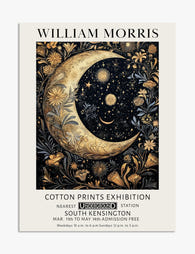
Poster gouden sikkelmaan en sterren in William Morris-stijl
Translation missing: nl.products.product.sale_price Vanaf €19,95€33,25 -

Canvas hemelse maan in William Morris-stijl
Translation missing: nl.products.product.sale_price Vanaf €64,95€92,95 -

Poster hemelse dromen van William Morris
Translation missing: nl.products.product.sale_price Vanaf €19,95€33,25 -

Poster maanlicht boven bos – William Morris
Translation missing: nl.products.product.sale_price Vanaf €19,95€33,25 -

Canvas hemelse dromen van William Morris
Translation missing: nl.products.product.sale_price Vanaf €64,95€92,95 -

Poster maan en sterren in William Morris-stijl, goud en zwart
Translation missing: nl.products.product.sale_price Vanaf €19,95€33,25 -
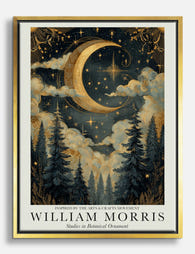
Canvas maanverlichte nacht geïnspireerd door William Morris
Translation missing: nl.products.product.sale_price Vanaf €64,95€92,95 -

Poster William Morris nachtelijke hemel
Translation missing: nl.products.product.sale_price Vanaf €19,95€33,25 -

Poster botanisch maanlicht geïnspireerd door William Morris
Translation missing: nl.products.product.sale_price Vanaf €19,95€33,25


Meer van The Frame

How to Build a Market-Themed Gallery Wall That ...
A gallery wall of market scenes does something a single print never can: it tells a story across cultures. You're not decorating with one image, you're curating a small museum...

How to Display Art Prints at Home: Hanging, Gro...
Most art prints don't look bad because of the print. They look bad because they've been hung 15cm too high, spaced like strangers at a bus stop, or floated above...

How to Build a Folk Art Gallery Wall (With Layo...
You've collected the prints. You've got a tape measure, a pencil, and a wall that's been blank for months. This guide takes you from indecision to nails in the plaster,...