
 Bestel vandaag, levering vóór
 You're Overthinking Your St. Louis Gallery Wall
A practical guide to building a gallery wall around your favourite city prints, without the chaos.


Most St. Louis gallery walls fail for the same reason: too many ideas competing for attention. You bought a beautiful Gateway Arch print, found a Soulard map you love, threw in a Forest Park photograph, and now your living room looks like a souvenir shop. This guide fixes that.

Start with your anchor: choosing the right St. Louis print
Every good gallery wall has a hero. One piece that's larger, bolder, or more visually arresting than everything else around it. Without an anchor, your wall reads as clutter no matter how nice the individual prints are.
For St. Louis themed decor, your anchor almost always wants to be one of three things: the Gateway Arch, the city skyline at dusk, or a vintage travel poster style illustration of the city. These work because they're instantly recognisable and graphically strong. They carry visual weight.
We'd avoid using a neighbourhood map (The Hill, Central West End, Soulard) as your anchor. Maps are detailed and reward close looking, which makes them excellent supporting pieces but weak focal points. A map at 70x100cm asks viewers to step in and read it. An Arch silhouette at 70x100cm hits you from across the room.
If you're choosing between photography and illustration for your anchor, go with whichever has the strongest single shape. A black and white Arch photograph against a pale sky is a stronger anchor than a busy, colour-saturated skyline shot, because the silhouette does the heavy lifting. Browse St. Louis art prints and squint at the thumbnails. The ones that still read clearly when blurred are your anchor candidates.
What size should your anchor be?
For a standard living room wall above a sofa, a 70x100cm framed print or a 100x150cm canvas works as your anchor. For a hallway, dining nook, or bedroom, drop to 50x70cm. Your anchor should be roughly two-thirds the width of the furniture below it. Wider than that and it floats awkwardly. Narrower and it looks lost.
How many cities is too many? The rule of three
Here's where most themed gallery walls go off the rails: people treat their wall like a passport stamp collection. St. Louis where you grew up, Chicago where you went to uni, Nashville where you got married, New Orleans because the trip was fun. Seven cities later, your wall has no point of view.
Our rule: maximum three cities on one gallery wall, and one of them needs to dominate. If St. Louis is the story (and it should be, this is your home), then 60-70% of the wall is St. Louis content. The other 30-40% can be one or two other cities that genuinely matter to you.
Two cities is even better than three. St. Louis plus one other place tells a clear story: this is where I'm from and this is where I've been, or this is home and this is the city I love to visit. Three is the upper limit before the wall stops feeling curated and starts feeling like a travel agency window.
If you can't bear to leave a fourth city out, put it somewhere else. A second smaller arrangement in the hallway or bedroom. Trying to fit your entire life history onto one wall is the single most common gallery wall mistake we see.
Keeping it cohesive: frame finishes and tonal moods
If you take one thing from this article, take this: every frame on your gallery wall should match. Same finish, same profile, same width. This is the non-negotiable.
You have three good options:
- All black: sharpest, most graphic. Works brilliantly with photography and modern illustration. Best in rooms with strong contrast (white walls, dark furniture).
- All natural oak: warmer, softer. Works with vintage travel poster styles, maps, and watercolour illustration. Best in rooms with warm tones, linen, wood furniture.
- All white: lightest, most gallery-like. Works when your prints already have strong colour and you want the frame to disappear. Best on coloured walls (sage, navy, terracotta).
Don't mix. A black frame next to an oak frame next to a white frame turns your wall into a frame catalogue. The eye reads the frames first, then the art. You want the opposite.
This is also why we use solid FSC-certified wood across our framed prints rather than veneers or MDF. The colour and finish stays consistent across sizes, so a 30x40cm in oak genuinely matches a 70x100cm in oak. With cheaper frames you often get slight tonal mismatches between sizes, which is fatal on a gallery wall.
Tonal mood matters as much as frame colour
Beyond frames, your prints themselves need to share a temperature. Warm-toned vintage travel posters with sepia and ochre tones do not mix well with cool-toned modern Arch photography in slate blues and steel greys. Pick a lane.
For a warm wall: vintage poster style St. Louis prints, hand-drawn neighbourhood maps in muted earth tones, sepia photography, illustrations with mustard and rust palettes.
For a cool wall: black and white architectural photography, modern minimal illustration, contemporary skyline shots at dusk or dawn, prints with navy, charcoal, and white palettes.

Layout templates that actually work
The internet is full of gallery wall layouts. Most of them look great in inspiration photos and terrible in real homes. Here are the layouts we'd actually recommend, with dimensions.
The anchored asymmetric (our favourite)
One large print (70x100cm) sitting slightly off-centre. Three to four smaller prints (30x40cm and 40x50cm) clustered to one side, with deliberate negative space on the other. Looks intentional, doesn't read as fussy.
Use this when: you have one truly stunning St. Louis anchor and a few supporting pieces you love.
The salon hang (advanced)
Mixed sizes (30x40cm up to 60x80cm) arranged with tight 5cm spacing, treating the entire grouping as one rectangle. Hardest to execute, most rewarding when done well. Plan it on the floor first.
Use this when: you have 7-9 prints, all in matching frames, and a large wall (minimum 2m wide).
The horizontal row (underrated)
Three to five prints in matching sizes (all 40x50cm or all 50x70cm), hung in a perfectly straight line with equal spacing. Calm, modern, almost impossible to get wrong.
Use this when: you want the easiest possible gallery wall above a sofa, console, or bed.
Layouts to avoid
The perfect grid (four or six identical prints in two rows) looks great in theory but flattens into wallpaper in practice. There's no visual hierarchy, no place for your eye to rest. Skip it unless you're committing to a very minimal aesthetic on purpose.
The random scatter, where prints are spread across the wall with inconsistent spacing, always looks chaotic. If you want asymmetry, plan it. Asymmetry by accident is just mess.
Size ratios: one large, several small
A common mistake is buying four or five prints in the same size, hanging them in a grid, and wondering why the wall feels boring. The eye needs variation in scale to know where to look.
The ratio we recommend: one print at 70x100cm, two at 40x50cm, and two to three at 30x40cm. The largest print is roughly four times the area of the smallest. That contrast creates a clear hierarchy. The Arch hits you first, then your eye travels to the smaller pieces.
If you're buying everything together, a wall art set takes the guesswork out of this. The sizes and tones are already coordinated. If you're building piece by piece, start with your anchor at 70x100cm, then add smaller pieces around it over time.
For mixed-city walls, the anchor (largest piece) should always be your dominant city. A 70x100cm St. Louis skyline with 30x40cm prints of Chicago and New York around it reads as "St. Louis person who also loves these places." Flip the sizes and it reads as "person who can't decide what they're doing."
Spacing and hanging height for standard ceilings
Two numbers to remember:
Spacing between frames: 5-7cm. Closer than 5cm and the prints feel crammed. Wider than 7cm and they stop reading as a group. We aim for 6cm and use a ruler, not eyeballs.
Centre of the gallery wall: 145-150cm from the floor. This is gallery and museum standard for eye level. With standard 2.4m ceilings, this puts the centre of your arrangement at the right height for a standing viewer, with enough breathing room above the sofa or console.
When hanging above furniture, the bottom of the lowest frame should sit 15-25cm above the top of the sofa or console. Closer than 15cm feels squashed. Further than 25cm and the art floats and disconnects from the furniture.
A practical tip: lay your full arrangement on the floor first. Measure it. Cut paper templates the size of each frame, tape them to the wall, and live with the layout for 24 hours before drilling. Adjust spacing, swap positions, then commit.
This is also where buying framed prints that arrive ready to hang with fixtures already fitted saves enormous time. Hanging a gallery wall is fiddly enough without sourcing hooks, sawtooth hangers, and wall plugs for every frame.

Mixing photography and illustration without chaos
Mixing mediums is where most St. Louis gallery walls either come alive or collapse. Done well, a black and white Arch photograph next to a vintage travel poster next to a hand-drawn Forest Park illustration feels rich and personal. Done badly, it looks like you grabbed everything you could find.
The rule: shared colour palette beats shared medium. You can mix photography, illustration, typography, and maps freely if they all sit in the same tonal world. You cannot mix even two prints from the same medium if their palettes clash.
Here's a working combination we'd happily put on a wall:
- 70x100cm black and white Gateway Arch photograph (anchor)
- 40x50cm minimal Arch illustration in charcoal and cream
- 40x50cm typographic St. Louis print in black on off-white
- 30x40cm Soulard neighbourhood map in muted greys and white
- 30x40cm black and white Forest Park photograph
Different mediums, one palette, total cohesion.
If your existing collection skews warm (vintage posters, sepia photography, earth-toned illustration), commit to warm. If it skews cool (modern photography, minimal black and white work), commit to cool. The single fastest way to ruin a gallery wall is buying one beautiful print in a palette that doesn't match anything else.
This logic extends if you're building a multi-city wall. A vintage New York art print in warm ochre and cream sits beautifully next to a sepia St. Louis travel poster. The same New York print in saturated neon photography would fight everything around it. Browse our wider city art prints collection with palette in mind, not city loyalty.

A few final thoughts
If you already have one or two St. Louis pieces on the wall, don't start over. Match new frames to your existing frames (or reframe the existing pieces to match the new ones, which is often easier). Build outward from what's already up. The wall doesn't need to be finished in one weekend.
Take your time choosing the anchor. The right hero print does 80% of the work. The rest is just measurement.

Fab-producten in dit blog
-
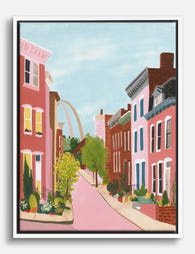
Canvas pastel straatbeeld van St. Louis
Translation missing: nl.products.product.sale_price Vanaf €64,95€92,95 -

Canvas pastelkleurige rijtjeshuizen St. Louis
Translation missing: nl.products.product.sale_price Vanaf €64,95€92,95 -

Poster pastelkleurige rijwoningen St. Louis
Translation missing: nl.products.product.sale_price Vanaf €19,95€33,25 -

Poster pastelkleurige rijtjeshuizen in St. Louis
Translation missing: nl.products.product.sale_price Vanaf €19,95€33,25 -

Canvas pastel rijtjeshuizen in Saint Louis
Translation missing: nl.products.product.sale_price Vanaf €64,95€92,95 -

Poster pastelgekleurde rijtjeshuizen met St. Louis Arch
Translation missing: nl.products.product.sale_price Vanaf €19,95€33,25 -
Canvas stadsscène met kleine figuren
Translation missing: nl.products.product.sale_price Vanaf €64,95€92,95 -

Poster Parijse straat in Montmartre
Translation missing: nl.products.product.sale_price Vanaf €19,95€33,25 -

Poster kleurrijk stadsgezicht
Translation missing: nl.products.product.sale_price Vanaf €19,95€33,25 -
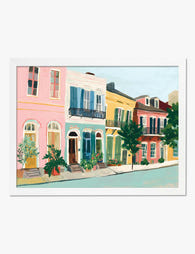
Poster kleurrijk straatbeeld New Orleans
Translation missing: nl.products.product.sale_price Vanaf €19,95€33,25 -

Poster skyline en stadswandeling
Translation missing: nl.products.product.sale_price Vanaf €19,95€33,25 -

Poster charme van Parijse straten
Translation missing: nl.products.product.sale_price Vanaf €19,95€33,25 -

Canvas stadsgezicht San Francisco
Translation missing: nl.products.product.sale_price Vanaf €64,95€92,95 -
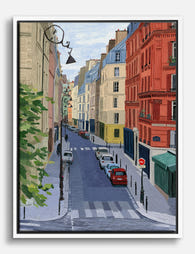
Canvas straatbeeld van Parijs
Translation missing: nl.products.product.sale_price Vanaf €64,95€92,95 -

Poster wandeling door Parijs
Translation missing: nl.products.product.sale_price Vanaf €19,95€33,25 -
Canvas kanaalwandeling in kleur
Translation missing: nl.products.product.sale_price Vanaf €64,95€92,95 -
Poster stadswandeling in zachte pastelkleuren
Translation missing: nl.products.product.sale_price Vanaf €19,95€33,25 -

Poster Parijse stadswandeling met Eiffeltoren
Translation missing: nl.products.product.sale_price Vanaf €19,95€33,25 -

Canvas stadswandelingen en kleine momenten
Translation missing: nl.products.product.sale_price Vanaf €64,95€92,95


Meer van The Frame

Dragonflies in Japanese Art: From Samurai Symbo...
The dragonfly might be the most underrated motif in Japanese visual culture. For over a thousand years it has hovered through armour, woodblock prints, kimono silk and haiku, carrying a...

The Real Plants Behind William Morris's Most Fa...
Most people know William Morris loved nature. Almost no one knows which specific plants are in which patterns, or how to recognise them once you do. This is the field...

The Best Rooms for Dragonfly Art (and How to St...
Dragonfly prints are quietly versatile. They carry the symbolism of transformation and the visual lightness of botanical art, which means they slot into far more rooms than most nature motifs....