
 Bestel vandaag, levering vóór
 How to Build a Gallery Wall with Watercolor Prints That Actually Works
The medium most forgiving of mistakes, the layout that always works, and the spacing rule that changes everything.


A gallery wall is the answer to a large blank wall, but most fail because the pieces fight each other. Watercolour solves this in a way no other medium does. If you've been staring at an empty stretch of plaster wondering whether to commit to one big piece or risk a multi-print arrangement, this is the guide that gives you the framework.
Why watercolour is the easiest medium to build a gallery wall around
Watercolour has soft edges. That single quality makes it the most forgiving medium for multi-piece arrangements. Where graphic prints, photography, and bold illustrations have hard borders that visually slam against each other when hung close together, watercolour pieces have ambient edges where the paint fades into the paper. Your eye reads the wall as one composition rather than five competing rectangles.
The translucency helps too. Watercolours share a luminous quality regardless of subject, which means a botanical study, an abstract wash, and a figurative portrait all carry the same light. That visual logic is what makes a gallery wall feel curated instead of chaotic.
There's also a colour palette advantage. Watercolour pigments tend to sit in a slightly muted, dusty register. Even a vivid watercolour reads softer than the equivalent in acrylic or digital illustration, so contrasting subjects don't shout over each other.
If you've avoided gallery walls because past attempts felt busy, the problem probably wasn't your eye. It was the medium. Switch to watercolour wall art prints and the whole exercise gets easier.

Choosing a colour thread: how to unify different watercolour subjects
A colour thread is the single hue (or two related hues) that appears in every print on the wall, even if it plays a different role in each one. It's what your eye picks up subconsciously and what makes the arrangement feel intentional.
Here's how to find one. Pick a colour that already exists somewhere in the room: the velvet on your armchair, the rug, a cushion, the curtains. That's your thread. Now choose watercolour prints where this colour appears, even as a minor element.
A worked example. Say your thread is a dusty terracotta. You might choose:
- An abstract watercolour where terracotta is the dominant wash
- A botanical print of dried grasses with terracotta seedheads against cream
- A figurative piece where the subject wears a terracotta scarf
- A loose landscape with terracotta rooftops in the distance
Four wildly different subjects, one shared note. The wall reads as a collection.
The trick is letting the colour appear at different intensities. If terracotta is the lead in every piece, the wall feels flat. If it's the lead in one, a supporting note in two, and a whisper in the fourth, you get rhythm.
Avoid threading by subject (all florals, all landscapes). Subject-matching is the obvious move and it's why most gallery walls look like a hotel corridor. Thread by colour and let the subjects diverge.
The layout that works every time: sizing, spacing, and the anchor piece
If you're planning your first gallery wall and want a layout that consistently works, here it is: an asymmetrical cluster around a single anchor piece, with consistent 5cm spacing between every print.
The anchor
Choose one piece that's noticeably bigger than the others. We'd suggest a 70x100cm framed print, or a 60x80cm if your wall is more modest. This is your anchor. Place it slightly off-centre on the wall, with its centre point at roughly 145cm from the floor (standard gallery hanging height for a seated viewer at eye level).
The supporting cast
Around the anchor, arrange four to six smaller prints in mixed sizes. A good combination is two A3 (30x40cm) prints, two A4 (21x30cm), and one or two squares (30x30cm). The size variation is what creates visual interest. If everything is the same size, you've made a grid, which works but feels formal.
The 5cm rule
Keep exactly 5cm between every print, edge to edge (frame to frame, not image to image). This is tighter than most guides recommend, and it's the spacing that makes watercolour gallery walls work specifically. Because watercolour edges are soft, you can hang pieces closer together without the visual collision you'd get with graphic art. Tighter spacing reads as one composition. Looser spacing (10cm or more) reads as separate pieces hung near each other.
Above furniture
If your gallery wall sits above a sofa or sideboard, the full arrangement should span roughly two-thirds the width of the furniture below. Anchor the bottom of the lowest print 15-20cm above the furniture top. Closer than that and it looks cramped. Further away and it floats untethered.
Grid or salon?
We commit to organic over grid every time, for watercolour specifically. Grids work brilliantly for photography and graphic prints where the hard edges echo the geometry. Watercolour's softness wants a looser arrangement. A salon-style cluster lets the gentle edges breathe.
Mixing abstract watercolour prints with botanical and figurative pieces
This is where most people freeze. They've got the colour thread sorted, but they don't know whether they're allowed to put an abstract next to a portrait next to a fern study.
You are. In fact, you should.
A successful watercolour gallery wall needs subject variety, not subject uniformity. Three categories cover most of what you'll want:
- Abstract: colour washes, gestural marks, atmospheric pieces. These act as visual breathers between more detailed work. Abstract watercolour prints are the connective tissue of a gallery wall.
- Botanical: pressed-flower studies, single-stem subjects, foliage. Botanicals add structure because they have a clear focal subject. Botanical art prints ground the wall in something recognisable.
- Figurative: portraits, figures, animals. One figurative piece in a gallery wall draws the eye and gives the arrangement a "lead character".
The ratio we'd suggest for a six-piece wall: one figurative, two botanical, three abstract. The abstract pieces do the heavy lifting of unifying the wall. The botanicals add weight. The figurative gives you a focal point.
If you're nervous about combining categories yourself, pre-curated wall art sets take the guesswork out, since the colour and subject relationships have already been worked through.

Frame consistency vs. eclectic frames: our honest take
The advice you'll usually get is "do whatever feels right". That's not advice, that's avoidance.
Here's what we actually think. For watercolour gallery walls, consistent frames win 90% of the time. The reason is simple: watercolour subjects are already varied, the colour palettes within each piece are already complex, and the soft edges are already doing a lot of subtle visual work. Adding frame variety on top of all that pushes the wall into visual chaos.
Our recommendation: pick one frame finish for the entire wall. Natural oak is the most flexible and works in nearly any room. Black is sharper and best for high-contrast watercolours. White is gentle but can disappear against a pale wall.
The 10% where eclectic frames work: when the room itself is heavily layered (think antique furniture, bold textiles, deeply patterned rugs) and the gallery wall needs to match that energy. In that case, mix oak, black, and brass-coloured frames in a roughly 2:2:1 ratio. Random doesn't read as deliberate. Proportional does.
A note on the framing itself. The most common gallery wall disaster is frames that arrive separately from prints, leaving you to fit, align, and hope nothing warps. Fab framed prints arrive with the print already fitted, the fixtures attached, and ready to hang. The frames are solid FSC-certified wood (no MDF, no veneers) with UV-protective acrylic glaze rather than glass, which matters for watercolour because acrylic doesn't shatter and is significantly lighter for hanging multiple pieces.
Should watercolour have a mat?
We think yes, where the print allows it. A white mat (the card border between the image and the frame) gives watercolour the breathing room its soft edges need. It also makes a smaller print feel more substantial on the wall. If your prints come without a mat built in, the soft watercolour edge meeting the frame directly still works, just with a more contemporary feel.
Rooms where watercolour gallery walls shine (and one where they don't)
Living rooms: the natural home for a gallery wall. The viewing distance (sofa to wall) is right for appreciating the detail in watercolour pieces, and the lighting is usually soft enough to let the pigments glow.
Bedrooms: watercolour's calm, low-contrast quality suits a room you sleep in. Hang the arrangement above a low headboard or a long dresser opposite the bed.
Hallways and staircases: narrow spaces benefit hugely from gallery walls because there's nothing else competing for attention. Watercolours work better than photography here because the soft edges don't feel oppressive in tight quarters.
Home offices: a varied gallery wall behind your desk gives video calls a curated backdrop and gives you something to rest your eyes on between tasks.
Dining rooms: especially good if the wall faces seated diners, since you'll be looking at it for an hour or two at a time.
The room where it doesn't work: bathrooms. Even with UV-protective glazing and quality framing, the humidity cycles in a bathroom are hostile to paper-based art. Steam, condensation on frames, and constant temperature swings will eventually compromise the paper. If you want art in a bathroom, canvas prints handle the conditions better. Save the watercolour gallery wall for a room with stable air.
A note on lighting
Watercolour benefits from indirect, warm lighting. A picture light above the wall (set to a warm 2700K bulb) draws the pigment colours forward without bleaching them. Avoid direct sunlight not because Fab prints fade easily (the museum-grade inks last for hundreds of years even in direct sun) but because direct light flattens the depth of watercolour. The pieces look better in ambient light.

How to plan your wall before putting a single nail in
The single most useful exercise you can do before buying anything is the paper template method. It takes 30 minutes and prevents nearly every gallery wall mistake.
The paper template method
- Measure your prospective prints (or the prints you're considering buying). Note dimensions on paper.
- Cut sheets of newspaper or kraft paper to the exact dimensions of each frame, not the print inside.
- Stick each paper rectangle to the wall using low-tack masking tape. Start with your anchor piece, then arrange the others around it.
- Maintain 5cm gaps between every rectangle. A ruler or piece of card cut to 5cm makes this fast.
- Live with the layout for at least 24 hours. Walk past it. See it from the sofa. See it in morning light and evening light.
- Adjust before you commit. Move pieces around, swap sizes in your head, take photos and look at them on your phone (the smaller view shows you the overall composition more honestly than standing in front of it).
Only when the paper layout looks right should you order the prints, and only when the prints arrive should you put a single nail in the wall.
Buying in stages
You don't need to buy everything at once. A strong approach is to start with your anchor piece and two supporting prints, live with them for a few weeks, and then add the remaining pieces over the following months as you find watercolours that fit your colour thread.
This staggered approach often produces better walls than buying a full set in one go, because each new piece is chosen against the existing wall rather than against an imagined one. The 99-day returns window also means you can order a piece, test it against the others, and send it back if the colour isn't quite landing.
A practical note on scale
When mixing A4, A3, and larger prints, keep the smallest prints away from the outer edges of the arrangement. Small prints on the perimeter make the whole wall look like it's tapering off. Cluster the smaller pieces toward the centre or alongside the anchor, and let mid-sized prints define the outer edges.

Plan on paper, commit to a colour thread, choose one frame finish, and trust the soft edges of the medium to do the unifying work for you. The wall you've been putting off is a weekend's project once you stop treating it like an art-historical exam and start treating it like styling a room.

Fab-producten in dit blog
-

Canvas tropische waterval in zonlicht
Aanbiedingsprijs Vanaf €65,95€93,95 -

Canvas geef je eigen gras water met blauwe gieter
Aanbiedingsprijs Vanaf €65,95€93,95 -
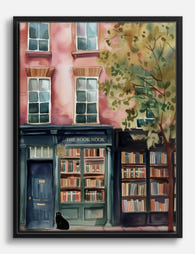
Canvas knusse boekwinkel
Aanbiedingsprijs Vanaf €65,95€93,95 -

Canvas aquarel met zachtroze bloemen
Aanbiedingsprijs Vanaf €65,95€93,95 -

Canvas speelse bomen en figuren
Aanbiedingsprijs Vanaf €65,95€93,95 -

Poster lentebloemen in aquarel
Aanbiedingsprijs Vanaf €19,95€33,25 -

Canvas zwevende bloemen in blauw
Aanbiedingsprijs Vanaf €65,95€93,95 -

Canvas kleurrijke boekenstapel
Aanbiedingsprijs Vanaf €65,95€93,95 -

Poster Painted Ladies San Francisco skyline
Aanbiedingsprijs Vanaf €19,95€33,25 -

Canvas violet en groen van Kandinsky
Aanbiedingsprijs Vanaf €65,95€93,95 -

Poster zwevende aquarelbloemen in dromig blauw
Aanbiedingsprijs Vanaf €19,95€33,25 -

Poster kleurrijke boekenstapel met planten
Aanbiedingsprijs Vanaf €19,95€33,25 -

Canvas dromerige vijver
Aanbiedingsprijs Vanaf €65,95€93,95 -

Canvas met kleurrijke bloemen in oranje en paars
Aanbiedingsprijs Vanaf €65,95€93,95 -

Canvas zachtroze aquarel bloemen
Aanbiedingsprijs Vanaf €65,95€93,95


Meer van The Frame

You're Overthinking Art Above Your Sofa
The blank wall above your sofa isn't a maths problem. It's a mood decision, a colour decision, and a "what do I actually want to look at every evening" decision....

Our Favourite Art Prints for Bedrooms That Help...
Bedroom art is the one place in your home where a "statement piece" is usually the wrong instinct. The job here is quieter, and getting it right means unlearning most...

Vintage Rose Prints: From Botanical Illustratio...
Vintage rose prints are having a proper moment. Not the dusty, chintzy kind your nan had over the settee, but the considered, well-framed kind that anchor a modern room and...