
 Bestel vandaag, levering vóór
 Why William Morris Gallery Walls Work Better with Fewer Prints
The counterintuitive rules for arranging Victorian botanical prints without creating a wall that fights itself.


Morris prints are dense, layered, and full of movement. Hang too many together, or hang them wrong, and a wall meant to feel romantic ends up feeling exhausting. This guide solves that.
Why Morris prints are ideal for gallery walls (and the one pitfall to avoid)
Morris designs are made for repetition. The patterns were originally produced as wallpapers and textiles, drawn to tile endlessly across a surface, so when you group them on a wall you're working with their natural language. The botanical motifs share a visual DNA: curling stems, layered foliage, birds tucked into leaves, a flatness inherited from medieval tapestry. That shared grammar is what lets a Strawberry Thief sit next to a Pimpernel without looking like they were chosen by two different people.
The pitfall is volume. Most generic gallery wall advice tells you to fill the wall, mix freely, layer your patterns. That advice was written for minimalist line art and black and white photography. Morris prints carry roughly three times the visual weight of a minimal print, which means a six-piece grid that would look balanced with abstract art looks frantic with Morris. The rule we keep coming back to: fewer prints, more breathing room, tighter colour discipline.
If you're new to the work, our William Morris print collection is a useful starting point for seeing the full range before you commit to a grouping.

Choosing a colour thread: grouping prints by palette, not just pattern
The single most useful framework we can give you is this: choose your prints by colour thread first, pattern second.
A colour thread is the shared palette running through your selection. Morris worked in distinct colour families across his career, and once you start looking, they're easy to spot. Acanthus in indigo and olive belongs to one world. Honeysuckle in coral and cream belongs to another. Trellis in sage, rose, and ivory belongs to a third. Mix prints across these worlds and your wall fights itself, no matter how lovely each piece is individually.
How to identify a colour thread
Look at the background colour first. This is the largest area of pigment on each print and the colour your eye registers from across the room. Then look at the two or three dominant motif colours. If three prints share a background tone (say, a soft cream or a deep teal) and at least one motif colour in common, they're on the same thread.
The four palettes that recur most
- Indigo and olive: Acanthus, Pimpernel, Snakeshead. Moody, library-feeling.
- Sage and rose: Trellis, Willow Bough, Brer Rabbit. Soft, English-cottage.
- Coral and cream: Honeysuckle, Daffodil, Marigold. Warmer, more decorative.
- Charcoal and ochre: Strawberry Thief in darker colourways, Bird and Pomegranate. Saturated and graphic.
Pick one thread. Stay in it. You can break this rule, but you need to know why you're breaking it, and you need to use a neutral print (a botanical study, a single specimen on cream) as the bridge.
The three layouts that work best with Morris designs
Forget the eight-piece salon-style gallery wall. Morris patterns need space, and they look best in one of three configurations.
1. The horizontal row
Three prints in a row, same size, same frame, even spacing. This is the most foolproof Morris layout and the one we recommend if you've never built a gallery wall before. It works above a sofa, a sideboard, a bed, or along a hallway. The repetition of frame and spacing creates calm, which lets the patterns inside the frames do the talking.
Best for: living rooms, hallways, above a console. Pair it with a william morris prints set of 3 chosen from a single colour thread.
2. The asymmetric trio
One large print flanked by two smaller prints stacked vertically on one side. This is the layout to use when you want movement without chaos. The large print anchors the composition; the stacked pair adds rhythm. It suits taller walls and works particularly well in bedrooms above a chest of drawers.
3. The tight grid
Four prints, two by two, identical sizes, matching frames, 5cm gaps. This is the most formal option and the best choice for narrow patterns that benefit from being read as a unit (Willow Bough, Larkspur, Fruit). Avoid grids of six or more with Morris work. The density compounds.

Size combinations: mixing large and small prints with confidence
Morris patterns are designed to be read at multiple distances. The overall composition reads from across the room; the bird hidden in the foliage reads from a metre away; the brushwork on a single petal reads from close up. Sizing your prints well means giving the eye different distances to settle at.
Here are the combinations we'd actually recommend:
Horizontal row, modest wall (160 to 200cm wide):
Three prints at 40x50cm each, with 5cm gaps. Total visible width around 130cm. Frame this above a 160cm sofa and you're hitting the two-thirds rule cleanly.
Horizontal row, generous wall (220cm+):
Three large william morris prints at 50x70cm or 60x80cm. This is the configuration we'd use above a long sideboard or a king-size bed. At this scale, the patterns become architectural.
Asymmetric trio:
One 70x100cm print paired with two 30x40cm prints stacked vertically. Leave 5cm between the small prints and 8cm between the small stack and the large print. The slightly wider gap stops the composition from reading as a four-piece grid.
Tight grid:
Four prints at 40x40cm or 50x50cm (square formats hold a grid better than rectangles). Identical frames, identical spacing, identical mat widths if you're using mats.
A note on print quality at large sizes: Morris's intricate detail demands proper resolution and pigment depth. At 70x100cm, a poorly printed Morris reveals every weakness, banded skies, muddy greens, soft outlines. Giclée printing on thick matte paper holds the detail; cheaper digital printing on thin stock doesn't. This matters more with Morris than with almost any other category of botanical art prints.
Frame consistency: why matching frames matter more than matching prints
This is the rule most people get wrong, and it's the one that fixes the largest number of failed gallery walls.
When your prints are visually quiet (think minimal line drawings), you can vary your frames for interest. When your prints are visually loud (Morris, vintage botanical, Victorian textile reproductions), your frames must be identical. Identical material, identical width, identical finish. The frames are the only visual element holding the composition together. Vary them and the wall has no anchor.
The three frame finishes that work with Morris
- Natural oak: Warm, honest, sits beautifully alongside the sage and rose palette. Our default recommendation for most rooms.
- Black: Graphic and modern. Works particularly well with the indigo and olive palette and stops Morris from feeling twee in contemporary interiors.
- Dark walnut or stained oak: Traditional, library-feeling. Best with charcoal and ochre prints or in rooms with existing dark wood.
Avoid ornate gilt frames, distressed finishes, and anything with carved detail. Morris already has enough going on inside the rectangle. The frame's job is to contain, not to compete.
Frame width should be thin to moderate, roughly 2 to 3cm. Anything wider starts to fight the pattern for attention.
One practical note worth mentioning: poorly fitted framing is the single biggest failure point in this category. Frames shipped separately from prints, warped mounts, bubbling under the glaze, prints that arrive misaligned in the window. We ship frame and print together in one box, properly fitted, with the UV-protective acrylic glaze already in place, which matters when you're hanging three or four pieces that need to look like a set rather than a collection of near-misses.

Step-by-step hanging guide with measurements
Step 1: Measure your wall and find the centre
Identify the horizontal centre of the wall (or of the furniture below the artwork). All composition planning starts from this vertical line.
Step 2: Set the centre height at 145 to 150cm
Gallery convention puts the centre of the composition (not the top of the highest print) at 145 to 150cm from the floor. Above furniture, leave 15 to 20cm between the top of the furniture and the bottom of the lowest print.
Step 3: Apply the two-thirds rule
Your full composition (outer edge to outer edge) should span roughly two-thirds the width of the furniture below it. Wider feels heavy; narrower feels stranded.
Step 4: Build a paper template
Cut newsprint or brown paper to the exact dimensions of each frame. Lay the templates on the floor and arrange them. Take a photo from directly above. Adjust spacing until it reads cleanly, then tape the templates to the wall with low-tack masking tape.
For Morris specifically: step back two metres and squint. If the patterns blur into one indistinguishable mass, your spacing is too tight. Add 2 to 3cm to each gap and reassess.
Step 5: Mark the fixings through the paper
Each Fab framed print arrives with fixtures attached. Hold a frame against its paper template, measure from the top of the frame to the hanging point, and transfer that measurement to the paper. Mark, drill, hang. Then tear the paper away.
Step 6: Check from across the room
Always assess gallery walls from the position you'll most often see them from (the sofa, the bed, the doorway). Adjustments made at arm's length almost always look wrong from across the room.
Three ready-made Morris gallery wall combinations you can copy
These are the combinations we'd actually pick. Each works as a set of 3 wall art grouping built around a single colour thread.
The English Garden (sage and rose thread)
- Willow Bough (centre), 50x70cm
- Trellis (left), 40x50cm
- Brer Rabbit (right), 40x50cm
Natural oak frames, 5cm spacing, asymmetric trio layout. Best in living rooms with linen upholstery, warm whites, and either oak or rattan furniture.
The Library (indigo and olive thread)
- Acanthus (left), 50x70cm
- Pimpernel (centre), 50x70cm
- Snakeshead (right), 50x70cm
Black frames, 5cm spacing, horizontal row. Suits darker rooms, deep wall colours (forest green, navy, oxblood), and traditional joinery.
The Conservatory (coral and cream thread)
- Honeysuckle (top left), 40x40cm
- Marigold (top right), 40x40cm
- Daffodil (bottom left), 40x40cm
- Fruit (bottom right), 40x40cm
Natural oak or warm walnut frames, 5cm spacing, 2x2 grid. Works in breakfast rooms, sunrooms, and anywhere with plenty of natural light.

Troubleshooting: my wall looks too busy
Three things to check, in this order.
Colour thread: Are all your prints sharing a background tone and at least one motif colour? If you have one print with a cream background and two with deep indigo backgrounds, that's your problem. Swap the outlier.
Frame consistency: Are your frames identical in material, width, and finish? If not, this is almost certainly the issue. Replacing frames is cheaper than replacing prints.
Spacing: Is there at least 5cm between frames, ideally 6 to 7cm for larger prints? Morris patterns need more breathing room than minimal art. Tight spacing that works for line drawings will look claustrophobic with Acanthus.
If you've checked all three and the wall still feels busy, you probably have one print too many. Take the least essential piece down and live with the gap for a week. Most of the time, you won't put it back.
A final thought
The instinct with Morris is always to add. One more print, one more pattern, one more frame. Resist it. The reason these designs have survived a hundred and fifty years is that each one is already complete. Your job isn't to compose a symphony out of them. Your job is to give three or four of them enough wall to breathe, identical frames to hold them together, and a single colour thread to make them feel like a thought rather than a collection. Do that, and the wall does the rest of the work on its own.

Fab-producten in dit blog
-
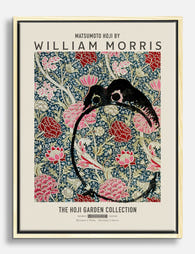
Canvas William Morris tuinbloemen
Translation missing: nl.products.product.sale_price Vanaf €64,95€92,95 -

Canvas William Morris florale elegantie
Translation missing: nl.products.product.sale_price Vanaf €64,95€92,95 -

Canvas William Morris Wallflower (blauw)
Translation missing: nl.products.product.sale_price Vanaf €64,95€92,95 -

Poster Brits platteland in William Morris-stijl
Translation missing: nl.products.product.sale_price Vanaf €19,95€33,25 -

Canvas drie klassieke katten in William Morris-stijl
Translation missing: nl.products.product.sale_price Vanaf €64,95€92,95 -

Poster bloemenpatroon in William Morris-stijl
Translation missing: nl.products.product.sale_price Vanaf €19,95€33,25 -

Canvas met bloemenpatroon in William Morris-stijl
Translation missing: nl.products.product.sale_price Vanaf €64,95€92,95 -

Poster bloemenharmonie in William Morris-stijl
Translation missing: nl.products.product.sale_price Vanaf €19,95€33,25 -

Poster William Morris bloemen en vogels
Translation missing: nl.products.product.sale_price Vanaf €19,95€33,25 -

Canvas William Morris bloemenmotief in groen
Translation missing: nl.products.product.sale_price Vanaf €64,95€92,95 -

Poster groene vogels van William Morris
Translation missing: nl.products.product.sale_price Vanaf €19,95€33,25 -

Poster bloemen in William Morris-stijl
Translation missing: nl.products.product.sale_price Vanaf €19,95€33,25 -

Poster bloemrijke elegantie in William Morris-stijl
Translation missing: nl.products.product.sale_price Vanaf €19,95€33,25 -

Poster vogels en bloemen – William Morris
Translation missing: nl.products.product.sale_price Vanaf €19,95€33,25 -

Poster wallflower van William Morris
Translation missing: nl.products.product.sale_price Vanaf €19,95€33,25 -

Poster botanisch patroon in William Morris-stijl
Translation missing: nl.products.product.sale_price Vanaf €19,95€33,25 -

Poster rozen in William Morris-stijl
Translation missing: nl.products.product.sale_price Vanaf €19,95€33,25 -

Canvas William Morris bloemenmotief
Translation missing: nl.products.product.sale_price Vanaf €64,95€92,95 -

Canvas William Morris Cray bloemenpatroon
Translation missing: nl.products.product.sale_price Vanaf €64,95€92,95


Meer van The Frame

What to Hang in Awkward Corners
Corners are the dead zones of most homes. Your eye skims past them, furniture refuses to sit flush against them, and you end up with a triangular patch of wall...

Art for Narrow Walls and Hallways
Narrow walls are the most under-decorated surfaces in most homes. Not because they're hard to style, but because most advice treats every awkward space as the same problem when really...

What to Put on a Big Blank Wall
Big blank walls feel impossible because they multiply your options instead of narrowing them. Every idea seems plausible, nothing feels right, and the wall stays empty for another six months....