
 Beställ idag, leverans senast
 From Victorian Textiles to Your Wall: The Story of the Fox in Art
How a humble woodland creature went from Victorian curiosity to one of the most quietly enduring motifs in interior design.


The fox has been hiding in plain sight for over 150 years, slipping from Victorian tapestries to wallpapers to the walls of your living room. Its appeal isn't accidental. Understanding where the fox came from in decorative art makes choosing a print for your home a far less arbitrary decision.
The Fox in Victorian Decorative Art: More Than a Hunting Trophy
The Victorian obsession with foxes started, unhelpfully, with hunting culture. The fox appeared in sporting paintings, on commemorative ceramics, in trophy panels and on country house walls as a symbol of rural gentry and the pursuit of game. Artists like Jacques-Laurent Agasse produced careful naturalist studies, treating the fox as a specimen rather than a character.
But Victorian decorative art was always pulling in two directions. On one side: the documentary impulse, the natural history illustration, the Linnaean cataloguing of British wildlife in coloured plates. On the other: the medieval revival, the Gothic, the rejection of industrial uniformity that would eventually produce the Arts and Crafts movement.
The fox sat awkwardly between the two. It was a real animal, native to British woodland, familiar enough to be sentimental about. It was also a symbol with deep folkloric roots, appearing in medieval bestiaries as a creature of cunning, mischief and transformation. Victorian designers who wanted to break away from sporting art and trophy culture found something useful in that older symbolism.
This is the context that produces victorian fox art as we recognise it today: not the dead fox draped over a hunter's saddle, but the living fox glimpsed between ferns, woven into pattern, treated as part of a domestic landscape rather than a quarry.

How William Morris Turned the Fox Into a Design Icon
William Morris is the figure who matters most here, and the story is more interesting than the search results suggest. Morris himself didn't produce the famous "Morris fox" that everyone is looking for. That credit belongs to John Henry Dearle, Morris's protégé and eventual successor at Morris & Co.
The work in question is the tapestry known as The Forest (or Greenery), woven in 1887 from a design by Morris with the animals contributed by Philip Webb and the dense foliage by Dearle. A fox sits among a lion, a hare, a peacock and a raven, surrounded by acanthus leaves so layered they almost swallow the creatures whole. It is the closest thing to a definitive "Morris fox" that exists.
What Morris did, philosophically, was refuse the choice between scientific accuracy and decorative flatness. The Arts and Crafts movement rejected mass-produced industrial decoration in favour of hand craftsmanship, medieval inspiration and motifs drawn directly from English nature. Morris wanted animals in his work because animals belonged in English fields and forests, not because they made nice illustrations.
The result is recognisable across all genuine william morris fox designs: symmetrical composition, flat decorative colour, heavy botanical integration, a medieval influence in how the creatures are styled, and an absolute commitment to surface pattern over illusionistic depth. The fox is never just a fox. It is part of a woven world.
What separates a real Morris aesthetic from "Morris-inspired"
A lot of what is sold today as "William Morris fox" is interpretation rather than reproduction. That isn't necessarily bad. Some interpretations are gorgeous and honour the original spirit. But it helps to know what you're looking at.
Authentic Morris aesthetics tend to share these qualities:
- Dense, edge-to-edge botanical pattern with no empty background
- Flat, slightly muted colour palettes built around indigo, madder red, sage green and ochre
- Medieval-style stylisation of figures, never photorealism
- Symmetry or rhythmic repetition across the composition
If a "Morris fox" print shows a naturalistic fox on a plain cream background with a few scattered leaves, it's borrowing the name, not the philosophy.
Art Nouveau and the Fox: A Different Take
It's worth pausing on Art Nouveau because the periods overlap and the styles get conflated constantly. Art Nouveau emerged roughly a decade after Morris's mature work, peaking around 1890 to 1910, and shared the Arts and Crafts rejection of industrial ugliness. But the visual language is different.
Where Morris is flat, medieval and symmetrical, an art nouveau fox print tends to be flowing, asymmetric and built on the famous "whiplash" curve. Think Mucha's organic line work or the sinuous metalwork of Hector Guimard. When Art Nouveau artists depicted animals, they used them as anchors for swirling decorative lines, often paired with stylised long-stemmed flowers, hair, smoke or water.
A genuine Art Nouveau fox print, then, will feel restless and elegant rather than dense and rooted. The colour palette is often paler, with gold accents, soft greens and dusty pinks. The composition usually has a single dominant curve sweeping through the image.
For your wall, this matters. Art Nouveau foxes suit rooms with some breathing space and a slightly more theatrical edge. Morris foxes prefer enclosure, layered textiles and the visual density of a proper Victorian parlour.

Why the Fox Is Having a Moment in Modern Interiors
The fox is everywhere again, and the reasons are partly aesthetic and partly cultural. Cottagecore, dark academia, the broader return to maximalism and the rejection of cold minimalist interiors have all created appetite for motifs that feel rooted, narrative and slightly old-fashioned.
The fox also occupies a useful middle ground. It's wild without being threatening, British without being twee, decorative without being childish. You can put a fox print in a child's bedroom or above a drinks cabinet and it will work in both rooms for completely different reasons.
There's a more practical answer too. After a decade of abstract shapes and minimalist line drawings dominating wall art, the eye is hungry for detail. A well-printed Victorian fox illustration, with its fine engraving lines and rich background foliage, gives you something to actually look at. It rewards proximity.
This is one of the small but real arguments for printing on thick matte paper with high-resolution giclée, especially for historical reproductions. Cheap printing flattens the cross-hatching and crushes the shadows. Done properly, with archival inks and proper resolution, the detail in a Victorian illustration reads as crisply on your wall as it did in the original portfolio.
The "gentleman fox" trend, briefly
You will have seen the anthropomorphic fox in a top hat and tweed waistcoat. It's a contemporary digital genre with nothing to do with Victorian art, though it borrows the aesthetic surface. There's nothing wrong with it if you love it. Just know it isn't historical, and it isn't Morris. It's a modern cottagecore and steampunk hybrid trading on Victorian visual cues.
Vintage vs. Contemporary Fox Prints: Which Suits Your Home
The honest answer is that they suit different rooms and different temperaments. Here's how we'd think about it.
Pick a vintage fox art print (genuine Victorian naturalist illustration or a faithful reproduction) if your home leans traditional, layered or scholarly. These prints sit beautifully against painted panelling, in studies with built-in shelving, in dining rooms with deep wall colours. They suit antique furniture without making the room feel like a museum.
Pick a Morris-style decorative fox if your home is maximalist, pattern-rich or already includes Arts and Crafts elements. These work in living rooms with patterned upholstery, in hallways with wallpaper, in bedrooms where you want the walls to feel enclosed and intentional.
Pick a modern interpretation if you want the fox motif without the historical weight. Cleaner illustration styles work in Scandinavian-leaning interiors, in children's rooms, in kitchens and in spaces where you want a single graphic element rather than an immersive aesthetic.
A note on telling genuine Victorian work from modern digital pastiche: real Victorian illustrations, even reproduced, show their printing heritage. You see engraving lines, lithographic stippling, the slight unevenness of hand-coloured plates. Modern AI-generated "Victorian" foxes tend to be too smooth, with the symmetry slightly off and the foliage oddly generic. If you're shopping for the historical look, look at the detail close up before you buy.
Where to Hang a Fox Print for Maximum Impact
Fox prints reward a bit of thought about placement. They are mid-tone, often dense with detail, and they want a wall that lets them be looked at.
Above a fireplace is the obvious answer and it works, especially for a single larger piece at around 60x80cm or 70x100cm. Centre the print so the fox's eye sits roughly at standing eye level, which usually means the centre of the artwork lands about 145cm to 150cm from the floor.
In a hallway at the end of a sightline, a fox print stops you on the way past. Hallways often have less furniture competing for attention, so a more detailed image gets to breathe. Framed prints work especially well here because they survive the everyday knocks of coats and bags better than unframed canvas.
Above a bed the fox should feel calming rather than confrontational, so vintage botanical-style illustrations work better than direct-gaze portraits. Pair with a smaller botanical or two on either side at a third of the scale.
In a dining room with deep walls (forest green, oxblood, navy), a Morris-style fox in a dark wood frame becomes the room's quiet centrepiece. The UV-protective glaze matters here if the room gets afternoon sun, because rich earth tones are exactly the colours that fade fastest under direct light.

Building a small gallery wall around a fox
If you want to build out from a single fox print, the rule we use is to mix one statement piece with two or three quieter companions. Botanical illustrations, hand-drawn maps, vintage ornithology plates and Morris-pattern fragments all work. Keep frames consistent (all dark wood, or all black) even if the prints themselves vary in style. The visual coherence comes from the framing, not the imagery.
For a mantelpiece or sideboard arrangement, lean rather than hang. A 50x70cm framed fox print leaning at the back with two smaller framed botanicals leaning in front gives you the gallery feel without committing to hooks.
Our Favourite William Morris Fox Prints Right Now
The fox motifs that travel best from the Morris and Morris & Co. canon into contemporary homes are the dense, foliage-heavy compositions: anything that takes the spirit of The Forest tapestry and translates it into a print you can actually hang. Look for designs where the fox is woven into the pattern rather than isolated against blank space. That integration is the whole point.
A few favourites worth seeking out in the william morris art prints collection:
- A faithful reproduction of The Forest tapestry detail, with the fox visible among the foliage. Best in a generous size, framed, on a deeper wall colour.
- Acanthus-based compositions with woodland creature motifs. These read as classically Morris and sit beautifully above sideboards or in studies.
- Strawberry Thief variations that include fox or hare figures. The indigo and madder palette is unmistakeable and pairs with almost any wood tone.
For a more direct, single-subject approach, the broader fox art prints collection includes vintage naturalist reproductions that work in entirely different rooms: less pattern, more portrait, suited to traditional or country-style interiors.

A final thought
The fox endures in decorative art because it carries more than its image. It's a piece of Victorian medievalism, a survivor of Arts and Crafts philosophy, a quiet rebellion against rooms that look like everyone else's. Choose the version that fits your house, hang it where you'll actually look at it, and let the print do the work it was always designed to do.

Fab-produkter som visas i denna blogg
-

Poster räv med blommönster – inspirerad av William Morris
Translation missing: sv.products.product.sale_price Från £11.95£19.95 -

Poster räv i William Morris-stil
Translation missing: sv.products.product.sale_price Från £11.95£19.95 -
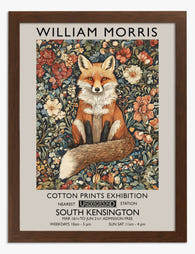
Poster räv av William Morris
Translation missing: sv.products.product.sale_price Från £11.95£19.95 -

Poster räv inspirerad av William Morris
Translation missing: sv.products.product.sale_price Från £11.95£19.95 -

Poster räv i William Morris-stil
Translation missing: sv.products.product.sale_price Från £11.95£19.95 -

Canvastavlor räv med blommönster i William Morris-stil
Translation missing: sv.products.product.sale_price Från £44.95£74.95 -

Canvastavlor blommig räv i William Morris-stil
Translation missing: sv.products.product.sale_price Från £44.95£74.95 -

Canvastavlor räv av William Morris
Translation missing: sv.products.product.sale_price Från £44.95£74.95 -

Poster räv i William Morris-stil
Translation missing: sv.products.product.sale_price Från £11.95£19.95 -

Poster räv bland ängsblommor – William Morris
Translation missing: sv.products.product.sale_price Från £11.95£19.95 -

Canvastavlor med röd räv i William Morris-inspirerat blommönster
Translation missing: sv.products.product.sale_price Från £44.95£74.95 -

Poster räv bland blommor, Morris
Translation missing: sv.products.product.sale_price Från £11.95£19.95 -

Canvastavlor räv och flora av William Morris
Translation missing: sv.products.product.sale_price Från £44.95£74.95 -

Canvastavlor rävillustration av William Morris
Translation missing: sv.products.product.sale_price Från £44.95£74.95 -

Canvastavlor räv och blommor i William Morris-stil
Translation missing: sv.products.product.sale_price Från £44.95£74.95 -

Poster räv i frodigt blommönster – Morris
Translation missing: sv.products.product.sale_price Från £11.95£19.95 -

Poster räv och flora i William Morris-stil
Translation missing: sv.products.product.sale_price Från £11.95£19.95 -

Canvastavlor röd räv bland blommor – William Morris
Translation missing: sv.products.product.sale_price Från £44.95£74.95 -

Poster William Morris räv i botaniskt mönster
Translation missing: sv.products.product.sale_price Från £11.95£19.95 -

Poster vinterräv av William Morris
Translation missing: sv.products.product.sale_price Från £11.95£19.95


Mer från The Frame

What Interior Stylists Know About Botanical Win...
Botanical window art is a specific subgenre: prints that frame foliage, flowers, or garden scenes as if viewed through a real window. Styled well, it borrows light, adds depth, and...

Living Room Botanical Prints: The Right Way to ...
Botanical prints are one of the most forgiving categories of wall art to choose, and one of the easiest to ruin with bad framing. A warped frame, the wrong glazing,...

Why William Morris Animal Prints Work in Modern...
Morris's floral patterns get all the attention, but his animal designs are quietly the easier win. A fox or a hare gives your eye somewhere to land, which means these...