


 Order today for delivery by
 How to Build an Architecture Gallery Wall That Actually Looks Curated
The secret most interior designers won't tell you: architecture prints do most of the curation work for you.


Gallery walls intimidate people because they look like they require a designer's eye. They don't, especially if you choose architecture as your subject. The geometry, repetition, and structural language of buildings give you visual cohesion almost for free, which is why a wall of cityscapes, façades, and floor plans tends to look considered even when you've barely tried.
Why architecture is one of the best subjects for a gallery wall
Most gallery wall advice ignores subject matter entirely, which is strange because subject matter is doing half the work. Mix a botanical print with an abstract, a portrait, and a landscape and you'll spend hours fighting to make them feel like they belong together. Architecture prints arrive pre-coordinated.
Buildings share a visual vocabulary. Vertical lines, horizontal cornices, repeating windows, geometric symmetry. A photograph of the Barbican and an illustration of a Parisian apartment block have almost nothing in common stylistically, and yet they rhyme, because both are organised around the same structural grammar.
That built-in consistency means you can mix mediums (photography, illustration, blueprints, line drawings) more freely than with any other subject. It's the cheat code of gallery wall design, and almost nobody talks about it.
Pick your anchor: start with one large print and build around it
Every gallery wall that looks curated has an anchor. One print, noticeably larger than the rest, that the eye lands on first. Without an anchor, the eye has nowhere to rest and the whole wall reads as busy.
For a standard living room or bedroom wall (around 200cm wide, above a sofa or sideboard), your anchor should be 70x100cm in portrait, or 100x70cm in landscape. That's the largest size we make framed, and it's deliberately chosen to do this job. Anything smaller and it gets outshouted by its supporting cast.
Pick the anchor first. Pick it because you love it, not because it fits a colour scheme. Everything else is built around this one piece, so it has to earn its place.

Choosing a unifying thread
Once you have your anchor, the next decision is what holds the rest of the wall together. You need one consistent thread, and only one. More than that and the wall starts fighting with itself.
Same city
The cleanest option. A wall of New York prints, or only Lisbon, or only Tokyo. Different photographers, different eras, different mediums, but one place. The viewer's eye stitches it together automatically.
Same era
Mid-century modernist buildings. Art Deco façades. Victorian terraces. Choosing an era gives you stylistic range across cities (Brasília, Palm Springs, Tel Aviv all sit happily together if you stick to mid-century) while keeping a clear visual signature.
Same colour palette
The most flexible thread. Pick three colours and source prints that live within them. Warm sandstone and ochre for a Mediterranean feel. Cool greys and blacks for black and white architecture. Concrete tones and deep teals for a more industrial mood.
Same frame
If your prints are visually varied, let the frame do the unifying. Identical black frames, identical oak frames, identical white frames. We'll come back to this, because it's the most common place people go wrong.
Pick one. Don't try to do all four.
The layouts that work
There are three layouts that consistently look curated, and each suits a different mood. Here are the dimensions that actually work, not just the principles.
The grid
Symmetrical, calming, slightly formal. Best for photography-led walls where you want the images to feel like a single considered series. Use identical frame sizes throughout.
For a 200cm wall, a 3x2 grid of 50x70cm framed prints works beautifully. Total footprint roughly 165cm wide by 155cm tall, with 5cm gaps between frames. Or a 4x2 grid of 40x50cm prints, totalling 175cm wide by 110cm tall.
The grid is the easiest layout to hang and the hardest to get wrong. If you've never built a gallery wall before, start here.
The salon
Asymmetrical, dense, slightly maximalist. This is the layout people picture when they hear "gallery wall." It's also the one that looks worst when poorly executed.
Salon walls work best with 5, 7, 9, or 12 pieces. Odd numbers feel more dynamic, but 12 in a roughly rectangular cluster is a reliable formula. Mix sizes: one anchor at 70x100cm, two mid-size pieces at 50x70cm, and the rest at 30x40cm or 40x50cm.
Maintain 5 to 7cm of breathing room between frames. Less and it looks cramped. More and the cluster falls apart into individual prints.
The asymmetric line
Two or three larger pieces along a horizontal axis with smaller prints staggered above and below. Modern, architectural, well suited to long walls or hallways.
For a 200cm wall, try a 70x100cm anchor on the left, a 50x70cm to its right at the same baseline, and three 30x40cm prints staggered around them. Keep the bottom edge of your two largest prints aligned. That single horizontal line is what stops the layout collapsing into chaos.

Mixing architectural photography with illustrated or graphic pieces
This is where architecture earns its keep as a subject. You can mix a high-contrast black and white photograph of a Manhattan skyline with a hand-drawn illustration of a Bauhaus building and a flat graphic poster of the Sydney Opera House, and the wall will still feel coherent.
The reason is structural. All three pieces are organised around the same kind of lines. The eye registers the shared geometry before it registers the difference in medium.
A few rules of thumb when mixing mediums. Keep the proportion roughly 60% photography, 30% illustration, 10% graphic or typographic. If you flip those ratios, the wall starts to feel like a poster collection rather than a gallery. And if you're including any text-based prints (blueprints, architectural drawings with annotations, typographic city posters), limit them to one or two pieces total.
Floor plans and architectural blueprints are an underrated addition. They bring a different visual texture (line drawings on neutral backgrounds) and immediately signal that the wall is about architecture as a subject, not just pretty buildings. One blueprint among five photographs adds depth.
Browse architecture art prints with a mix in mind, then narrow to your unifying thread.
Frame colour and consistency
Here is the rule that designers repeat constantly and that home decorators ignore most often: match all your frames, or accept that your wall will look messy.
There are exceptions. Three, specifically.
Exception one: all-black frames mixed with all-natural-oak frames, in a roughly 70/30 ratio, on a white wall. This works because both are quiet, neutral, and the contrast feels intentional.
Exception two: unframed canvas prints mixed with framed prints, where the canvases bring textural variety rather than competing colour. The smooth matte finish of a stretched canvas next to a framed print can be lovely if the frames are consistent.
Exception three: when you're doing a deliberately eclectic, vintage-inspired salon wall and the frame variety IS the point. This is hard to pull off and not what most people want.
Outside of those, pick one frame colour. Black is the safest for cityscape prints and high-contrast photography. Natural oak warms up black-and-white work and suits softer interiors. White frames disappear into pale walls and let the prints do the talking.
We use solid FSC-certified wood frames with UV-protective acrylic glaze rather than glass, which matters more than people realise on a gallery wall. Glass is heavy, reflective, and prone to glare from multiple angles, which is exactly the problem when you have eight pieces catching light from different positions. Acrylic stays clear and weighs a fraction.
Common mistakes that make gallery walls look messy instead of curated
Too many styles. Mixing a watercolour, a vintage poster, a modern photograph, and an abstract is the fastest way to lose cohesion. Stick to your unifying thread.
No anchor. Six prints all the same size, hung in a vague cluster, with nowhere for the eye to land. Even a grid needs visual hierarchy somewhere in the room (often supplied by furniture below it).
Inconsistent spacing. Some frames 3cm apart, some 10cm apart. The eye reads the gaps as much as the prints, and uneven gaps make the wall feel accidental.
Hung too high. The centre of your gallery wall (the visual midpoint of the whole arrangement) should sit roughly 145 to 150cm from the floor. Above a sofa or sideboard, the bottom edge of the lowest frame should be 15 to 20cm above the furniture. Most people hang everything too high.
Wall too empty. Your gallery wall should cover roughly 60 to 75% of the width of the furniture beneath it. A 200cm sofa wants a gallery wall around 130 to 150cm wide. Anything smaller looks lost.
Mixing frame colours without intent. Already covered, but worth repeating because it's the single most common mistake.

The paper template method
Before you put a single nail in the wall, do this. Cut sheets of newspaper or kraft paper to the exact dimensions of each frame. Tape them to the wall with low-tack masking tape in the layout you're considering.
Live with it for 24 hours. Walk past it. Look at it from the sofa, from the doorway, in morning light and evening light. Move pieces around. This costs nothing and saves you hanging things twice.
When you're happy, mark the top centre of each paper template with a small pencil dot, then remove the paper and hang the frame to that mark. This is how professional installers work, and it's the single biggest difference between a gallery wall that lands first time and one that gets re-hung repeatedly.
A ready-made template for a 200cm-wide wall
Here is a layout that works above a 200cm sofa or sideboard. Seven prints, salon-style, with one anchor.
- Anchor: one 70x100cm portrait print, positioned slightly left of centre, with its centre 150cm from the floor.
- Upper right of anchor: one 50x70cm portrait print, top edge aligned with the top of the anchor.
- Lower right of anchor: one 50x70cm landscape print, bottom edge aligned with the bottom of the anchor.
- Far right column: two 30x40cm prints stacked vertically, one above the other with 6cm between them.
- Above the anchor: one 40x50cm landscape print, 6cm above the anchor's top edge.
- Below the anchor: one 40x50cm landscape print, 6cm below the anchor's bottom edge.
Total wall coverage roughly 175cm wide by 155cm tall. Maintain 5 to 7cm spacing throughout. Use identical frames in black or oak.
This works for cityscapes, for a single-city tour (six views of London plus one anchor), or for an era-based collection. If you'd rather buy a coordinated set rather than build one print by print, our wall art sets are designed to work as cohesive groupings out of the box.

A final thought
Gallery walls fail when people treat them as a collection of individual decisions. They succeed when you treat them as one decision (the unifying thread) followed by a lot of measuring. Pick your thread, pick your anchor, paper-template the layout, and match your frames. The architecture will do the rest.

Fab products featured in this blog
-

Bauhaus Ausstellung 1923 Teal Arch Canvas Print
Sale price From €66,95€94,95 -

Modern Geometric Haven Canvas Print
Sale price From €66,95€94,95 -

Split Arch in Black and Cream Canvas Print
Sale price From €66,95€94,95 -

Split Arch in Terracotta and Cream Canvas Print
Sale price From €66,95€94,95 -

Yellow Villa with Cypress Canvas Print
Sale price From €66,95€94,95 -

Bauhaus Summer Vibes Canvas Print
Sale price From €66,95€94,95 -

Red Tower on Dusty Blue Art Print
Sale price From €16,95€23,95 -

Split Arch in Black and Cream Art Print
Sale price From €16,95€23,95 -

Tower on Terracotta Canvas Print
Sale price From €66,95€94,95 -

Park Güell Barcelona Cityscape Canvas Print
Sale price From €66,95€94,95 -
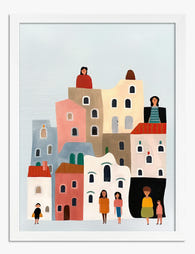
Little Town, Tall Houses Art Print
Sale price From €16,95€23,95 -

Bauhaus Ausstellung 1923 Pink Arch Canvas Print
Sale price From €66,95€94,95 -

Street Lamp Cut-Out Cityscape Canvas Print
Sale price From €66,95€94,95 -

Bauhaus Ausstellung 1923 Pink Arch Art Print
Sale price From €16,95€23,95 -

Arches and Bowls Abstract Canvas Print
Sale price From €66,95€94,95 -

Stacked Arch and Sun Canvas Print
Sale price From €66,95€94,95


More from The Frame

What Are Botanical Prints? From 17th-Century Sc...
Botanical prints are detailed, scientifically accurate depictions of plants, originally created to help botanists identify species before photography existed. What began as working documents for scientists in the 1600s has...

The Best Art for an Entryway: What to Hang, Whe...
Your entryway is the first thing you see when you come home and the first thing guests see when they arrive. It's also, for most people, the last wall in...

Beatrix Potter Prints Beyond the Nursery: 5 Roo...
Beatrix Potter was a trained mycologist whose scientific fungi illustrations are held in the Armitt Museum, and whose original watercolours sell for six-figure sums at auction. Treating her work as...