
 Order today for delivery by
 How to Hang Landscape Art Prints: Heights, Spacing, and the Rules Worth Breaking
Everything you need to know about hanging wide art without making holes you'll regret.


You've just unwrapped a landscape print, you're holding a pencil, and the wall is staring back at you. This guide is for that exact moment. We'll cover the rules that work, the ones to ignore, and what to do if you've already drilled in the wrong place.
Before you pick up a hammer: gather what you actually need
You don't need a workshop. You need six things, and most of them are probably in a drawer.
- A tape measure (metal, not fabric, fabric stretches and lies)
- A pencil with a soft tip that wipes off paint
- A spirit level, or the level app on your phone if the frame is small
- A roll of low-tack painter's tape
- A sheet of brown paper or newspaper big enough to trace the frame
- The right fixings for your wall (picture hooks for plasterboard, wall plugs for masonry)
The painter's tape and paper are the two tools most people skip and then regret. Tracing your frame onto paper, cutting it out, and taping the template to the wall lets you live with the placement for an hour before you commit. Stand back, sit on the sofa, walk past it on the way to the kitchen. If it still looks right after a cup of tea, drill.
One more thing worth saying out loud: holes can be filled. A bit of polyfilla and a dab of paint and the wall forgets. The pressure you're feeling is bigger than the actual stakes.

The 57-inch centre rule and when it doesn't apply
The 57-inch rule (roughly 145cm) says the centre of your artwork should sit 57 inches from the floor. It comes from gallery and museum hanging standards, where 57 inches approximates average human eye level. It works because it puts the visual heart of the piece where your eye naturally lands when you walk into a room.
To use it, measure the height of your frame and divide by two. That's the distance from the centre to the top. Subtract that number from 145cm. The result is the height the top of the frame should sit at. If your frame uses a hanging wire, pull the wire taut upward (as it'll sit when hung) and measure the gap between the top of the frame and the peak of the wire. Subtract that gap too. Mark the wall, drill, hang.
Now ignore it whenever it's wrong. The 57-inch rule assumes a blank wall and a standing viewer. It falls apart over furniture, in dining rooms where you're seated, in stairwells, and in rooms with very high or very low ceilings. If you're hanging in a lounge where you'll mostly view the art from the sofa, drop the centre to around 140cm. Eye level when seated is lower than eye level when standing, and your art should meet your eyes where they actually live.
Hanging above furniture: the two-thirds width and 15-20cm gap rule
This is the one most people get wrong, and it's the one that matters most for landscape prints because they tend to live above sofas, beds, sideboards, and consoles.
The rule, sometimes called the 2/3 rule, says your artwork should be roughly two-thirds the width of the furniture below it. If your sofa is 220cm wide, aim for art that's around 145cm wide. If your sideboard is 150cm, you want art around 100cm wide. Anything narrower looks like it's floating apologetically. Anything wider than the furniture itself starts to feel top-heavy.
For wider sofas and longer sideboards, this is exactly where large wall art earns its keep. A 100x150cm canvas above a three-seater sofa carries the visual weight the wall needs. A 40x60cm print over the same sofa looks like a postage stamp.
The second part is the gap. Leave 15 to 20cm between the top of your furniture and the bottom of the frame. Less than 15cm and the art feels like it's resting on the sofa back. More than 20cm and it floats away from the furniture, breaking the visual connection between the two.
This will often conflict with the 57-inch rule. That's fine. Above furniture, the 15 to 20cm gap wins. Always.
What to do above low-profile modern furniture
Low sofas and floor-skimming sideboards create a different problem. If you measure 20cm above a 70cm-tall sofa, your frame's bottom edge is at 90cm. A tall frame might centre at 130cm, which is below 57 inches but visually correct.
Trust the gap. The relationship between the art and the furniture matters more than an abstract number derived from a museum.
How to hang a single wide landscape print dead-centre (and level)
For one print on one wall, the process is short.
- Find the centre of the wall (or the centre of the furniture below, if there is any). Mark it lightly with pencil.
- Decide your target centre height (57 inches for blank walls, 15-20cm above furniture otherwise).
- Measure your frame's height, halve it, and add that to your centre height. That's where the top of the frame goes.
- Account for the hanging hardware. If it's a wire, measure the slack. If it's two D-rings, measure each from the top.
- Mark the hook position. Drill. Hang.
For frames wider than about 80cm, use two hooks instead of one. A single central wire on a wide frame allows it to tilt every time someone closes a door, and tiny tilts on long horizontal frames are painfully obvious. Two hooks, evenly spaced about a third of the way in from each edge, lock the frame in place.
Framed landscape prints from us arrive with fixtures already attached and the print properly fitted, so you're not assembling anything on the floor at midnight. The frame, mount, and print ship in one box, which avoids the warping and bubbling you sometimes get when prints are framed badly after the fact.

Hanging two landscape prints as a pair: spacing and alignment
Two landscape prints side by side need to feel like a unit, not two separate decisions.
Spacing depends on size. For small to medium frames (up to about 50x70cm), keep 5 to 10cm between them. For larger landscape prints (60x90cm and up), 10 to 15cm feels right. Tighter than 5cm and they read as one chaotic image. Wider than 15cm and the gap competes with the art.
Treat the pair as a single rectangle when you apply the other rules. The combined width plus the gap is what should hit two-thirds of your sofa or sideboard. The vertical centre of the pair is what should sit at 145cm or 15-20cm above furniture.
Both frames must align horizontally. Use a long spirit level laid across the top of both frames once they're up. If one's even 3mm off, you'll see it.
For prints on the same theme or by the same artist, browse our landscape art prints and look for pieces that share a colour palette or a tonal weight. Two prints with wildly different brightnesses will fight each other no matter how perfectly you space them.
Hanging landscape prints in a gallery wall arrangement
A landscape-led gallery wall is a different beast from the typical Pinterest grid of mismatched portraits. Wide prints anchor a gallery wall, so start with your largest landscape piece and build outward.
Lay everything on the floor first. Move pieces around until the arrangement feels balanced, then photograph it from directly above. Use that photo as your reference when you transfer to the wall.
Cut paper templates for every piece and tape them to the wall in the same arrangement. Live with it for a day if you can. Adjust until it looks right, then drill through the templates so your hook positions are exact.
For a triptych (three landscape prints meant to be viewed as one piece), keep the gaps tight, between 3 and 6cm. For three separate landscape prints displayed in a row, use larger gaps of 8 to 12cm so each piece reads independently. The eye should know whether it's looking at one image or three.
If you'd rather not assemble a gallery wall from scratch, our pre-curated wall art sets take the matching question off your plate. The pieces are designed to live together, so you only have to solve the hanging.
Common mistakes that make good art look wrong
Hanging too high. The single most common error. You're standing at the wall holding the frame, so anything below your shoulders feels low. Step back ten paces before you commit. If the centre looks like it's at forehead height from across the room, drop it.
Centring on the wall when you should be centring on the furniture. If your sofa isn't centred on the wall (a window, a door, a radiator pushed it sideways), your art usually shouldn't be either. Centre it on the sofa.
Ignoring architectural interruptions. Light switches, thermostats, air vents, picture rails. Don't pretend they aren't there. If a switch sits awkwardly close to your planned frame edge, shift the art 5cm to give it breathing room. The eye reads visual clutter as a mistake.
Tiny art on big walls. A 30x40cm print above a three-seater sofa looks like an afterthought. Either go bigger or add companion pieces.
Wire-only hanging on wide frames. Already mentioned, worth repeating. Two hooks for anything wider than 80cm.
Forgetting the viewing angle. Test from where you'll actually sit. Standing in front of the wall is not where you'll experience the art most of the time.

Quick fixes if you've already made a hole in the wrong spot
You drilled, you hung, it's wrong. This happens to everyone. Here's how to recover without re-painting the whole wall.
The hole is within 5cm of where you actually want the hook. Move the hook. The frame will cover the old hole entirely. Done.
The hole is visible above or beside the frame. Fill it. Lightweight polyfilla (or any interior wall filler) goes in with a finger or putty knife, dries in an hour, sands flat in two minutes. Touch up with a small amount of your wall paint using a cotton bud or tiny brush. If your paint is more than two years old, the colour has shifted slightly and the patch will show, so a wider feathered touch-up looks better than a precise dot.
You drilled through plasterboard and the plug is still in there. Push it through into the cavity with a thin screwdriver, then fill the hole. Don't try to pull it out. You'll tear the surrounding plaster.
The art is hung but the height feels wrong. Live with it for 48 hours before redoing anything. Your eye adjusts. Around half the time, what felt wrong on day one feels correct by day three. The other half, you'll be certain it needs moving, and now you've earned that confidence.
You hung it level but it looks crooked. Check if your floor or ceiling is level first. Old houses lie. If the room itself is wonky, hanging your art "correctly" level can make it look tilted relative to the room. Sometimes hanging the art parallel to the ceiling line, even if it's not technically level, looks more right.
When to break the rules entirely
The rules exist because they work most of the time. They don't exist to be obeyed.
If you love a print hanging 5cm higher than the formula suggests, leave it. If a panoramic piece is technically too wide for your wall but the room comes alive with it there, keep it wide. If your dining room art sits at 130cm because that's where it meets your eyes when you're seated, that's the right height for that room.
Take ten minutes, mock it up with paper, and trust what your eye tells you over what a number tells you. Walls are forgiving. Polyfilla is cheap. The print is going to be on that wall for years, so the hour you spend getting it right is the easiest hour of the whole project.


Fab products featured in this blog
-

Sunlit Stories Art Print
Sale price From 185.00 kr265.00 kr -
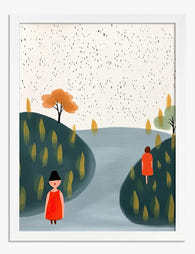
Quiet Hills, Tiny Wanderers Art Print
Sale price From 185.00 kr265.00 kr -

Undergrowth by Cézanne Art Print
Sale price From 185.00 kr265.00 kr -

Canopy Perspective Art Print
Sale price From 185.00 kr265.00 kr -

Shadowed Canopy Silhouette Art Print
Sale price From 185.00 kr265.00 kr -

Rolling Greens Coastal Landscape Art Print
Sale price From 185.00 kr265.00 kr -

Klimt 20th Century Exhibition Poster Art Print
Sale price From 185.00 kr265.00 kr -

Sunlit Hills and Full Moon Canvas Print
Sale price From 740.00 kr1,057.00 kr -

Landscape with Trees by Renoir Art Print
Sale price From 185.00 kr265.00 kr -

Sunlit Valley Retreat Art Print
Sale price From 185.00 kr265.00 kr -

Quiet Hills, Tiny Wanderers Canvas Print
Sale price From 740.00 kr1,057.00 kr -

Sunlit Italian Hillside Art Print
Sale price From 185.00 kr265.00 kr


More from The Frame

Every Room Deserves William Morris Forest Print...
Morris's forest and woodland designs are the moodier cousins of his famous florals. Denser patterns, darker palettes, more visual weight per square centimetre, which is exactly why they need different...

Tulip Art for Bedrooms: The Best Colours, Sizes...
Tulips are one of the few florals that feel equally at home in a minimalist bedroom and a maximalist one. Their soft, sculptural forms and huge colour range mean you...

William Morris Animal Designs: The Complete Sto...
Animals in William Morris's original work: what he actually designed William Morris designed a surprising number of animals, but not the ones most people assume. His original wallpapers, textiles and...