
 Commandez aujourd'hui, livré le
 How to Build a Dog-Themed Gallery Wall That Looks Intentional (Not Obsessive)
The design rules that separate a sophisticated tribute to your dog from a themed gift shop disaster.


Loving your labrador is not a design problem. Decorating a wall with eight prints of one is. This guide gives you the rules, the layouts, and the exact size combinations to celebrate your dog without your home tipping into kitsch.
The golden rule: your gallery wall needs at least one non-dog print
If every print on the wall features a dog, you have a shrine. Add one print that has nothing to do with dogs and the entire arrangement reads as art curation rather than obsession. This is the single most important rule, and it works because the human eye needs a visual palate cleanser.
The non-dog print should share a visual language with the rest of the wall. If your dog prints are painterly and warm, choose a botanical study or a muted landscape. If they are graphic and bold, pick an abstract or a typographic print. Avoid anything jarring like a neon quote print or a stark black and white photograph if the rest of your wall is soft and illustrative.
We recommend the non-dog print sits roughly in the centre or slightly off-centre of the arrangement, so it acts as an anchor for the eye. Browse animal art prints for adjacent subjects (birds, horses, hares) that feel related but break the single-topic pattern.
Start with your anchor piece
Every gallery wall needs one print that does the heavy lifting. For a dog-themed wall, a large labrador print is the obvious anchor. We suggest going larger than feels comfortable: 70x100cm framed, or 100x150cm on canvas if the wall can take it. Anything smaller and the rest of the prints have nothing to orbit around.
The anchor sets the tone. A vintage oil-painting style labrador feels traditional and lounge-appropriate. A loose watercolour feels softer and works in bedrooms or hallways. A graphic, mid-century style print suits modern interiors with clean lines. Pick the style that matches your room first, then build the rest of the wall to support it.
For labrador art ideas that work as anchor pieces, look for prints with strong composition and a clear focal point. Busy, fussy images do not anchor well. You want one dominant shape, ideally the dog's head or a three-quarter portrait.

Choosing a consistent frame colour across different prints
This is where most dog gallery walls fall apart. Mismatched frames make even beautiful prints look like a charity shop haul. Pick one frame colour and stick to it across every single print on the wall, including the non-dog one.
Three frame colours work reliably:
Natural oak. Warm, soft, suits almost every interior. Particularly good with yellow and chocolate labradors because the wood tone echoes the fur.
Black. Sharp and modern. Pulls the gallery wall together when the prints themselves vary in style. Works best with black labrador prints and graphic illustrations.
White. Clean and gallery-like. Best for bright rooms with lots of natural light. Can wash out on white walls, so use a coloured wall behind it.
We would avoid mixing frame colours unless you really know what you are doing. The "eclectic mix of frames" look only works when every other element on the wall is rigorously coordinated, and even then it is risky.
A note on construction: cheap frames warp, especially in humid rooms or when the print is not properly fitted. Solid wood frames with the print fitted at the point of manufacture stay flat and sit flush against the wall. This matters more than you think on a gallery wall, where any warping is immediately obvious next to neighbouring prints.
Layout templates that work
Three layouts cover almost every scenario. Pick one and commit. Hybrid layouts (a bit of grid, a bit of cluster) tend to look indecisive.
The grid
Equal-sized prints in a uniform grid, usually 2x2, 3x2, or 3x3. The most formal option and the hardest to get wrong. Spacing between prints should be consistent, typically 5-7cm. Tighter spacing (3-4cm) makes the grid read as one large piece. Wider spacing (8-10cm) gives each print breathing room.
The grid works brilliantly with a series of related prints: three different breeds in the same illustration style, or four labrador studies in different poses. It does not work if your prints vary wildly in style or composition. Browse wall art sets if you want pieces designed to hang as a coordinated group.
The salon hang
Dense, floor-to-ceiling arrangement with prints of varying sizes packed together. Traditional, maximalist, and surprisingly forgiving. The trick is to start with your anchor in roughly the centre, then build outwards, keeping the gaps between frames roughly even (around 4-5cm).
Salon hangs need at least seven prints to look intentional. Five or six and it looks like you ran out of art. Aim for nine to twelve.
The asymmetric cluster
The middle ground. One large anchor on the left or right, with smaller prints clustered around it in an irregular but balanced arrangement. The negative space is part of the composition.
This layout suits most modern homes. It is more relaxed than a grid, less committed than a salon hang, and forgiving of mixed sizes. We recommend it for first-time gallery wall builders.
Mixing breeds and styles without it looking random
A pure labrador wall is fine if you have a labrador. But if you want variety, the rule is this: mix breeds OR mix styles, not both at once.
If you mix breeds (a labrador, a spaniel, a whippet), keep the illustration style identical. All watercolours, or all line drawings, or all vintage oil portraits. The visual consistency makes the breed variety feel curated rather than scattered.
If you mix styles (a photographic black labrador, a graphic chocolate labrador, an oil-painted yellow labrador), keep it to one breed. Now the breed becomes the unifying element and the styles read as different perspectives on the same subject.
Mixing labrador colours is genuinely effective and a clever move for labrador home decor. One yellow, one chocolate, one black labrador in matching frames and matching illustration style looks deliberate and considered. It also flatters most interior palettes because you have warm, mid, and dark tones working together.
What does not work: a mixed-breed, mixed-style wall. That is when it tips into "I just bought everything I liked." Edit ruthlessly.

Size combinations that create visual balance
Vague advice like "mix your sizes" is useless. Here are specific combinations that work.
For an asymmetric cluster of five prints:
- 1x anchor at 70x100cm
- 2x mid-size at 50x70cm
- 2x small at 30x40cm
For a grid of six prints (3 wide, 2 tall):
- 6x identical at 40x50cm
For a salon hang of nine prints:
- 1x anchor at 60x80cm
- 2x at 50x70cm
- 3x at 40x50cm
- 3x at 30x40cm
For a tight pair above a sofa:
- 2x at 60x80cm hung side by side with 5cm between them
The numbers matter. Sizes that are too close to each other (a 50x70cm next to a 40x50cm) read as a mistake. Sizes with clear hierarchy (70x100cm next to 30x40cm) read as design.
A useful matting trick: if you are stuck with prints at slightly awkward sizes, larger mounts inside the frames can normalise them. A 30x40cm print in a 50x70cm frame with a wide mount looks intentional and gives the gallery wall extra breathing room.
Where to hang your dog gallery wall (and where not to)
Some rooms suit dog art. Others actively work against it.
Good locations:
- Lounge or snug, especially above a sofa or sideboard
- Hallway or staircase wall (a salon hang works beautifully running up stairs)
- Home office or study
- Boot room or utility (genuinely the most appropriate room for dog art)
- Master bedroom, if the prints are calm and painterly
Locations to avoid:
- Kitchen, particularly near the hob or sink. Steam and grease shorten the life of any printed art. If you must have art in the kitchen, hang it well away from cooking zones.
- Bathroom. Humidity warps frames and damages paper. Canvas copes slightly better, but we would still avoid it.
- Dining room, if you entertain formally. Guests sitting opposite a wall of dog portraits during dinner is a particular experience.
- Children's bedrooms, unless the child specifically wants it. Dog art for adults rarely translates.
- Above the bed, if the prints feature direct-stare portraits. Eye contact with multiple dogs while you sleep is unsettling.
For rooms with even moderate humidity, canvas prints handle the conditions better than paper. A hand-stretched canvas with a smooth matte finish does not warp the way a poorly fitted framed print can.
A sample gallery wall layout using five prints
Here is a complete, buildable layout using five prints in an asymmetric cluster. Wall space required: roughly 200cm wide by 140cm tall. Best hung above a sofa or sideboard.
The prints:
- Anchor: A 70x100cm framed yellow labrador portrait, oil-painting style, in natural oak. Position: left side, hung so the centre is at standard eye level (around 145cm from the floor).
- Secondary: A 50x70cm framed chocolate labrador in the same illustration style, natural oak frame. Position: top right, with the top edge aligned roughly to the top edge of the anchor.
- Tertiary: A 50x70cm framed black labrador, same style and frame. Position: bottom right, directly below the chocolate print, with 5cm gap.
- Non-dog print (the grounding piece): A 30x40cm botanical study or abstract landscape, natural oak frame. Position: between the anchor and the right column, slightly higher than centre.
- Small accent: A 30x40cm graphic print of a dog-related but non-portrait image (a bone, a collar study, a pawprint illustration done well, or a small landscape with a distant dog figure). Position: bottom centre, below the non-dog print.
Total: three labrador prints (one of each colour), one non-dog print, one tangential print. The wall reads as a curated arrangement about your love of dogs and the countryside, not a labrador appreciation society.

Spacing: 5cm between all prints. Use a paper template (cut newspaper to the size of each frame and tape it to the wall) before committing to nail holes. Adjust until it feels right, then mark the hanging points through the paper.
This layout works for labrador picture prints in almost any room with enough wall space. Scale it up or down by 20% if your wall is larger or smaller, keeping the proportions consistent.

A few final notes on commitment
If you are nervous about going all-in on a dog gallery wall, start with three prints in an asymmetric cluster. You can add more later, or scale back to a single large statement piece if you redecorate. Framed prints with proper fixtures hang and rehang without leaving major damage, and the prints themselves outlast most interiors several times over.
Edit harder than feels comfortable. A wall of five excellent prints beats a wall of nine good ones. Trust the negative space. And remember that one non-dog print is doing more work than you realise.

Produits Fab présentés dans cet article
-

Toile chiens joueurs en tons pastel
Prix promotionnel À partir de €54,95€91,95 -

Affiche chiens multicolores
Prix promotionnel À partir de €16,95€23,95 -

Toile chiens élégants
Prix promotionnel À partir de €54,95€91,95 -

Toile portrait de chien au regard fidèle
Prix promotionnel À partir de €65,95€94,95 -

Affiche portrait de chien minimaliste
Prix promotionnel À partir de €16,95€23,95 -

Toile chien noir élégant dans pièce colorée rose et bleu
Prix promotionnel À partir de €54,95€91,95 -

Toile portrait de labrador joueur
Prix promotionnel À partir de €54,95€91,95 -

Toile chien stylé avec lunettes de soleil
Prix promotionnel À partir de €54,95€91,95 -

Toile chien chic aux couleurs vives
Prix promotionnel À partir de €54,95€91,95 -

Affiche croquis de chien joyeux sur fond bleu
Prix promotionnel À partir de €14,95€24,95 -
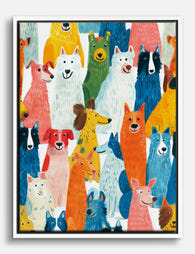
Toile parade de chiens joueurs
Prix promotionnel À partir de €65,95€94,95 -

Toile chiens attachants
Prix promotionnel À partir de €54,95€91,95 -

Affiche teckel muse à l'aquarelle
Prix promotionnel À partir de €16,95€23,95 -

Affiche chiens sur une pile de livres
Prix promotionnel À partir de €14,95€24,95 -

Toile terrier et labrador, duo de chiens joueurs
Prix promotionnel À partir de €54,95€91,95 -

Toile chien au regard fidèle
Prix promotionnel À partir de €65,95€94,95


Plus de The Frame

Beyond the Fruit Bowl: Kitchen Wall Art Ideas T...
The kitchen is the most photographed, most lived-in room in your home, and yet it's usually decorated like an afterthought. A print of lemons here, a chalkboard-style coffee poster there,...

Vintage Botanical Prints in Modern Homes: How t...
Botanical prints have a reputation problem. Done badly, they read as chintzy, twee, or straight out of a 1980s guest bedroom. Done well, they're one of the most timeless things...

The Complete Guide to Decorating with Botanical...
Botanical prints are the closest thing interior design has to a universal donor. They work with almost any style, palette, and period. Almost. This is a room-by-room guide with specific...