
 Commandez aujourd'hui, livré le
 What Interior Designers Know About Styling Matisse Landscape Prints
You own one Matisse landscape. Here's exactly how to build a gallery wall around it without it looking accidental.


Most gallery wall advice assumes you're starting with nothing. This guide assumes you already own one Matisse landscape print, or you're about to, and you want everything you hang next to it to look deliberate. We'll cover anchor selection, the sizing formula designers actually use, which works pair naturally, and three layouts you can copy this weekend.
Start with your anchor: choosing the right Matisse landscape as your centrepiece
Your anchor is the largest piece on the wall and the one your eye lands on first. For a Matisse landscape gallery wall, three works tend to function best as anchors: Landscape at Collioure (1905), View of Collioure (1907), and Open Window, Collioure (1905).
Landscape at Collioure works because the composition is loose and almost abstract, with warm pinks, sage greens and dabs of cobalt that give you a colour palette to pull from for every other piece on the wall. View of Collioure is more architectural, with stronger horizontal bands, which makes it a calmer anchor for a busier gallery layout. Open Window is the most graphically striking thanks to its frame-within-a-frame composition, but it's almost too bold to anchor more than three or four supporting prints.
Choose your anchor based on what the rest of the wall needs to do. Loud anchor, quiet supporting cast. Quiet anchor, more freedom around it. You can browse the full range of Matisse landscape prints to see which palette feels right for your room.
A note on size: an anchor smaller than 50x70cm rarely reads as an anchor on a wall above a sofa or console. Go bigger than you think. 70x100cm is the sweet spot for most living rooms.

The 1-2-3 rule: one large, two medium, three small for a balanced layout
The 1-2-3 rule is the simplest way to build a gallery wall that looks intentional. One large piece (your anchor), two medium pieces, and three small pieces. Six prints total, which is enough to feel substantial without becoming chaotic.
Use these dimensions as a starting point:
- Large (anchor): 70x100cm or 60x80cm
- Medium: 40x50cm or 30x40cm (two of them)
- Small: 21x30cm or 30x30cm (three of them)
The ratio matters more than the exact sizes. Each tier should be roughly half the visual area of the tier above it. If your anchor is 70x100cm and your "medium" prints are 50x70cm, the wall starts to feel like four large pieces fighting each other.
The 1-2-3 rule also gives you natural permission to mix orientations. Your large anchor can be horizontal, your two mediums vertical, and your three smalls a mix of square and portrait. Variety in orientation is what stops a gallery wall from looking like a showroom display.
If you'd rather buy a coordinated grouping in one go, pre-curated wall art sets take the guesswork out of getting the ratios right.
Which other Matisse works pair naturally with his landscapes
Matisse worked across distinct periods, and not all of them play nicely together. The cleanest pairings come from staying within his Fauvist period (roughly 1904-1908), which is when most of his major landscapes were painted.
Fauvist landscapes pair beautifully with Fauvist still lifes from the same era: Still Life with Blue Tablecloth, Vase of Sunflowers, and the various Collioure interior scenes. The shared palette (warm pinks, ochres, sage, ultramarine) means everything looks like it belongs to the same conversation.
Later Matisse works (the 1940s cut-outs, the Jazz series, Blue Nudes) can absolutely sit alongside his landscapes, but you need to commit. Either go all-Fauvist for a unified, painterly feel, or deliberately mix in two or three cut-outs to create contrast. What doesn't work is one cut-out floating among five landscapes. It looks like an accident.
Drawings and line works from his later career are the safest bridge between periods. They're quiet, monochromatic, and they let his colourful landscapes do the heavy lifting.
For the broadest selection across all his periods, the full Henri Matisse art prints collection is worth scrolling through with your anchor's palette in mind.
Mixing Matisse with other artists without creating visual chaos
The safest non-Matisse pairings are his contemporaries who shared a colour sensibility or a compositional approach. Bonnard's interiors, Derain's Fauvist landscapes, and early Braque all sit comfortably next to Matisse without feeling like a museum gift shop.
If you want more contrast, Picasso's neutral-toned still lifes (Cubist period) work surprisingly well because the muted palette gives the eye somewhere to rest between Matisse's saturated colours. The trick is keeping the ratio firmly in Matisse's favour. Five Matisse, one Picasso. Not the other way around.
What we'd avoid: pairing Matisse landscapes with high-contrast modern photography, anything in heavy black-and-white, or graphic typography prints. The painterly, hand-made quality of his work fights against crisp digital aesthetics. You end up with two visual languages shouting at each other.
A useful rule: if you can imagine the two artists having a conversation, they probably belong on the same wall. If one would clearly walk out of the room, don't hang them together.

Frame consistency: why matching frames from one source changes everything
This is the single biggest mistake people make. They assemble a gallery wall over six months from different shops, and every frame is a slightly different black, a slightly different oak, or a slightly different width. The wall reads as messy even when the art itself is well-chosen.
Matched frames from a single source eliminate this entirely. The frame becomes invisible, and the art does the talking. We'd recommend committing to one frame colour across the whole gallery wall: natural oak, black, or white. Natural oak is the most forgiving with Matisse's warm palette. Black gives you a more graphic, contemporary feel. White disappears against most pale walls and lets the colours do everything.
Mixing frame finishes (oak with black, for example) can work if you do it deliberately and in a clear pattern, like alternating along a grid. What never works is two oaks that are slightly different oaks. The eye catches the inconsistency immediately.
The other reason single-source framing matters: build quality. Cheap frames warp, the print isn't fitted properly, and the whole thing arrives looking lopsided. Frames made from solid FSC wood with the print fitted in one factory and shipped together (rather than print and frame arriving in separate boxes for you to assemble) avoid all of this. Our framed prints arrive ready to hang with fixtures attached, which sounds basic until you've spent an evening trying to flatten a curled poster.
Spacing and alignment: the measurements that actually matter
Forget vague advice about "balanced spacing." Here are the actual numbers designers use.
Gap between frames: 5-7cm (roughly 2-3 inches). Tighter than this and the wall feels cramped. Wider and the prints stop reading as a single composition.
Clearance above furniture: 15-20cm (6-8 inches) between the top of a sofa or console and the bottom of the lowest frame. Closer and the art feels like it's resting on the furniture. Further and it floats away awkwardly.
Centre line height: the visual centre of the gallery wall (not the centre of the anchor) should sit at 145-150cm from the floor. This is gallery hanging height and it works because it matches average eye level for a standing adult.
Edge alignment: pick one consistent edge and align prints to it. Top edge, bottom edge, or a horizontal centre line running through the middle of the arrangement. Asymmetric layouts still need at least one alignment rule to feel intentional.
A practical tip: cut paper templates to the exact dimensions of each frame and tape them to the wall before you commit. Move them around for a day. What looks balanced in the morning often looks lopsided by evening light.
Three ready-made gallery wall layouts you can copy today
Layout 1: The Classic Grid (six prints, symmetrical)
Six prints in a 3x2 grid, all the same size (40x50cm works well), with 5cm gaps between them. Total wall space: roughly 130x110cm. Best for above a sofa, behind a bed, or in a hallway. Use this when your Matisse landscape is one of six equals rather than a dominant anchor.
Layout 2: The Anchor Cluster (1-2-3 rule)
One 70x100cm landscape on the left. Two 30x40cm prints stacked vertically to its right with 5cm between them. Three 21x30cm prints arranged in a small horizontal row beneath the stack. Total wall space: roughly 150x110cm. Asymmetric, dynamic, best for living rooms with strong horizontal furniture below.
Layout 3: The Horizontal Run
Three prints in a single row, all aligned along a central horizontal line. A 60x80cm landscape in the middle, flanked by two 40x50cm prints on either side, 7cm gaps. Total wall space: roughly 200x80cm. Perfect for above a long console, sideboard, or low bookshelf where vertical space is limited.
All three layouts work with Matisse landscapes as the anchor, and all three look better when every frame matches.

Common gallery wall mistakes and how to avoid them
Mistake 1: Anchor too small. A 30x40cm print cannot anchor anything. If your largest piece is under 60x80cm, you're not building a gallery wall, you're scattering prints. Size up.
Mistake 2: Inconsistent matting. A 5cm white border on one print and a 1cm border on the next breaks the visual rhythm. Pick one matting width and stick to it across the wall.
Mistake 3: Wall colour fighting the art. Matisse landscapes (warm, saturated, painterly) are killed by cold grey walls and bright white. They sing against warm off-whites, soft clay, sage green, or even a deep navy. If you're committed to cool grey, lean into the contrast and frame in black to give the art a fighting chance.
Mistake 4: Mixing frame colours by accident. We covered this above, but it bears repeating. Two slightly different blacks look worse than one black and one obvious oak. Commit to one frame finish.
Mistake 5: Hanging too high. The most common amateur mistake. Eye level (145-150cm to the centre of the arrangement) almost always feels too low when you're holding the print up, and almost always looks correct once it's hung. Trust the measurement.
Mistake 6: Treating the gallery wall as finished. Good gallery walls evolve. Start with three pieces, live with them, add two more in three months. The walls that look the most considered are usually the ones that grew slowly. You can browse landscape art prints more broadly when you're ready to expand beyond Matisse.

What to do this weekend
Pick your anchor first and make it bigger than feels comfortable. Decide on one frame colour and one matting width before you buy anything else. Cut paper templates and live with them on your wall for at least 24 hours. When everything looks deliberate rather than accidental, you've done it right. The rest is just adding pieces over time, slowly, with the same rules in mind.

Produits Fab présentés dans cet article
-

Affiche paysage à Collioure de Matisse
Translation missing: fr.products.product.sale_price À partir de £11.95£19.95 -

Toile paysage à Collioure de Matisse
Translation missing: fr.products.product.sale_price À partir de £44.95£74.95 -

Affiche nature morte aux géraniums de Matisse
Translation missing: fr.products.product.sale_price À partir de £13.99£19.99 -
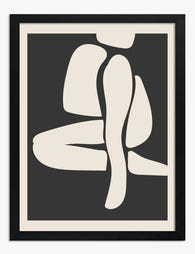
Affiche élégante inspiration Matisse
Translation missing: fr.products.product.sale_price À partir de £11.95£19.95 -

Toile le bonheur de vivre de Matisse, format paysage
Translation missing: fr.products.product.sale_price À partir de £44.95£74.95 -

Toile nature morte aux géraniums de Matisse
Translation missing: fr.products.product.sale_price À partir de £55.99£79.99 -

Affiche évasion au jardin de Matisses
Translation missing: fr.products.product.sale_price À partir de £11.95£19.95 -

Toile formes découpées inspirées de Matisse
Translation missing: fr.products.product.sale_price À partir de £44.95£74.95 -

Toile paysage près de Collioure par Henri Matisse
Translation missing: fr.products.product.sale_price À partir de £44.95£74.95 -

Affiche vue de balcon Matisse
Translation missing: fr.products.product.sale_price À partir de £11.95£19.95 -

Toile jardin en papiers découpés esprit Matisse
Translation missing: fr.products.product.sale_price À partir de £44.95£74.95 -

Affiche paysage joyeux de Matisse
Translation missing: fr.products.product.sale_price À partir de £11.95£19.95 -

Toile fenêtre ouverte inspirée de Matisse
Translation missing: fr.products.product.sale_price À partir de £44.95£74.95 -
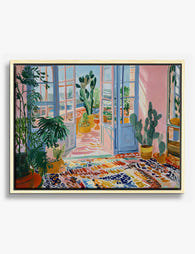
Toile havre botanique inspirée de Matisse
Translation missing: fr.products.product.sale_price À partir de £44.95£74.95 -
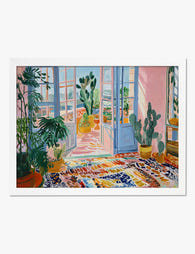
Affiche inspirée par Matisse, véranda ensoleillée
Translation missing: fr.products.product.sale_price À partir de £11.95£19.95 -

Affiche paysage près de Collioure d'Henri Matisse
Translation missing: fr.products.product.sale_price À partir de £11.95£19.95 -

Affiche découpes inspirées de Matisse
Translation missing: fr.products.product.sale_price À partir de £11.95£19.95 -
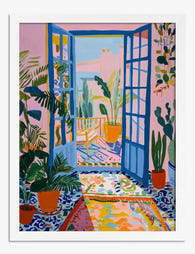
Affiche véranda ensoleillée inspirée de Matisse
Translation missing: fr.products.product.sale_price À partir de £11.95£19.95


Plus de The Frame

Are Floral Prints Still in Style? What's Actual...
Floral wall art is having a moment, but calling it a "trend" misses the point. Botanicals have been hung on walls since the 17th century, and the current resurgence is...

Why Floral Prints Work Better in Bedrooms Than ...
Floral prints carry baggage. Mention them in the context of a bedroom and most people picture chintz curtains, brass headboards, and a potpourri bowl on the dresser. That reputation is...

Vintage Dog Art: From Victorian Kennel Portrait...
Dogs have been painted, etched, lithographed and screen-printed for as long as people have made images of the things they love. The vintage dog art you can buy today draws...