
 Ordina oggi, consegna il
 How to Build a Face Art Gallery Wall That Actually Looks Intentional
Layout templates, exact measurements, and the trick to stopping multiple portraits feeling like a police lineup.


Face art is having a moment, but most gallery walls built around it look chaotic, creepy, or both. The difference between a wall that feels curated and one that feels like a crowd staring at your sofa comes down to spacing, scale, and what you put between the faces. Here's how to do it properly.
Why face art makes surprisingly great gallery wall material
Faces are the one subject our brains are hardwired to read first. That's a gift if you use it deliberately, because a single face print becomes an instant focal point without needing a huge canvas or a bold colour. Place that focal point inside a considered grid and you get tension, balance, and a sense of intent that landscape or abstract walls have to work harder for.
The catch is that faces also carry emotional weight. Five portraits hung too close together start to feel like an audience, and that's the failure mode most people fall into. The fix isn't fewer faces. It's better spacing, varied scale, and breaking the rhythm with non-portrait subjects so the eye gets somewhere to rest.
Done well, a face-led gallery wall feels like a small museum room. Done badly, it feels like a waiting area. The rest of this guide is about staying on the right side of that line.

Choosing a layout: grid, salon hang, or linear row
There are three layouts that actually work for face art, and most other arrangements are variations of these. Pick one before you buy anything.
The grid
A grid is two rows by three columns, or three by three, with identical frame sizes and equal spacing between every print. It's the most forgiving layout because the symmetry does most of the work for you. Grids suit modern interiors, hallways, and any wall where you want the art to feel architectural rather than expressive.
The salon hang
A salon hang is the dense, asymmetrical arrangement you see in old galleries: mixed sizes, mixed orientations, anchored around a central piece with smaller prints clustered around it. It's harder to pull off but rewards the effort with personality. Best above a sofa, in a lounge, or anywhere you want the wall to feel collected rather than designed.
The linear row
Three to five prints hung in a single horizontal line at the same height, with equal spacing. This is the layout designers default to above sideboards, beds, and benches because it draws the eye along the furniture below it. For face art specifically, a linear row of three portraits with consistent framing reads as confident and deliberate.
How many prints you actually need (hint: fewer than you think)
Most people overshoot. A wall above a three-seater sofa needs six to nine pieces at most for a salon hang, three to six for a grid, and three to five for a linear row. More than nine and the wall stops reading as a composition and starts reading as wallpaper.
For face art specifically, lean towards the lower end of each range. Multiple faces need breathing room that landscapes and abstracts don't. A grid of four large face prints will almost always look better than a grid of nine small ones, because each face gets the visual space it needs to feel like a deliberate choice rather than a tile.
If you're working above a sofa or sideboard, follow the two-thirds rule: your gallery wall should span roughly two-thirds the width of the furniture below it. A 220cm sofa wants an arrangement around 145cm wide. Wider feels untethered. Narrower feels apologetic.
Mixing face prints with other subjects: botanicals, abstract shapes, and typography
This is the step that separates a face wall that works from one that doesn't. Pure portrait clusters create what designers sometimes call the audience effect: too many sets of eyes pulling focus in too many directions. Breaking up the faces with neutral subjects gives the composition a rhythm.
Three categories mix particularly well with contemporary face prints:
Botanicals. A single-stem study or a soft leaf print in muted greens or sepia provides quiet space between portraits. Browse botanical art prints for pieces with the same restrained palette as most line-drawn face art.
Abstract shapes. Geometric forms, colour blocks, or abstract art prints in tones that echo the face prints' palette. Abstracts are the hardest working filler in any gallery wall because they carry visual weight without competing for attention.
Typography. A single typographic print, used sparingly, can break a sequence of portraits cleanly. One is plenty. Two starts to feel like a poster shop.
The ratio that works most reliably is roughly 60% face art, 40% supporting subjects. So in a six-piece wall, four faces and two non-portrait pieces. In a nine-piece salon hang, five or six faces and three or four supporting pieces.

Keeping it cohesive: matching frames, colour palettes, and print styles
Cohesion comes from three places, and you need at least two of them working together for the wall to hold up.
Frame consistency
The professional consensus is to limit yourself to no more than three frame styles across a single gallery wall, and ideally just one or two. All-black frames give a graphic, modern result. All-oak gives warmth. Mixing black and natural wood works if the proportion is roughly 70/30, but going 50/50 tends to look indecisive.
Frame quality matters more than people realise. Frames made from solid wood with proper acrylic glazing sit flat against the wall and stay flat. Cheaper MDF or veneer frames warp at the corners within months, and once one frame in a grid is out of true, the whole arrangement looks off. This is why we make our frames from solid FSC-certified wood with UV-protective acrylic rather than glass: lighter to hang, no glare across the faces, and they don't bow.
Colour palette
Face prints span a wide tonal range, from monochrome line drawings to richly coloured portraits. The trick is to commit to one tonal family across the whole wall. Either go fully monochrome (black, white, soft greys, sepia) or fully chromatic (warm terracotta, mustard, sage, dusty pink). Mixing the two without intent looks accidental.
If your face prints have varied skin tones or palette choices, pull a single recurring colour out of them and echo it in your supporting prints. One repeated colour across the whole wall is enough to tie everything together.
Print style
Stick to one drawing language. Continuous line drawings sit beautifully next to other line drawings. Painterly portraits sit beautifully next to other painterly work. Mixing a delicate single-line face with a heavily textured oil-style portrait usually creates more dissonance than dialogue.
Our face art prints are grouped loosely by style for this reason. If you're building a wall, pick a style family first and shop within it.
The exact measurements and spacing we recommend for each layout
This is where most guides go vague. Here are the actual numbers.
Centre height
Hang the centre of your gallery wall at 145 to 152cm from the floor (roughly 57 to 60 inches). This is standard gallery hanging height and lines up with average eye level. Above a sofa, drop the bottom edge of the lowest frame to around 15 to 25cm above the back of the sofa. Above a bed or sideboard, leave 20 to 30cm of breathing room.
Spacing between frames
Industry standard is 5 to 7.5cm (2 to 3 inches) between frames. For face art specifically, push towards the higher end. 7.5cm between portraits gives each face the breathing room it needs. Tighter spacing makes faces feel cramped and confrontational.
Grid layout (six prints, 50x70cm each)
Total wall area: roughly 165cm wide by 155cm tall. Two rows of three. 7.5cm between every frame, both horizontally and vertically. Centre of the arrangement at 150cm from the floor.
Linear row (three prints, 50x70cm each)
Total width: roughly 165cm. Hang all three at the same centre height of 150cm from the floor, with 7.5cm between each frame. Works perfectly above a 220 to 240cm sofa or a queen bed.
Salon hang (seven to nine pieces, mixed sizes)
Anchor with one large piece, ideally a 70x100cm face print, with its centre at 150cm from the floor. Cluster smaller pieces (30x40cm and 40x50cm) around it, maintaining 5 to 7.5cm gaps. The whole arrangement should fit within an imaginary rectangle roughly two-thirds the width of the furniture below.
Tools you'll need and how to hang everything level the first time
You don't need a designer. You need an hour, some brown paper, and the right tools.
The kit:
- Tape measure
- Spirit level (a phone app works, but a real one is better)
- Pencil
- Brown paper or newspaper
- Painter's tape
- A drill or hammer, depending on your wall
The floor mock-up method. Before you put a single hole in the wall, lay your frames out on the floor in front of the wall they're going on. Move them around until the composition feels right. Photograph it from above so you have a reference.
The paper template method. Cut a piece of brown paper to the exact size of each frame. Tape the paper templates to the wall using painter's tape. Step back. Adjust. Live with it for a day if you can. Once the templates are where you want them, mark the hanging point through the paper, drill or hammer there, then tear the paper away.
This sounds like more work than it is. It takes 20 minutes and saves you from the alternative, which is rehanging everything twice.
Our framed prints arrive with the fixtures already attached, so the hanging point is consistent and you don't have to faff with separate hooks and wire. That matters more than it sounds when you're trying to hang nine frames level.

Three gallery wall templates you can copy using our face art prints
Three exact configurations that work. Pick one, adapt the prints to your taste, follow the measurements.
Template one: The modern triptych
Three 50x70cm portrait-orientation face prints in identical black frames, hung in a linear row above a sofa or bed. 7.5cm between frames. Centre height 150cm from the floor. Choose three portraits in the same style (all line drawings, or all painterly) and ideally with the faces looking in slightly different directions to create flow.
This is the easiest layout in this guide and the one most likely to look like it was designed by a professional.
Template two: The mixed grid
A 2x3 grid using six 40x50cm prints in matching oak frames. Four face prints and two complementary pieces (one botanical, one abstract). Place the non-portrait prints in opposite corners of the grid so the faces don't cluster together. 7.5cm spacing throughout.
This is the layout that solves the "too many eyes" problem. The botanical and abstract pieces give the eye somewhere to rest, and the face prints feel curated rather than crowded.
Template three: The anchored salon hang
One 70x100cm hero face print, slightly off-centre, surrounded by six smaller pieces: three 30x40cm face prints and three 30x40cm supporting prints (botanicals, abstracts, or one piece of typography). Maintain 5 to 7.5cm gaps. Vary the orientations.
Harder to execute, but the most rewarding. Use the floor mock-up method religiously here. Pre-curated wall art sets can take some of the guesswork out if you'd rather start from a designed combination.
Final thoughts
A good face art gallery wall isn't about having more prints. It's about giving each face enough room, choosing frames that hold their shape, and breaking up the portraits with quieter subjects so the wall has a rhythm. Stick to one frame family, one tonal palette, and one drawing style, then follow the measurements above. Mock it up on the floor, mock it up again on the wall with paper, then hang it once.
If you remember nothing else: 7.5cm between frames, 150cm to centre, two-thirds the width of the furniture below, and never more than 60% faces.


Prodotti Fab presentati in questo blog
-
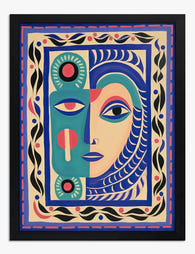
Poster volto folk moderno
Translation missing: it.products.product.sale_price A partire da £11.95£19.95 -

Poster volto astratto moderno e colorato
Translation missing: it.products.product.sale_price A partire da £11.95£19.95 -

Poster volto astratto blu a linea continua
Translation missing: it.products.product.sale_price A partire da £11.95£19.95 -

Poster volto moderno in stile folk
Translation missing: it.products.product.sale_price A partire da £11.95£19.95 -

Poster ritratto folk moderno
Translation missing: it.products.product.sale_price A partire da £11.95£19.95 -

Poster volto cubista a blocchi di colore
Translation missing: it.products.product.sale_price A partire da £11.95£19.95 -

Poster ritratto in blu intenso
Translation missing: it.products.product.sale_price A partire da £11.95£19.95 -

Poster ritratto minimalista moderno
Translation missing: it.products.product.sale_price A partire da £11.95£19.95 -

Tela ritratto cubista dai colori audaci
Translation missing: it.products.product.sale_price A partire da £49.95£74.95 -

Tela ritratto folk moderno
Translation missing: it.products.product.sale_price A partire da £49.95£74.95 -

Tela volto folk giocoso
Translation missing: it.products.product.sale_price A partire da £49.95£74.95 -

Tela volto astratto a linea continua blu intenso
Translation missing: it.products.product.sale_price A partire da £49.95£74.95 -

Poster ritratto di musa moderna
Translation missing: it.products.product.sale_price A partire da £11.95£19.95 -

Poster volto astratto vibrante
Translation missing: it.products.product.sale_price A partire da £11.95£19.95 -

Tela ritratto minimalista moderno
Translation missing: it.products.product.sale_price A partire da £49.95£74.95 -

Tela volto in stile folk moderno
Translation missing: it.products.product.sale_price A partire da £49.95£74.95 -

Poster volto astratto dai colori vivaci
Translation missing: it.products.product.sale_price A partire da £11.95£19.95 -

Poster ritratto moderno e giocoso
Translation missing: it.products.product.sale_price A partire da £11.95£19.95 -

Poster musa delle arti visive in bianco e nero di Sommese
Translation missing: it.products.product.sale_price A partire da £11.95£19.95 -

Poster musa nei toni della terracotta, ritratto cubista
Translation missing: it.products.product.sale_price A partire da £11.95£19.95


Di più da The Frame

Boho Sun Wall Art: How to Nail the Look Without...
Boho sun art has a reputation problem. Done badly, it screams student halls and macramé overload. Done well, it's one of the warmest, most grounding aesthetics you can put on...

Every Animal in William Morris's Designs: The C...
Most people know the thrush in Strawberry Thief and stop there. But Morris's wider body of work contains foxes, hares, peacocks, ravens, lions, herons, woodpeckers, deer, and doves, often half-buried...

Countryside Decor Ideas: How to Bring Rural Cal...
Countryside art has quietly become one of the most versatile choices in modern interiors. Not the chintz-and-bunting version, but the kind of soft, considered pastoral scenes that bring the outside...