
 Bestel vandaag, levering vóór
 Canvas, Art Print, Poster, or Framed? Every Wall Art Format Compared
The construction details, honest trade-offs, and a four-question flowchart to pick the right format on the first try.


Most format comparisons skip the part that actually matters: what you are physically buying. This is the only guide you need to understand the construction, weight, durability, and real trade-offs of each option. By the end you will know exactly which format suits your wall, your room, and your budget.
What you are actually buying: materials and construction for each format
Before we get into aesthetics, let's talk physical objects. The four main formats look similar on a screen but feel and behave very differently on a wall.
Posters are single sheets of thin paper, usually 150-200 gsm, printed on commercial offset or digital presses with standard inks. No mounting, no rigidity, no protection. They roll, crease, and fade.
Art prints (unframed) are single sheets of thick fine art paper, typically 200-300 gsm, printed using giclée technology with archival pigment inks. They feel substantial in the hand. They are designed to be framed, mounted, or clipped.
Framed art prints are the same fine art print, fitted into a solid wood frame behind a transparent glaze (glass or acrylic), often with a mat board surrounding the image. Hanging fixtures are pre-attached.
Canvas prints are printed on woven poly-cotton fabric, then hand-stretched over a wooden internal frame called a stretcher bar. The image wraps around the edges so it can hang on its own without a frame, although a floater frame can be added.
That is the structural reality. Now we can talk about which one is right for you.

Art prints (unframed): the versatile starting point
An unframed art print is the most flexible format you can buy. You get the image, on excellent paper, ready for whatever you want to do with it.
What "giclée" actually means
Giclée (pronounced zhee-clay) is a French word that has become shorthand for high-quality inkjet printing. In plain English: it is a digital printing process that uses pigment-based inks (not dye) sprayed through extremely fine nozzles onto archival paper. The result is sharper detail, deeper colour gradients, and far better longevity than standard printing.
It matters because pigment inks are stable for centuries. Dye inks, which most posters use, fade in a few years. When the term is used by a serious printer, on archival paper, with proper colour management, it is a meaningful quality indicator. When it is slapped on a £15 product with no paper specification, it is marketing fluff.
Our art prints are printed giclée on thick matte paper using water-based archival inks. They are designed to look good close up, where you can actually see the texture of the paper and the depth of the ink.
Why buy unframed
Three reasons. First, cost. You pay for the print and skip the frame. Second, flexibility. You can frame it later, mount it on a clipboard, hang it with magnetic poster hangers, or pin it to a gallery wall with washi tape if you are renting. Third, replaceability. Frames are expensive to ship and easy to damage. Buying the print separately and pairing it with picture frames you already own (or pick up locally) keeps things simple.
The trade-off: an unframed print needs something. Bare paper on a wall looks unfinished after about a week.
Framed art prints: ready to hang, but glaze matters
A framed print is the polished option. You order it, it arrives in one box, it goes on the wall in ten minutes. No measuring frames, no fitting prints into mounts, no broken glass during delivery.
Glass vs acrylic
This is the detail almost no one explains. The transparent layer protecting the print is called the glaze, and it is either glass or acrylic.
Glass is heavier, prone to shattering in transit, reflects more light, and offers no UV protection unless specifically treated. It is what cheap framing uses because it is cheap.
Acrylic is lighter, virtually unbreakable, and can be UV-protective, which prevents the print fading even in direct sunlight. It is what museums use. The downside is that acrylic can scratch if you wipe it with the wrong cloth.
Every framed art print we make uses UV-protective acrylic glaze in a solid FSC-certified wood frame, with the print properly fitted and the hanging fixtures pre-attached. The frame and print ship together in one box, which sounds obvious until you have ordered framed art elsewhere and received two boxes, two weeks apart, with a print that does not fit the frame.
When framed is worth it
If the print will live in a sunny room, a humid room, or a room you actually use, framed is the right answer. The acrylic protects the paper from moisture, dust, and UV. The frame gives the image visual weight and a clean finish. And you skip the framing project, which always costs more and takes longer than you think.

Canvas prints: the gallery look without the gallery price
Canvas is a different animal entirely. Instead of paper behind glass, you get a textured fabric stretched over a wooden frame, with the image printed directly onto the weave.
Stretcher bars and mirrored edges
The wooden internal frame is called a stretcher bar. Cheap canvas prints use thin, flimsy bars (around 2 cm deep) that warp within a year. Quality canvas prints use solid wood stretcher bars around 3-4 cm deep, which give the canvas physical depth on the wall and stay flat over time.
The other detail to look for is how the image wraps around the sides. Some printers crop your image so the main subject runs off the edges. We use mirrored edge wrapping, which means the edges show a mirrored reflection of the image, so nothing important gets cut off.
Canvas prints hang beautifully unframed for a minimal look, or you can add a floater frame to create a framed canvas print, which has a small visible gap between the canvas and the surrounding frame. It is the most gallery-like finish you can get.
Weight and humidity
Canvas is significantly lighter than a framed print of the same size. A large canvas (24x32in) typically weighs around 1.5-2 kg. The framed equivalent with acrylic and a wood frame can weigh 3-4 kg or more. For plasterboard walls or rented flats with limited fixings, that matters.
Canvas also handles humid rooms better than framed paper. There is no glass to fog, no paper to ripple. If you want art in a bathroom or kitchen, canvas is usually the smarter pick.
The trade-offs: canvas can be punctured, the texture diffuses fine detail (so it is less ideal for crisp typography or super-detailed illustrations), and it is harder to clean than acrylic.
Posters: when they are fine and when they will disappoint you
Posters get unfairly dismissed in most format comparisons. They have a place. They are also wrong for most situations.
When a poster is genuinely fine
Kids' rooms where the art will be replaced every six months. Student halls. Rental flats where you cannot put significant fixings in the wall. Temporary decor for a season or an event. Any situation where you want to spend £10-30 and accept that the piece will not last forever.
A poster is the right format when the cost of the artwork should match how long you plan to keep it. Spending £200 on a framed piece for a flat you will leave in six months is bad maths.
When a poster will disappoint you
Anywhere with direct sunlight. Anywhere humid. Anywhere you want the image to look its best. Posters are printed on thin paper with dye inks, which means they fade noticeably within 2-5 years even in normal indoor light. They crease at the slightest mishandling. They cannot be cleaned. And they look thin, because they are.
If you want the poster aesthetic but better paper and longevity, what you actually want is an unframed art print. Same look, same flexibility, ten times the lifespan.
Side-by-side: the same image in four formats
Imagine a single illustration, say a botanical print of a fig leaf. Here is how it changes across formats.
As a poster: the colours are flatter, the leaf veins less defined, the paper visibly thin. From two metres away it looks fine. Up close it looks cheap.
As an unframed art print: the same image but with depth. The greens have range, the dark tones do not muddy together, the paper has a slight texture you can feel. It looks like art, even before you frame it.
As a framed print: the print sits behind acrylic with a small white mat border around it. The frame creates a window effect, drawing the eye in. The image looks gallery-grade. This is the format that makes guests assume you spent more than you did.
As a canvas print: the image is now textured, slightly softer in fine detail, and physically projects from the wall by 3-4 cm. The greens look slightly more painterly. It feels like an original work rather than a reproduction.
What does not change: the underlying image, the composition, the colour palette. What changes: how it feels in the room, how long it lasts, how much wall presence it has.

Which format for which room
Generic "canvas for modern, framed for traditional" advice is useless. Here is what actually matters: light, humidity, and how often you will look at it closely.
Living rooms
Framed prints. This is the room people sit in, look at, and judge your taste in. Spend the money. Use UV-protective acrylic if there is any direct sun. Medium to large sizes work best (16x20in to 24x32in) above sofas. We recommend hanging the centre of the artwork at around 145-150 cm from the floor.
Bedrooms
Either framed prints or canvas, depending on the mood. Framed feels considered and calm above a bed. Canvas feels softer and warmer. A pair of medium framed prints (12x16in) above a headboard is a reliable formula.
Bathrooms and kitchens
Canvas, every time. Steam, splashes, and humidity will buckle paper inside a frame over a few years. Canvas does not care. Avoid hanging anything directly above a stove or shower head.
Hallways and stairwells
Framed prints, often as a gallery wall. The lighting is usually controlled (no direct sun), the walls are usually neutral, and framed prints in matching frames create a cohesive sequence. Smaller sizes (6x8in to 12x16in) work well here.
Sunrooms, conservatories, and rooms with floor-to-ceiling windows
Framed prints with UV-protective acrylic, or canvas. Avoid posters and unprotected paper entirely. Direct UV will fade unprotected ink within months.
Kids' rooms and rentals
Posters or unframed art prints with damage-free hanging strips. Cheap, replaceable, low commitment. Save the framed pieces for when you own the walls.
Price, weight, and durability compared honestly
Rough price ranges across the market for a medium-sized piece (around 16x20in):
- Posters: £10-40
- Unframed art prints: £30-90
- Canvas prints: £60-180
- Framed art prints: £80-300+
Prices vary based on paper quality, frame material, and printing method. A £15 framed print uses MDF, a thin print, and glass. A £150 framed print uses solid wood, archival paper, and UV acrylic. The materials drive the price, not the markup.
Weight: posters and unframed prints weigh almost nothing. Canvas prints are mid-weight. Framed prints are the heaviest, especially in larger sizes with glass glazing. Acrylic glazing reduces framed weight by roughly 30-40%.
Durability timelines, honestly: archival giclée prints (framed or unframed) last 100+ years without noticeable fading when made with pigment inks on acid-free paper. Canvas prints last decades but are vulnerable to punctures. Posters look good for 2-5 years before fading and yellowing become obvious. Framed prints with glass are at risk of breakage in transit or if knocked.

The decision flowchart: 4 questions to pick the right format
Skip the agonising. Answer these four questions in order.
Question 1: How long do you plan to keep this art?
- Less than 2 years (rental, temporary, kids' room, seasonal): poster or unframed print with damage-free hanging.
- 2 years or more: continue to question 2.
Question 2: Is the room humid, sunny, or both?
- Humid (bathroom, kitchen, conservatory in summer): canvas print.
- Direct sunlight for hours daily: framed print with UV-protective acrylic glaze, or canvas.
- Neither: continue to question 3.
Question 3: Do you want to deal with framing yourself?
- No, I want it on the wall this weekend: framed art print, ready to hang.
- Yes, I have frames or want to choose them separately: unframed art print.
- I want a frameless gallery look: canvas print, hung unframed.
Question 4: How important is fine detail in the image?
- Very important (typography, detailed illustrations, photography): framed art print on paper. The smooth surface preserves every line.
- Less important (abstract, painterly, soft photography): canvas works beautifully, and the texture adds character.
- Mixed or unsure: framed art print is the safest default.

If you have answered those four questions, you have your format. The image you choose is up to you, but the construction is no longer a mystery, and you know exactly what is going to arrive at your door.
Fab-producten in dit blog
-

Poster/canvas Bauhaus-geometrie
Translation missing: nl.products.product.sale_price Vanaf €65,95€93,95 -
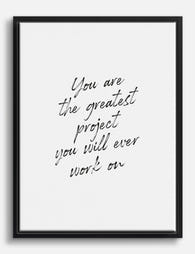
Canvas handgeschreven quote – jij bent je meesterwerk
Translation missing: nl.products.product.sale_price Vanaf €65,95€93,95 -

Poster/canvas Bauhaus geometrisch patroon in diepgroen en crème
Translation missing: nl.products.product.sale_price Vanaf €65,95€93,95 -

Canvas vintage tentoonstellingsposter met bloemen
Translation missing: nl.products.product.sale_price Vanaf €65,95€93,95 -

Poster/Canvas elke stap telt – retro sneaker
Translation missing: nl.products.product.sale_price Vanaf €65,95€93,95 -

Canvas abstract rood met geometrische lijnen op donkerblauw
Translation missing: nl.products.product.sale_price Vanaf €65,95€93,95 -

Canvas moderne abstracte vormen in aardetinten
Translation missing: nl.products.product.sale_price Vanaf €65,95€93,95 -

Canvas typografie 'Yeah'
Translation missing: nl.products.product.sale_price Vanaf €65,95€93,95 -

Canvas krachtige moderne typografie in bruintinten
Translation missing: nl.products.product.sale_price Vanaf €65,95€93,95 -

Canvas minimalistische lijnen en bogen in zwart-wit
Translation missing: nl.products.product.sale_price Vanaf €65,95€93,95 -

Canvas Bauhaus minimalistisch en modern
Translation missing: nl.products.product.sale_price Vanaf €65,95€93,95 -

Poster/Canvas Bauhaus-vormen
Translation missing: nl.products.product.sale_price Vanaf €65,95€93,95 -

Poster/Canvas Bauhaus geometrische ringen in zwart-wit
Translation missing: nl.products.product.sale_price Vanaf €65,95€93,95 -

Canvas Five met minimalistische blauwgroene typografie
Translation missing: nl.products.product.sale_price Vanaf €65,95€93,95 -

Poster zwart-wit typografie met strakke lijnen
Translation missing: nl.products.product.sale_price Vanaf €16,95€23,95 -

Canvas Andy Warhol citaat in zwart-wit
Translation missing: nl.products.product.sale_price Vanaf €65,95€93,95 -

Canvas vintage fietsrace
Translation missing: nl.products.product.sale_price Vanaf €65,95€93,95 -

Canvas moeiteloze elegantie in zachte pasteltinten
Translation missing: nl.products.product.sale_price Vanaf €65,95€93,95 -

Canvas krachtige typografie in zwart-wit
Translation missing: nl.products.product.sale_price Vanaf €65,95€93,95


Meer van The Frame

Every Bird in William Morris's Designs: The Sto...
Why birds obsessed William Morris more than any other motif Morris designed acanthus leaves, willow boughs, strawberries, tulips and pomegranates, but he kept coming back to birds. Between the 1870s...

The Best Beige Art Prints for Bedrooms (And Exa...
Most guides tell you how to hang art, but not which beige prints actually suit a bedroom, or what size to buy for your specific bed. This one does both....

The Most Famous William Morris Designs, Ranked:...
William Morris designed over 50 patterns in his lifetime, and roughly six of them get all the attention. That's mostly fair, but not entirely. Here's our honest ranking of the...