
 Beställ idag, leverans senast
 Klimt's Gold Phase: The Story Behind the Most Expensive Paintings Ever Sold
How a trip to Ravenna, a scandalous rejection, and a layer of real gold leaf created the most coveted paintings in art history.


In 2006, a single painting sold for $135 million. It was a portrait of a Viennese socialite, painted with real gold leaf, that had spent decades hanging in a stolen art collection. That painting is the reason most people now recognise Gustav Klimt on sight.
What was Klimt's Gold Phase and when did it happen?
Klimt's Gold Phase ran roughly from 1901 to 1909, the period when he applied actual gold and silver leaf directly onto his canvases. Before this, he was a successful but conventional Austrian decorator, painting ceilings for Vienna's grand public buildings. During the Gold Phase, he became something else entirely: the artist who fused Byzantine grandeur with raw eroticism and produced the most recognisable paintings of the early 20th century.
The phase is usually bookended by two specific works. Pallas Athene (1898) and Judith I (1901) mark the early experiments with gold backgrounds, while Judith II (1909) is generally considered the closing act. Everything iconic about Klimt's art style, the flattened figures floating in shimmering geometric fields, the patterned robes, the dreamlike sensuality, happened in those eight years.
It's also worth noting that Klimt grew up around gold. His father was a gold engraver, and Gustav and his brother Ernst trained in the decorative arts before turning to painting. The comfort with precious metals, with patterning, with surface ornamentation, was in his hands long before it appeared on his canvases.
The trip to Ravenna that changed everything
In 1903, Klimt travelled to Ravenna in northern Italy. He went specifically to see the Byzantine mosaics in the Basilica of San Vitale, completed in the 6th century. He came back changed.
The mosaics at San Vitale, especially the famous panels of Emperor Justinian and Empress Theodora with their courts, show figures rendered almost flat against shimmering gold backgrounds. There's no perspective in the Renaissance sense. The figures don't recede into space. They sit on the surface, robed in geometric patterns, surrounded by halos of gold tesserae that catch the light.
You can see exactly this approach translated into Klimt's work after 1903. The Kiss has no real background, just gold. Portrait of Adele Bloch-Bauer I dissolves her body into a sea of golden ornament so she appears to float. The eyes-front pose, the lack of depth, the obsessive geometric patterning: it's Byzantine sacred art reimagined for fin-de-siècle Vienna.

The key works: The Kiss, Adele Bloch-Bauer, Judith, and Pallas Athene
Four paintings define the Gold Phase, and each one does something different with the technique.
The Kiss (1907-1908)
The most famous painting of the period, and arguably the most reproduced artwork of the 20th century. Two figures kneel on a flowering meadow, wrapped in a single gold robe. The man's pattern is rectangular and black-and-white; the woman's is circular and floral. The whole composition pulses with contrast: hard and soft, geometric and organic, male and female. It's romantic on the surface and unsettlingly intense underneath.
Portrait of Adele Bloch-Bauer I (1907)
Often called the "Austrian Mona Lisa," this portrait of a Viennese sugar heiress took three years and countless preparatory sketches. Adele's face and hands emerge from a riot of golden symbols: Egyptian eyes, spirals, triangles, stylised eyes within eyes. The painting is more than gold-coloured; it is made of gold.
Judith I (1901)
Klimt's Judith doesn't look like the biblical heroine who decapitates Holofernes to save her people. She looks like a Viennese socialite mid-orgasm. The gold background, the half-closed eyes, the bare breast, the severed head almost cropped out of frame: this is Klimt collapsing the sacred and the sexual into one image. Contemporary critics were scandalised.
Pallas Athene (1898)
The proto-Gold Phase painting. Athena stares directly out, armoured in gold, holding a tiny nude figure of Truth. This is the work where Klimt first announced his break from convention, and it telegraphs everything to come.
Why was Klimt controversial? The university paintings scandal
To understand the Gold Phase, you have to understand what Klimt was reacting against.
In 1894, the University of Vienna commissioned him to paint three ceiling panels representing Philosophy, Medicine, and Jurisprudence. Standard academic stuff, in theory. What he delivered between 1900 and 1907 was anything but.
Philosophy showed a chaotic mass of naked, suffering humanity floating in cosmic void. Medicine depicted a column of nude bodies drifting past a skeleton, with a pregnant woman prominently featured. Jurisprudence showed a withered old man tormented by furies, with the law represented as a distant, indifferent abstraction.
The faculty were horrified. Eighty-seven professors signed a petition demanding the paintings be rejected. The press accused Klimt of pornography and "perverted excess." He fought back, then bought the paintings back from the state and refused to take another public commission for the rest of his life.
This is the moment that matters. Rejected by the Austrian establishment, Klimt turned to private patrons, mostly wealthy Jewish industrialists and their wives, and to subject matter no committee could veto. He had no boss anymore. The Gold Phase begins almost immediately after the scandal peaks. The freedom to plaster a society wife in real gold leaf, to paint Judith as a sexual ecstatic, came directly from the burning of those bridges.
The $135 million painting: how Portrait of Adele became 'Woman in Gold'
Portrait of Adele Bloch-Bauer I has the strangest provenance story in modern art.
Adele Bloch-Bauer died in 1925. Her husband Ferdinand fled Austria when the Nazis annexed it in 1938, and the painting, along with the rest of his collection, was seized. It hung in the Belvedere gallery in Vienna for decades, renamed simply Woman in Gold to obscure the sitter's Jewish identity. Austria treated it as a national treasure.
In 1998, Adele's niece, Maria Altmann, then living in Los Angeles, began a legal battle to reclaim the painting. The case went to the US Supreme Court in 2004 (Republic of Austria v. Altmann) and Altmann won. An Austrian arbitration panel ruled in her favour in 2006.
That summer, she sold the painting to Ronald Lauder for the Neue Galerie in New York for $135 million. At the time, it was the highest price ever paid for a painting. The story was later dramatised in the 2015 film Woman in Gold with Helen Mirren.
For context: The Kiss has never been sold. It belongs to the Belvedere and is considered priceless. Portrait of Adele Bloch-Bauer II, the second portrait Klimt painted of her, sold privately for around $150 million in 2016. The Gold Phase paintings are, by some distance, the most valuable body of work by any single artist in modern auction history.

Did Klimt use real gold? Materials and technique explained
Yes. Actually yes. Not gold paint, not metallic pigment, but hammered gold leaf, applied by hand.
The technique came directly from Byzantine icon painters and medieval manuscript illuminators. Klimt would paint the canvas in oils, then apply sheets of gold leaf, each one thinner than a human hair, using an adhesive size. He'd then burnish them, often tooling patterns directly into the metal to catch the light at different angles.
But he didn't only use gold. Portrait of Adele Bloch-Bauer I contains gold leaf, silver leaf, and platinum leaf, each producing a subtly different sheen. The cooler silver areas read almost grey-white next to the warm yellow gold; the platinum gives that ghostly luminescence around her face. Contemporary critics described his application as having "goldsmith diligence," and they meant it as both compliment and dig.
What made his use of gold modern, rather than a pastiche of medieval icons, was the context. Byzantine artists used gold to represent divine light, the realm of the sacred. Klimt used it on naked society women, on lovers in a meadow, on a biblical assassin glowing with sexual triumph. He kept the visual vocabulary of the sacred and pointed it at the body. That tension is the entire engine of his work.
Why Klimt's gold tones still work in modern homes
Klimt remains the best-selling artist in museum gift shops worldwide. He outsells everyone. There's a reason, and it has nothing to do with art-historical fashion.
Gold-toned Klimt prints occupy a rare position in interior design. They feel luxurious without feeling stuffy. The geometric patterns, those circles, triangles, and spirals, sit surprisingly well next to contemporary furniture, where more traditional gilded art would look fussy. The flatness of the compositions, that Byzantine refusal of deep perspective, means his work reads almost graphically on a wall, more like a poster than a window.
Warm metallics are also having an extended moment in interiors. Brass tapware, gold-framed mirrors, ochre upholstery, terracotta walls. A Klimt print in a sage green room with brass accents looks deliberate, not dated. In a minimalist white space, the gold becomes the entire colour story.
Practically, the warm tones flatter most lighting conditions. Cool north-facing rooms get a hit of warmth. South-facing rooms with afternoon sun make the gold actually glow. This is something that gets overlooked: Klimt designed his paintings to be seen by candlelight and oil lamp in Viennese salons, which is roughly the same colour temperature as a modern warm LED.
If you're working with art nouveau prints more broadly, Klimt is the gateway drug. His Gold Phase sits at the intersection of art nouveau's organic curves and the more geometric Vienna Secession aesthetic, which means his work cross-references both styles without committing to either.

Choosing a Gold Phase print: our recommendations
A few honest opinions on getting this right at home.
Match the size to the painting
The Kiss was painted at 180x180cm. Portrait of Adele at 138x138cm. These are large, near-square paintings. If you hang a tiny 30x40cm version above a sofa, you lose the immersive quality that made the original work. Go big where you can. A 70x100cm framed print of The Kiss above a bed or sofa is closer to the experience Klimt intended.
Framed almost always beats unframed
Klimt's gold tones need a real frame to feel finished. The geometric patterning is so dense that a borderless print can read as visually noisy. A solid wood frame in black, dark walnut, or natural oak contains the composition. Avoid actual gold frames; they compete with the painting and tip the whole thing into pastiche.
Consider the lesser-known works
Everyone knows The Kiss. Fewer people own Water Serpents I, Hope II, or studies from the Stoclet Frieze (Klimt's enormous mosaic commission for a Brussels mansion, featuring the famous Tree of Life). These read as more sophisticated choices and tend to wear better over years of looking at them. The Stoclet Tree of Life in particular works beautifully as a vertical statement piece in a hallway or beside a bed.
Watch the print quality
This matters more with Klimt than almost any other artist. Cheap reproductions flatten the gold into a single mustardy yellow and lose all the subtle variation between gold, silver, and platinum. You want a print where you can still see the metallic shifts, the tooled patterning, and the brushwork. Museum-grade giclée on a thick matte paper keeps the depth without adding glare, which matters if you're hanging in a bright room.
Pairing with other work
Klimt anchors a wall well, but he doesn't always play with others. A single large Gold Phase print does more than a gallery wall of mixed work. If you do want to pair him, lean toward abstract art prints with similar warm tones rather than other figurative work, or build a more neutral grouping using gold art prints in coordinating tones.

The takeaway
Klimt's Gold Phase happened because a respected academic painter got publicly humiliated, took a trip to Italy, and decided the rest of his career belonged only to him. The gold leaf, the geometric obsession, the floating sensual figures: all of it came out of that freedom. More than a century later, the work still does something almost nothing else on a wall can do, which is to feel both genuinely old and entirely current at the same time. Buy the biggest version you can hang. Frame it properly. Then leave it alone for ten years and see how it ages with you.
Fab-produkter som visas i denna blogg
-

Poster vildblommornas symfoni av Gustav Klimt
Translation missing: sv.products.product.sale_price Från €16,95€23,95 -

Canvastavlor gyllene skog inspirerad av Gustav Klimt
Translation missing: sv.products.product.sale_price Från €64,95€92,95 -

Canvastavlor gyllene omfamning av Gustav Klimt
Translation missing: sv.products.product.sale_price Från €64,95€92,95 -

Poster gyllene skog inspirerad av Gustav Klimt
Translation missing: sv.products.product.sale_price Från €16,95€23,95 -

Canvastavlor porträtt av Adele Bloch-Bauer I – Gustav Klimt
Translation missing: sv.products.product.sale_price Från €64,95€92,95 -
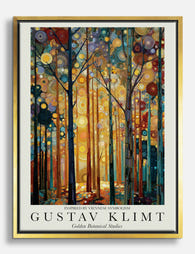
Canvastavlor gyllene skog i Gustav Klimts anda
Translation missing: sv.products.product.sale_price Från €64,95€92,95 -

Canvastavlor Klimts gyllene skog
Translation missing: sv.products.product.sale_price Från €64,95€92,95 -

Poster Klimts gyllene skog
Translation missing: sv.products.product.sale_price Från €16,95€23,95 -

Canvastavlor gul natt – inspirerad av Gustav Klimt
Translation missing: sv.products.product.sale_price Från €64,95€92,95 -

Canvastavlor gyllene skogsglöd – inspirerad av Gustav Klimt
Translation missing: sv.products.product.sale_price Från €64,95€92,95 -

Poster gyllene skog i Gustav Klimts anda
Translation missing: sv.products.product.sale_price Från €16,95€23,95 -

Canvastavlor Klimts gyllene skog
Translation missing: sv.products.product.sale_price Från €64,95€92,95 -

Canvastavlor Klimts gyllene skog
Translation missing: sv.products.product.sale_price Från €64,95€92,95 -
 Guldfolie
Poster solbelyst skog i guldfolie – inspirerad av Klimt
Translation missing: sv.products.product.sale_price Från €23,95€38,95 -

Canvastavlor Klimt-inspirerad gyllene skog
Translation missing: sv.products.product.sale_price Från €64,95€92,95 -

Poster Klimts blomstersymfoni
Translation missing: sv.products.product.sale_price Från €16,95€23,95 -

Canvastavlor Klimts gyllene skog
Translation missing: sv.products.product.sale_price Från €64,95€92,95 -

Poster gyllene skog – inspirerad av Gustav Klimt
Translation missing: sv.products.product.sale_price Från €16,95€23,95 -

Canvastavlor Klimts gyllene omfamning
Translation missing: sv.products.product.sale_price Från €64,95€92,95 -

Poster Gustav Klimts gyllene omfamning
Translation missing: sv.products.product.sale_price Från €16,95€23,95


Mer från The Frame

Kids' Room Art: Playful Without Childish
Most kids' room art falls into two camps: aggressively cute (rainbows, cartoon animals, alphabet posters) or weirdly adult (minimal black and white prints that could hang in a dentist's office)....

Nursery Art That Grows with the Room
Most nursery art gets retired by the time the cot comes down. That's a waste of money, wall space and the chance to build something genuinely meaningful. This guide is...

Office and Study: Art That Helps You Focus or A...
The art you hang in a workspace isn't neutral decoration. It either supports the kind of thinking you do at your desk, or it quietly works against it. The trick...