
 Heute bestellen, Lieferung bis
 Impressionist Moonlight Wall Art: Clustered or Spaced Layout?
A theme-specific guide to building a moonlit gallery wall that feels curated, not chaotic.


Most gallery wall guides treat every theme the same, but a moonlight gallery follows different rules than a sunny travel grid. Atmospheric, low-light impressionist work needs tighter colour control, closer spacing, and a clearer story. Here is exactly how to build one that holds together.
Start with one anchor print
Every good gallery wall has a centrepiece, and for nocturnal themes this matters even more. Moonlight pieces tend to be tonally similar (deep blues, charcoal, silver), so without a clear focal point the wall reads as a smudge rather than a composition. Start big.
We recommend a 70x100cm print as your anchor. That size has enough presence to lead the eye, but stays manageable on standard British walls (anything from a 2.4m bedroom feature wall up). Hung in portrait, it gives you vertical drama that suits moonlit landscapes and night skies. In landscape, it works above a sofa or bed.
Pick something with clear focal contrast: a moon, a reflective body of water, a lit window. The brightest point in your anchor becomes the brightest point on the entire wall, which gives every other piece something to defer to. If you are browsing impressionist moon art prints, look for one image that has a single, unambiguous light source.
We would go framed for the anchor. The weight of a solid wood frame around a large nocturnal piece settles the wall, and a UV-protective glaze keeps those deep blues from drifting toward grey over the years.

Building outward: how many prints you actually need
Fewer than Pinterest suggests. For a moonlight gallery, four to six pieces total is the sweet spot. Three can feel sparse for a theme that wants intimacy, and seven or more starts to dilute the mood. Each print has to earn its place by adding something the others lack.
Think of it as a visual sentence. The anchor is your subject, two supporting prints offer rhythm, and one or two smaller pieces add texture or detail. If a print does not change the meaning of the group, it is filler.
A common mistake is buying a pre-made set of nine matching tiles and calling it a gallery wall. That is a grid, not a gallery, and grids flatten the mood that makes moonlight work in the first place. Curate piece by piece instead.
If you do want a coordinated starting point, our wall art sets are designed to work together without feeling clinical. You can always add a contrasting piece later.
Mixing sizes without creating chaos
Two layouts handle nocturnal themes particularly well: the 2-1-2 and the L-shape.
The 2-1-2 layout
Your 70x100cm anchor sits in the centre. Two medium prints (we like 30x40cm) flank it on the left, and two more on the right, stacked vertically. The eye reads the anchor first, then sweeps outward in pairs. It is symmetrical without being rigid, and it suits sofas, beds, and console tables where you want the art to mirror the furniture below.
The L-shape layout
The anchor sits on the upper left. Two medium prints run along the bottom, one large print (50x70cm) sits to the right of the anchor, and a smaller piece (21x30cm) tucks into the corner. This layout works on taller walls or in corners, and it has a more organic, narrative feel. Better for hallways and reading nooks than above a sofa.
Whichever you choose, draw it on paper first. Tape newspaper cut-outs to the wall in the actual sizes and live with them for two days before committing to nail holes.
Keeping the palette cohesive
This is where most moonlight gallery walls fall apart. "Blues and silvers" sounds like a clear brief until you hold three prints up and realise one is a warm Prussian blue, one is a cool steel grey, and one is leaning purple. They fight.
Pick a temperature and stick to it. For nocturnal themes you have two viable directions:
Cool moonlight: ultramarine, indigo, slate grey, soft silver, hints of teal. This is the classic Whistler-leaning palette. Avoid warm gold accents here because they will look orange against the cool tones.
Warm moonlight: deep navy, charcoal, bronze, antique gold, brushed brass. Think candlelit windows under a dark sky. Avoid pure silver or icy blue, which will read as off-temperature.
Pick one. Mixing them creates the muddy, half-committed look that makes a wall feel accidental.
Deep greens (forest, bottle, moss) work in both palettes if used sparingly, usually as a single supporting piece. They reference the way impressionists rendered foliage in low light, and they break up the blues without breaking the mood. If you want to explore the broader category, impressionism art prints gives you a full range to filter from.
One more rule: stick to one light story. A full moon, a crescent moon, a lit lamppost, and a sunrise on the same wall creates visual chaos. Your prints should look like they were painted on the same night.

Frame consistency vs. eclectic mixing
The eclectic mixed-frame look has its place. A moonlight gallery is not it.
Atmospheric, tonally similar prints need a unifying element that sits outside the artwork itself. If the prints already share mood and palette, mixing frame styles introduces a second visual conversation that competes with the first. The wall stops feeling like one curated piece and starts feeling like five separate decisions.
Match your frames. We would go with one of two options:
Black solid wood: the strongest choice for moonlight. It picks up the dark passages in the prints and disappears into the wall in low light, letting the art carry the mood.
Natural oak: softer, warmer, better suited to a warm-moonlight palette or a bedroom where you want the wall to feel less graphic. Works particularly well with bronze and gold accents in the artwork.
Avoid white frames for this theme. They float the prints away from each other and undercut the intimacy you are building. Avoid ornate or distressed frames too, which add visual noise that nocturnal work does not need.
A note on finish: matte paper handles moody impressionist work better than gloss. Brushstroke texture stays visible, reflections do not interrupt the dark passages, and the ink sits into the paper rather than skating on top.
Spacing and alignment: exact measurements
Standard gallery wall spacing is 5 to 7cm (2 to 3 inches) between frames. For moonlight themes, go to the tighter end of that range. 5cm spacing creates intimacy and lets the wall read as one composition. Looser spacing (8cm+) introduces breathing room that fights the mood.
The centre of the gallery (not the centre of any single print, but the visual midpoint of the whole arrangement) should sit at 145 to 150cm from the floor. This is the museum-standard eye level, often called the 57-inch rule, and it is the single most reliable hanging measurement you can follow.
If your gallery sits above furniture, leave 15 to 20cm between the top of the furniture and the bottom of the lowest frame. Closer than that and the art looks like it is resting on the sofa. Further and it disconnects.
For alignment within the layout:
- Align the tops of prints in the same horizontal row, even if they are different heights
- Align the centres vertically through your anchor
- Keep all spacing consistent (5cm between every adjacent frame, no exceptions)
Use a pencil and a spirit level. Mark the centre of each print on the wall before you put a single nail in. Framed prints from us arrive with fixtures attached, so once your marks are right, hanging is the easy part.
The rooms where a moonlight gallery wall works best
Not every room can carry this theme.
Bedrooms: the natural home. Moonlight art reinforces the function of the room (rest, quiet, the end of the day) and looks beautiful in low ambient light. Hang above the bed or on the wall opposite, where you see it from the pillow.
Living rooms and snugs: excellent if the room has warm or moody lighting in the evening. Nocturnal art comes alive under a single floor lamp or a fire. It can feel flat under bright overhead lights, so think about your evening lighting before you commit.
Hallways and stairwells: strong choice, especially with the L-shape layout. Hallways are usually transitional spaces with softer lighting, and a moonlight gallery turns them into something atmospheric rather than purely functional.
Reading nooks and studies: yes, particularly if you want a contemplative mood.
Kitchens: no. Bright, task-lit, often steamy, and the mood is wrong. Save it for the rest of the home.
Bathrooms: also no, mostly because of humidity. Even with quality framing, a steamy room is not the right environment for paper-based art over the long term.
Children's rooms and playrooms: the mood is at odds with the function. Bright, energetic art suits these spaces better.
A quick word on lighting. Directional light (a picture light, a wall sconce, a focused track spot) flatters moonlight art far more than ambient overhead lighting. If you can install one warm-toned spot above your anchor print, the whole gallery lifts.

Ordering tips: how to test before committing
Buying five prints at once is a leap. We would not ask you to take it blind.
Our 99-day returns policy is built for exactly this situation. Order your anchor first and live with it on the wall for a week. See how it looks under your morning light, your evening lamps, and during the in-between hours. If the colour temperature is wrong for your room, you have time to swap it.
Once the anchor is right, order your supporting pieces in pairs. Hang them with removable adhesive strips before any nails go in, then walk away. Come back in a day. If anything feels off (a print that pulls warm against cool neighbours, a size that disappears next to the anchor), send it back and try a different one.
This staged approach also lets you test the layout itself. You might start planning a 2-1-2 and realise an L-shape suits your wall better. Better to find out before you have committed to five frames.
A couple of practical notes on ordering:
- Order all your frames in the same finish at the same time, even if they are different sizes. This guarantees the wood tone matches.
- If you are mixing framed and unframed canvas pieces, place the canvas off-centre rather than next to the anchor. Canvas reads differently to framed paper, and the contrast is more interesting at the edges of a layout than in the middle.
- For larger walls (over 3m), consider going to 100x70cm canvas for the anchor instead of a 70x100cm framed print. Canvas at scale carries atmospheric work beautifully, and the mirrored edge wrapping keeps the image intact.
You can browse impressionist night sky prints and impressionism moonlight wall art to start putting your shortlist together.

A seasonal rotation idea
Once your wall is settled, you can keep it interesting without redesigning. Swap one or two of the smaller supporting prints seasonally. A starry winter sky in January, a summer dusk in July. The anchor stays, the palette stays, but the wall keeps a small rhythm of change. This is also where the returns window earns its keep: you can try a seasonal swap in October and have it on the wall for Christmas.
Final thoughts
Build around one anchor. Keep the palette to a single temperature. Match your frames, tighten your spacing, and stop adding prints once the story is told. A moonlight gallery wall does not need to be busy to feel rich. It needs to feel like one moment, captured five times.

In diesem Blog vorgestellte Fab-Produkte
-

Poster Landschaft bei Mondschein
Translation missing: de.products.product.sale_price Ab CHF 16.00CHF 22.00 -
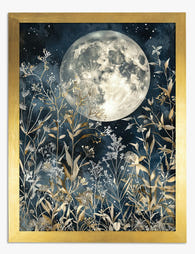
Poster Wildblumen im Vollmondlicht
Translation missing: de.products.product.sale_price Ab CHF 16.00CHF 22.00 -

Leinwandbild Mondnacht-Landschaft mit sanften Hügeln
Translation missing: de.products.product.sale_price Ab CHF 62.00CHF 88.00 -

Leinwandbild Botanische Mondnacht mit goldenem Sichelmond
Translation missing: de.products.product.sale_price Ab CHF 62.00CHF 88.00 -

Leinwandbild Mondlicht über Wildblumen
Translation missing: de.products.product.sale_price Ab CHF 62.00CHF 88.00 -

Poster Biarritz Mondsichel bei Nacht
Translation missing: de.products.product.sale_price Ab CHF 16.00CHF 22.00 -

Poster Gustav Klimts Nachtgarten – Blumengarten im Mondlicht
Translation missing: de.products.product.sale_price Ab CHF 16.00CHF 22.00 -

Leinwandbild Mondlicht am Mittelmeer
Translation missing: de.products.product.sale_price Ab CHF 62.00CHF 88.00 -

Leinwandbild Mondheller Hain – inspiriert von William Morris
Translation missing: de.products.product.sale_price Ab CHF 62.00CHF 88.00 -

Poster Mondnacht am Mittelmeer
Translation missing: de.products.product.sale_price Ab CHF 16.00CHF 22.00 -

Poster goldener Wald bei Nacht mit Halbmond
Translation missing: de.products.product.sale_price Ab CHF 16.00CHF 22.00 -

Leinwandbild Farn im Mondlicht – William Morris inspiriert
Translation missing: de.products.product.sale_price Ab CHF 62.00CHF 88.00 -

Poster Garten im Mondlicht – Verspielte Blumen & Sterne
Translation missing: de.products.product.sale_price Ab CHF 16.00CHF 22.00 -

Poster Küste im Mondlicht
Translation missing: de.products.product.sale_price Ab CHF 16.00CHF 22.00 -

Leinwandbild Bergnebel im Mondlicht
Translation missing: de.products.product.sale_price Ab CHF 62.00CHF 88.00 -

Leinwandbild Mondnacht von William Morris
Translation missing: de.products.product.sale_price Ab CHF 62.00CHF 88.00 -

Poster Mittelmeer-Küste im Mondlicht mit Orangen
Translation missing: de.products.product.sale_price Ab CHF 16.00CHF 22.00 -

Leinwandbild Sternennacht-Pfad in Blau und Gold
Translation missing: de.products.product.sale_price Ab CHF 62.00CHF 88.00 -

Poster Mondnacht von William Morris
Translation missing: de.products.product.sale_price Ab CHF 16.00CHF 22.00


Mehr aus The Frame

Every Animal in William Morris's Designs: The C...
Most people know the thrush in Strawberry Thief and stop there. But Morris's wider body of work contains foxes, hares, peacocks, ravens, lions, herons, woodpeckers, deer, and doves, often half-buried...

Countryside Decor Ideas: How to Bring Rural Cal...
Countryside art has quietly become one of the most versatile choices in modern interiors. Not the chintz-and-bunting version, but the kind of soft, considered pastoral scenes that bring the outside...

Arts and Crafts Animal Prints: The Victorian De...
The Arts and Crafts revival: why Victorian animal prints are trending again Scroll through any interior design hashtag right now and you'll see them everywhere: hares peering through curling foliage,...