
 Heute bestellen, Lieferung bis
 Klimt's Women Decoded: The Hidden Symbolism in His Most Famous Female Portraits
A guide to the patterns, poses, and gold that turn Klimt's portraits into a coded language about female power.


"I am less interested in myself as a subject for painting than I am in other people, above all women." Gustav Klimt said this near the end of his life, and it's the key to almost everything he made. His female portraits aren't just beautiful. They're a coded system of patterns, poses, gold, and gestures that say specific things about power, sex, mortality, and modernity.
This is a guide to reading that code, so the print on your wall means something to you beyond surface decoration.
Ornament as Armour: Why Klimt Wrapped His Women in Pattern
Look at any of Klimt's mature portraits and you'll notice the same trick. The face and hands are painted with photographic realism. Everything else collapses into flat, dense pattern. Triangles, eggs, spirals, eyes, gold rectangles, swirls of black and silver. The woman becomes an island of skin in a sea of ornament.
This wasn't a stylistic flourish. Klimt was treating pattern as armour. The dress doesn't drape the body, it encases it. The background doesn't recede, it presses forward and absorbs her. You can read this two ways at once, which is precisely the point. The pattern protects her from the viewer's gaze, and it also displays her like a jewel in a setting.
The shapes themselves carry meaning. Triangles and eggs are old fertility symbols. Spirals suggest cycles, sex, regeneration. The almond shapes scattered through Adele Bloch-Bauer's gown are deliberately erotic, a visual code that contemporary Viennese viewers would have recognised. Klimt was painting the body without painting the body.
There's a second effect. By dissolving individual identity into archetypal pattern, Klimt turns specific women into something closer to icons. The real Adele, the real Judith, the real Emilie Flöge are still there in the faces. But they've also become something larger.

The Symbolism of Gold in Klimt's Female Portraits
In 1903 Klimt travelled to Ravenna and saw the Byzantine mosaics at the Basilica of San Vitale. The empress Theodora, gold-leafed and frontal, staring out from a wall of shimmering tile. He came home and started what art historians call his Golden Phase, the period that produced his most famous woman portraits.
Gold in Klimt does several jobs at once. It's the sacred backdrop of icon painting, lifting his subjects out of ordinary time and into something eternal. It's wealth, obviously, signalling the Viennese haute bourgeoisie who commissioned him. And it's erotic, because gold flickers, catches light, behaves like skin under candlelight.
It's also armour again. Gold leaf is a hard, reflective surface. It bounces the viewer's eyes back rather than letting them sink in. The woman is protected by a wall of light.
What makes Klimt's gold radical is that he used the visual grammar of religious icons, traditionally reserved for the Virgin Mary or saints, to depict modern Jewish women from Vienna's progressive intellectual class. Adele Bloch-Bauer wasn't a saint. She was a salon hostess, a socialist sympathiser, and the wife of a sugar magnate. Putting her in gold was a quiet provocation.
Eyes Open, Eyes Closed: What Klimt's Women Are Really Doing
Once you start noticing this, you can't unsee it. Klimt's women fall into two camps, and the difference matters.
Eyes open women stare directly at the viewer. Adele Bloch-Bauer I. Judith I. These women are awake, conscious, and they're looking back. They have agency. They are not objects of contemplation, they're subjects with their own gaze, and they're sizing you up as much as you're sizing them up.
Eyes closed women are turned inward. The Kiss. Danaë. Water Serpents. These figures are wrapped in private experience, usually pleasure, sometimes sleep, sometimes both. They're not performing for the viewer. They're somewhere else entirely, and we're the ones intruding.
This split tells you what Klimt was doing with the male gaze long before that phrase existed. Eyes-open portraits give women social and intellectual power. Eyes-closed paintings give them sensual power, the kind that doesn't need the viewer's approval to exist. Neither is passive. Both are radical for 1907.
When you're choosing a print, this is one of the most useful distinctions to think about. An eyes-open Klimt in a room confronts everyone who enters it. An eyes-closed Klimt creates a more intimate, almost private atmosphere. You're choosing the social temperature of the wall.
The Three Ages of Woman: Mortality, Tenderness, and Decay in One Frame
Painted in 1905, The Three Ages of Woman is Klimt at his most philosophically blunt. A young mother cradles a sleeping infant. Beside them stands an old woman, her body wasted, her face hidden in her hand. All three are nude, all three are real, all three are painted with the same unflinching attention.
The painting refuses the standard art-historical fantasy of woman as eternal beauty. Klimt insists on the full arc. Birth, peak, decline. The young woman's skin is flushed and luminous. The old woman's is grey and slack. Klimt did not soften her. He painted varicose veins and a distended stomach. Viennese audiences found it unbearable, which is partly the point.
The patterns around the figures shift accordingly. The mother and child are surrounded by bright, fertile circles and triangles. The old woman stands against darker, more dissonant ornament. Even the symbolic backdrop ages.
If you're drawn to this painting, you're drawn to something quite different from the gold-phase portraits. It's a memento mori dressed in Art Nouveau, and it makes a very different room. It belongs somewhere thoughtful, like a bedroom or a reading corner, rather than a dining room where guests need to feel welcomed.

Judith vs. Adele: Two Very Different Kinds of Female Power
This is the most useful contrast in all of Klimt, and it's the one that should guide a lot of buying decisions.
Judith I (1901) shows the biblical heroine who seduced and beheaded the Assyrian general Holofernes. Klimt paints her topless, gold-collared, eyes half-closed in post-violent ecstasy, with the general's severed head pushed almost out of the frame as an afterthought. She is dangerous, erotic, triumphant. This is feminine power as predation. The viewer is not safe.
Adele Bloch-Bauer I (1907), sometimes called the Woman in Gold, shows a different kind of authority. Adele was 26, brilliant, fluent in several languages, a host of Vienna's leading intellectuals and socialists. Klimt paints her fully clothed in a cascade of gold and silver geometry, her hands clasped in front of her in a deliberately awkward gesture that, biographers note, may have concealed a disfigured finger. Her power is intellectual, social, composed. She doesn't need to threaten you. She simply outranks you.
These are two archetypes of female power that Klimt returns to throughout his career: the warrior and the intellectual, the body and the mind, the seducer and the salon hostess. Neither is more feminist than the other. They're complementary.
When you choose between them, you're choosing what kind of energy you want a room to hold. Judith is a statement piece for spaces that want drama. Adele is for spaces that want gravitas without confrontation. Both work brilliantly at scale, and you'll find both in our collection of Klimt woman art prints, where the gold detail genuinely benefits from a larger format like 70x100cm.
Klimt's Controversy in Context: Why Vienna Was Scandalised
To understand why these symbols mattered, you have to understand how badly Vienna reacted to them.
In 1894 the University of Vienna commissioned Klimt to paint three ceiling panels for its Great Hall, representing Philosophy, Medicine, and Jurisprudence. He delivered something nobody expected. Tangled masses of naked bodies. Pregnant women. Old men. Death floating in space. Female sexuality presented not as allegory but as raw fact. Eighty-seven faculty members signed a petition rejecting the paintings. A public prosecutor was called in. Klimt was accused of pornography.
He bought the paintings back and never accepted a public commission again. Privately he said: "Enough of censorship. I want to get away."
This is the context for everything that follows. The gold portraits, the eyes-closed nudes, the Three Ages of Woman, all of it was made by an artist who had just been publicly humiliated for taking female bodies seriously. His response was not to retreat but to go further, this time funded by progressive private patrons, mostly Jewish Viennese families like the Bloch-Bauers, the Lederers, and the Wittgensteins. These were people whose women were already breaking with Victorian norms. Adele ran a salon. Klimt's lifelong companion Emilie Flöge ran a couture fashion house that designed loose, reform-style dresses freeing women from corsets.
Klimt's women look the way they do because the women around him were actively reinventing what a modern woman could be. The symbolism is a record of that reinvention.

Choosing a Klimt Woman Print That Means Something to You
Now the practical part. With a framework in hand, you can make a sharper choice.
If you want intellectual gravitas: Adele Bloch-Bauer I. Eyes open, fully clothed, geometric. Works beautifully in studies, home offices, formal living rooms. The gold reads as warmth against deep colours like forest green, oxblood, or navy. Go large if you can. The detail in the geometric panels rewards close looking, which is one of the reasons matte giclée paper suits it better than glossy alternatives.
If you want drama and edge: Judith I or Judith II. These belong in spaces that already have personality. A hallway that needs an arrival moment. A dark living room. A bar area. Avoid pairing with anything else competing for attention.
If you want intimacy and sensuality: The Kiss, Danaë, or one of the eyes-closed nudes. Bedrooms, dressing rooms, private corners. The Kiss in particular is so widely reproduced that scale and quality really matter. A small, badly printed version is a cliché. A large 70x100cm framed print on thick matte paper, where you can actually see the texture of the gold leaf reproduction, is something else entirely.
If you want something philosophical: The Three Ages of Woman, Hope II, or Death and Life. These reward slow rooms. Reading nooks, bedrooms, anywhere people sit still.
A few practical notes. Klimt's gold tones can clash with cool greys and stark whites. They sing against warm neutrals, deep saturated colours, natural wood, and unpainted brick. If you're going framed, a thin black or natural oak frame stays out of the way. Ornate gold frames fight the gold inside the picture and usually look fussy.
Print quality matters more with Klimt than with most artists because so much of the work depends on fine geometric detail and the way gold tones modulate across a surface. Cheap reproductions flatten the gold into a single yellow and lose the metallic shifts between warm and cool. If you're investing in a piece you'll live with for years, the format you choose, paper weight, frame construction, UV protection on the glaze, all of it shapes whether the print still looks alive in five years.
You'll find the full range across our Klimt collection, and if you're building a wall around a broader theme you can pair Klimt with other works from the Art Nouveau period or with classical portrait prints for a layered, salon-style hang.

The point of decoding Klimt isn't to turn art into a puzzle. It's to know what you're choosing. Pick the woman whose particular kind of power you want to live alongside, hang her at eye level, and give her room to breathe.

In diesem Blog vorgestellte Fab-Produkte
-

Poster Dame mit Pelzhut von Gustav Klimt
Translation missing: de.products.product.sale_price Ab CHF 15.00CHF 22.00 -

Poster Gustav Klimt – Frau im Blumenkleid im Garten
Translation missing: de.products.product.sale_price Ab CHF 15.00CHF 22.00 -

Leinwandbild Dame mit Pelzhut – Gustav Klimt
Translation missing: de.products.product.sale_price Ab CHF 60.00CHF 86.00 -
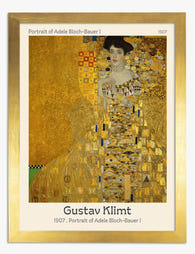
Poster Adele Bloch-Bauer von Gustav Klimt
Translation missing: de.products.product.sale_price Ab CHF 15.00CHF 22.00 -

Leinwandbild Adele Bloch-Bauer I von Gustav Klimt
Translation missing: de.products.product.sale_price Ab CHF 60.00CHF 86.00 -

Leinwandbild Gustav Klimt – Hermine Gallia
Translation missing: de.products.product.sale_price Ab CHF 60.00CHF 86.00 -

Poster Klimts katzenhafte Muse im Vintage-Stil
Translation missing: de.products.product.sale_price Ab CHF 15.00CHF 22.00 -

Leinwandbild Porträt Helene Klimt - Gustav Klimt
Translation missing: de.products.product.sale_price Ab CHF 60.00CHF 86.00 -

Leinwandbild Gustav Klimt – Porträt der Fritza Riedler
Translation missing: de.products.product.sale_price Ab CHF 60.00CHF 86.00 -

Leinwandbild Dame in Weiß von Gustav Klimt
Translation missing: de.products.product.sale_price Ab CHF 60.00CHF 86.00 -

Poster Die Dame in Weiß von Gustav Klimt
Translation missing: de.products.product.sale_price Ab CHF 15.00CHF 22.00 -
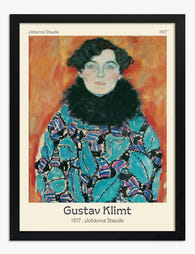
Poster Johanna Staude von Gustav Klimt
Translation missing: de.products.product.sale_price Ab CHF 15.00CHF 22.00 -

Poster Helene Klimt von Gustav Klimt
Translation missing: de.products.product.sale_price Ab CHF 15.00CHF 22.00 -

Leinwandbild Klimts Blütensinfonie
Translation missing: de.products.product.sale_price Ab CHF 60.00CHF 86.00 -

Leinwandbild Der Kuss von Gustav Klimt
Translation missing: de.products.product.sale_price Ab CHF 60.00CHF 86.00 -

Poster Klimts Blumensinfonie
Translation missing: de.products.product.sale_price Ab CHF 15.00CHF 22.00 -

Poster Klimts Sonnenbeschienener Wald
Translation missing: de.products.product.sale_price Ab CHF 15.00CHF 22.00 -
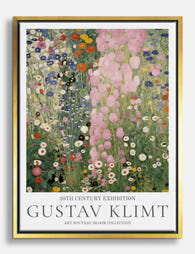
Leinwandbild Gustav Klimt – Florale Sinfonie
Translation missing: de.products.product.sale_price Ab CHF 60.00CHF 86.00


Mehr aus The Frame

What Interior Designers Know About Styling Japa...
Japanese bird prints are quietly the most versatile art you can buy. They sit happily in a modernist flat, a Victorian terrace, or a beige rental, and they rarely fight...

Botanical Prints vs. Floral Art: What's the Dif...
If you've searched for "botanical art prints" and ended up scrolling through everything from Victorian fern studies to neon abstract peonies, you're not imagining the chaos. The two categories get...

Modern Floral Prints That Don't Look Dated: 7 S...
Floral prints have a reputation problem. Mention them to anyone under 40 and they picture chintz curtains, peach watercolour bouquets in oval frames, or those identical rose prints that haunted...