
 Heute bestellen, Lieferung bis
 How to Build a Picasso Gallery Wall That Actually Works
A prescriptive, no-nonsense framework for choosing, sizing, and arranging Picasso prints so your wall looks curated, not chaotic.


Most gallery wall guides tell you to "play around with the layout" and "trust your eye." That advice is useless when you're staring at over a hundred Picasso prints trying to figure out which five belong on your living room wall. This is the prescriptive guide we wish existed: exact numbers, exact sizes, exact rules for mixing periods, and a layout template that works on almost any UK wall.
Why Picasso is the perfect artist for a gallery wall
Picasso made everything. Sombre Blue Period portraits, fractured Cubist still lifes, single-line doves drawn in seconds, ceramics, etchings, neoclassical nudes. One artist, dozens of visual languages, all unmistakably his. That breadth is exactly what a gallery wall needs: variety inside a single creative voice.
The unifying thread is line. Whether you're looking at a 1903 portrait or a 1949 dove, Picasso's mark-making is consistent and confident. That means you can mix radically different periods on one wall and the eye still reads it as coherent. Try doing that with five different contemporary artists and you'll get visual noise.
The other reason Picasso works: most of his prints sit in a restrained palette. Blacks, off-whites, ochres, terracottas, the occasional flash of cobalt. That natural colour discipline does half the styling work for you.
How many prints you actually need (hint: it's fewer than you think)
The honest answer for 90% of UK homes is five to seven prints. Not ten. Not twelve. Definitely not the dense salon-style wall you've seen on Pinterest with twenty frames jammed together.
Here's why fewer wins. Picasso prints, especially the line drawings and Cubist works, need breathing room to be read. Cram them and they fight each other. Five well-chosen pieces at considered sizes look intentional. Twelve pieces look like you panic-bought a job lot.
The maths is simple. A standard UK sofa is around 200cm wide. Your gallery wall should sit at roughly two-thirds of that width, so 130 to 140cm. With sensible 5cm spacing, that wall comfortably holds five to seven frames in mixed sizes. Past seven, the individual prints stop having impact.
If you're building a collection slowly, start with a starter trio: one larger statement piece (60x80cm), one medium (40x50cm), one small (30x40cm). You can add to it over months without re-planning the whole wall.

Mixing Blue Period, Cubist, and line drawings without chaos
This is where most people come unstuck. They buy a sombre Blue Period portrait, a busy Cubist guitar, and a delicate line drawing of a dove, hang them next to each other, and wonder why it looks wrong.
The fix is a ratio. We use 60/20/20.
- 60% line drawings. These are your unifying element. Light, airy, mostly white space. They give the wall room to breathe and stop it feeling heavy. Browse line art prints to see why this style is so easy to live with.
- 20% Blue Period or Rose Period. One or two pieces with deeper colour and emotional weight. This is what stops the wall feeling too clinical.
- 20% Cubist. One piece, maybe two if it's a large wall. Cubist works are visually loud, so you want them as accents, not the main event.
For a five-print wall, that's three line drawings, one Blue Period, one Cubist. For a seven-print wall, four line drawings, one or two from the Blue/Rose Period, one or two Cubist.
The mistake to avoid: equal weighting. Two of each period creates visual democracy, which sounds nice and looks terrible. You need a clear hierarchy.
Watch the colour temperature
Picasso's Blue Period is cool. His Rose Period is warm. His line drawings are neutral. Mixing one Blue Period and one Rose Period piece on the same wall can feel jarring because the temperatures clash. Pick a side. We'd lean Blue Period for cool-toned rooms (greys, sage greens, deep blues) and Rose Period for warmer rooms (terracotta, cream, oak).
The layout that works for 90% of walls: a practical template
Forget freeform "organic" arrangements. They're harder than they look and usually end up lopsided. Use the asymmetric focal point layout instead.
Here's the template for a wall above a 200cm sofa:
- The anchor. One large print (60x80cm portrait orientation), positioned slightly left of centre. This is your focal point, usually the Cubist piece or the Blue Period portrait.
- The cluster. To the right of the anchor, a vertical pair: one medium print (40x50cm) above one small print (30x40cm), aligned to a shared right edge.
- The bridge. Above and slightly right of the anchor, one medium print (50x70cm landscape) that ties the whole composition together.
- The grace note. A small print (30x40cm) tucked into the lower right, finishing the composition.
That's five prints. The eye enters at the large anchor, travels up to the bridge, across to the cluster, and down to the grace note. It's a deliberate path, not a random scatter.
Spacing between frames: 5cm consistently. Not 2cm (looks cramped) and not 10cm (looks like separate pieces, not a wall). 5cm is the sweet spot for prints up to 70x100cm.
For hallway walls, which are typically narrower, drop to three or four prints in a horizontal row, all aligned along their horizontal centres. Same 5cm spacing.

Choosing one frame style to tie everything together
This is non-negotiable: all your frames must match. Same colour, same profile, same width. The whole point of varied prints is that they're varied. The frame is what tells the eye "these belong together."
Three frame options work for Picasso:
Solid oak (or natural wood). Our default recommendation. Warm, organic, never dates. Works in almost any UK interior, from period Victorian to new-build. Makes line drawings feel modern and softens the seriousness of Blue Period works.
Black wood. Sharper, more graphic. Brilliant for Cubist-heavy walls because it amplifies the geometry. The trade-off: black frames can overwhelm delicate single-line drawings and make them feel funereal. Use black only if your wall leans Cubist-heavy.
White wood. Clean and minimal. Good in white or very pale rooms where you want the prints, not the frames, to do the work. Less forgiving in busier rooms where they can disappear.
We'd avoid metal frames for Picasso. They feel too cold and corporate against his hand-drawn quality.
A note on materials: cheap frames warp, especially if they're MDF or veneered chipboard. On a gallery wall, even one warped frame ruins the whole effect because it sits at a slightly different angle to its neighbours. Solid wood frames stay true. Our framed picasso posters and prints ship with the print already fitted into a solid FSC-certified wood frame, with UV-protective acrylic glaze rather than glass. The acrylic matters because glass on five frames at once is genuinely heavy and a hanging risk.
Mat or no mat?
A mat (the white border between print and frame) adds formality and breathing space. For Picasso line drawings, mats are excellent because they extend the white space the artwork already relies on. For Cubist works with imagery running edge to edge, mats can feel fussy. If you want consistency, go mat for everything or no mat for everything. Don't mix.
Sizing guide: the combination of print sizes that looks balanced
Buy five prints in five different sizes and the wall looks chaotic. Buy five prints in three sizes and it looks composed. Use this combination:
For a five-print wall (sofa or feature wall, 130-150cm wide):
- 1 x 60x80cm (anchor)
- 2 x 40x50cm (medium)
- 2 x 30x40cm (small)
For a seven-print wall (longer feature wall, 180-220cm wide):
- 1 x 70x100cm (anchor)
- 2 x 50x70cm (medium)
- 4 x 30x40cm (small)
For a three-print starter (200cm sofa, building gradually):
- 1 x 60x80cm (anchor)
- 1 x 40x50cm
- 1 x 30x40cm
The principle: one clearly largest piece, two or three medium pieces, the rest small. Avoid having two prints at the same size next to each other unless they're a deliberate pair, and even then, only do this once on the wall.
If you'd rather skip the maths, pre-curated wall art sets handle the size ratios for you.

How to hang your gallery wall straight (the tape trick that saves hours)
Do not start with a hammer. Start with newspaper or kraft paper.
- Trace each frame onto paper and cut out templates the exact size of each print.
- Mark the hanging point on each template (measure where the hook or wire sits on the back of the actual frame and replicate it on the paper).
- Tape the templates to the wall with low-tack masking tape, in your planned layout.
- Live with it for 24 hours. Walk past it. See it from the sofa, from the doorway, in morning and evening light. You will spot problems you wouldn't notice in five minutes of arranging.
- Adjust freely. Move templates around until it feels right. Paper is free. Holes are not.
- Hammer through the marked hanging point on each template. This puts the nail or hook in exactly the right place. Then tear the paper away.
This method takes an hour and saves you from a wall full of patched holes. It's how professional installers do it.
For height: the centre of your gallery wall as a whole should sit at around 145-150cm from the floor (UK average eye level). Above a sofa, leave 20-25cm between the top of the sofa back and the bottom of the lowest frame. Closer than 20cm feels cramped. More than 30cm and the art looks like it's floating away from the furniture.
A quick word on weight: framed prints with acrylic glaze are lighter than glass-framed prints, which matters when you're putting five or six on one wall. Standard picture hooks rated for 5kg are fine for prints up to 50x70cm in solid wood frames. For the 70x100cm anchor piece, use two hooks spaced 30cm apart for stability.
Adding non-Picasso prints to a Picasso-led wall
Yes, you can mix artists. The trick is keeping the visual language consistent.
Stick to black, white, and neutral palettes. Picasso's prints sit naturally in a black and white art prints palette, so adding other monochrome works (Matisse cut-outs, Cocteau line drawings, vintage Bauhaus posters, modernist photography) tends to land well.
Avoid adding anything with a strong, unrelated colour story. A bright botanical print or a saturated landscape will pull the eye away from the Picasso pieces and break the cohesion you've built.
The ratio rule: even when adding other artists, at least 60% of the wall should remain Picasso. If you drop below that, it stops being a Picasso gallery wall and becomes a generic mixed wall. Once you've found prints you love, the abstract picasso prints and complementary line work read as one curated whole.
One more rule: don't add family photos to a Picasso wall. They sit in a different visual register and the contrast undermines both. Photos belong on their own wall.
A final note on the trade-offs
A Picasso gallery wall is not the easiest decorating project. It costs more than a single statement piece. It takes longer to plan. And once it's up, you're committed to a specific aesthetic in that room.
But done properly, it's the kind of wall that genuinely changes how a room feels. Five carefully chosen prints, in matching solid wood frames, hung at the right height with consistent spacing, will outlast every trend that comes through your home for the next twenty years.
Start with the trio. Live with it for a month. Then build from there.


In diesem Blog vorgestellte Fab-Produkte
-

Leinwandbild Farbenfroher Friedens-Blumenstrauß
Translation missing: de.products.product.sale_price Ab CHF 62.00CHF 88.00 -

Poster Ruhe der schottischen Highlands
Translation missing: de.products.product.sale_price Ab CHF 16.00CHF 22.00 -

Poster Friedliche Blüten – inspiriert von Picasso
Translation missing: de.products.product.sale_price Ab CHF 16.00CHF 22.00 -
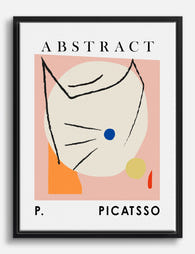
Leinwandbild Abstrakte Katze im Stil Picassos
Translation missing: de.products.product.sale_price Ab CHF 62.00CHF 88.00 -

Leinwandbild Rosa Herz – Picasso-inspirierte Linienzeichnung
Translation missing: de.products.product.sale_price Ab CHF 62.00CHF 88.00 -

Leinwandbild Park Güell, Barcelona – Stadtblick
Translation missing: de.products.product.sale_price Ab CHF 62.00CHF 88.00 -

Poster/Leinwandbild Bauhaus-Geometrie in Blau und Weiß
Translation missing: de.products.product.sale_price Ab CHF 62.00CHF 88.00 -

Poster Kleine Welten IX – inspiriert von Kandinsky
Translation missing: de.products.product.sale_price Ab CHF 16.00CHF 22.00 -

Leinwandbild Barcelona Stadtansicht in Farbflächen
Translation missing: de.products.product.sale_price Ab CHF 62.00CHF 88.00 -

Leinwandbild Barcelona Traumlandschaft
Translation missing: de.products.product.sale_price Ab CHF 62.00CHF 88.00 -

Leinwandbild Matisse-Kurven Mallorca
Translation missing: de.products.product.sale_price Ab CHF 62.00CHF 88.00 -

Poster Kleine Welten II von Kandinsky
Translation missing: de.products.product.sale_price Ab CHF 16.00CHF 22.00 -

Poster Barcelona Stadtansicht mit mediterranem Charme
Translation missing: de.products.product.sale_price Ab CHF 16.00CHF 22.00 -

Leinwandbild Kleine Welten I von Kandinsky
Translation missing: de.products.product.sale_price Ab CHF 62.00CHF 88.00 -

Leinwandbild Bauhaus-Charme mit Geometrie & kräftigen Farben
Translation missing: de.products.product.sale_price Ab CHF 62.00CHF 88.00 -

Leinwandbild Bauhaus-Traumlandschaft mit klaren Linien
Translation missing: de.products.product.sale_price Ab CHF 62.00CHF 88.00 -

Leinwandbild Gaudís Barcelona-Charme
Translation missing: de.products.product.sale_price Ab CHF 62.00CHF 88.00 -

Leinwandbild Barcelona-Skyline in Pastellfarben
Translation missing: de.products.product.sale_price Ab CHF 62.00CHF 88.00 -

Leinwandbild Londoner Straßenszene in Pastell
Translation missing: de.products.product.sale_price Ab CHF 62.00CHF 88.00 -

Leinwandbild Kleine Welten IX von Wassily Kandinsky
Translation missing: de.products.product.sale_price Ab CHF 62.00CHF 88.00


Mehr aus The Frame

Every Animal in William Morris's Designs: The C...
Most people know the thrush in Strawberry Thief and stop there. But Morris's wider body of work contains foxes, hares, peacocks, ravens, lions, herons, woodpeckers, deer, and doves, often half-buried...

Countryside Decor Ideas: How to Bring Rural Cal...
Countryside art has quietly become one of the most versatile choices in modern interiors. Not the chintz-and-bunting version, but the kind of soft, considered pastoral scenes that bring the outside...

Arts and Crafts Animal Prints: The Victorian De...
The Arts and Crafts revival: why Victorian animal prints are trending again Scroll through any interior design hashtag right now and you'll see them everywhere: hares peering through curling foliage,...