
 Order today for delivery by
 William Morris Patterns Explained: What Each Garden Design Actually Depicts
A pattern-by-pattern guide to the real plants, places and creatures behind Morris's most beloved garden designs.


If you've ever scrolled through a Morris collection and felt all the patterns blur into one botanical haze, you're not alone. The differences between Honeysuckle, Jasmine and Bower are genuinely subtle, and most write-ups treat them as a single "Morris look" rather than distinct designs with distinct plants. This guide pulls them apart, so you can choose the right one for your wall with actual confidence.
Why Morris drew from real English gardens, not imagination
Morris had a rule that shaped almost everything he made: a pattern should give you "unmistakeable suggestions of gardens and fields." He wrote that in his 1884 essay on textiles, and it explains why his designs feel grounded in a way that purely decorative florals don't. He wasn't inventing flowers. He was drawing the ones outside his window.
Two gardens did most of the work. Red House in Bexleyheath, where Morris lived from 1860, gave him the rose-and-trellis structure of his earliest wallpaper. Kelmscott Manor in Oxfordshire, where he moved in 1871, gave him willow trees along the Thames, wild tulips in the meadow, and the fruit trees that turn up in pattern after pattern. Knowing this changes how you read the designs. They're not generic florals. They're portraits of specific places.
The other thing to understand is that Morris stylised everything. He believed a pattern should suggest nature, not copy it photographically. So the leaves curl into rhythms that real leaves don't, and the flowers sit in repeats that no garden ever grew. The plants are real. The arrangement is art.

Trellis: the very first wallpaper and what it started
Trellis (1862) is where the whole story begins. It was the first wallpaper Morris ever designed, and he based it on the rose trellis in the garden at Red House. You can see the architecture of the actual trellis in the lattice, with climbing roses winding through the wood and birds perched among the thorns.
The birds are worth pausing on. Morris didn't draw them. His architect friend Philip Webb did, which is why they have a slightly stiffer, more naturalistic quality than the plants around them. It's the first instance of a habit that runs through Morris's work: the garden is never just plants. There's always something living in it.
Trellis matters because it set the template. A real garden, observed closely, then stylised into a flat repeat with hidden creatures inside it. Every pattern that came after, from the dense canopies of the 1870s to the bold florals of the 1880s, builds on what Trellis started. If you want to understand Morris's garden designs as a body of work, this is the one to start with.
Honeysuckle and Bower: dense, layered garden canopy designs
This is where most shoppers get confused, because Honeysuckle, Bower and Jasmine all look like dense, layered tangles of leaves and flowers at thumbnail size. Up close they're entirely different.
Honeysuckle (designed by May Morris, William's daughter, in 1883, though often grouped with her father's work) is built around honeysuckle blooms with their distinctive trumpet shape, layered over rose hips and broad leaves. The pattern reads as romantic and slightly wild, with flowers facing different directions like a real hedgerow.
Bower (1877) is more architectural. It's named for the leafy garden alcove it depicts, and the design is structured around an arching framework of stems with fruit and flowers nestled inside. Where Honeysuckle feels like a tangle, Bower feels like a designed garden room.
Jasmine (1872) is the most useful one to know, because it's frequently mistaken for both of the above. It features small white jasmine flowers scattered over a backdrop of hawthorn branches. The hawthorn gives it a darker, more structural underlay, and the jasmine itself is much smaller and starrier than honeysuckle's trumpets. If you see tiny five-petalled white flowers over twiggy branches, it's Jasmine.
The trick to telling them apart: look at the dominant flower shape. Trumpets mean Honeysuckle. Tiny stars over twigs mean Jasmine. An arching architectural frame means Bower.
Willow Boughs: why the simplest pattern became the most beloved
Willow Boughs (1887) is the Morris pattern most people can picture without looking it up. It's just willow leaves and slender boughs, repeating in a soft, all-over rhythm. No flowers, no birds, no fruit. And yet it's consistently the bestseller across every Morris collection, ours included.
The plant is real and specific. Morris drew it from the willows along the Thames at Kelmscott Manor, where he walked almost daily. The pattern captures something true about willows: the way the leaves all hang the same way, the way the boughs cross without ever quite forming a tangle.
It works because it's restful. Morris himself argued that "large patterns are more restful" than small busy ones, and Willow Boughs proves the point even though its motifs are small, because the overall effect is calm and rhythmic. It also reads as almost neutral on a wall, which is why it suits rooms where a busier pattern would compete with the furniture.
If you're nervous about committing to a Morris pattern, this is the safe entry point. It looks considered without shouting, and it sits beautifully alongside almost any colour scheme.

Garden Tulip and Chrysanthemum: Morris's bolder floral statements
If Willow Boughs is the whisper, these two are the statement. Both are large in scale, confident in colour, and unmistakable on a wall.
Wild Tulip (1884), sometimes called Garden Tulip, is based on the wild tulips that grew in the Kelmscott meadows. The flowers are stylised into bold, almost calligraphic shapes, with sweeping leaves that move across the design in long diagonal rhythms. It's one of Morris's most graphic designs, and it works particularly well at larger sizes where the rhythm has room to breathe.
Chrysanthemum (1877) is denser and more complex. The pattern layers chrysanthemum blooms with leaves and smaller flowers in a rich, almost tapestry-like surface. It's one of Morris's most ambitious patterns from his 1870s peak, and it carries serious visual weight. We'd reach for it in a dining room or hallway, not a small bedroom.
A note on attribution while we're here. Some patterns sold under the Morris name were actually designed by John Henry Dearle, who took over Morris & Co. after Morris's death. Golden Lily (1897) and Blackthorn (1892) are Dearle, not Morris, and you'll find them in any William Morris collection including ours. They're beautiful designs in the Morris tradition, but if historical accuracy matters to you, it's worth knowing the difference.
Bird and animal motifs hidden inside the garden patterns
Once you start looking for the creatures in Morris patterns, you can't stop. Trellis has Webb's birds, as we mentioned. But the most famous example is Strawberry Thief (1883), which depicts thrushes stealing strawberries from the kitchen garden at Kelmscott. The pattern is based on something Morris actually witnessed: birds raiding the fruit, and the household's frustrated attempts to chase them off. The strawberries themselves are wild strawberries, and there are also tulips and other small blooms tucked into the design.
Brer Rabbit (1882) does something similar, with rabbits hidden in a dense flowering tangle. Acanthus (1875), Morris's most ornate and complex pattern, doesn't have animals but does have a visual richness that rewards close inspection: layers of curling acanthus leaves in deep, painterly colours that shift as you move past.
The hidden-creature thing matters when you're choosing for a child's room or a kitchen, because patterns with animals tend to feel warmer and more storytelling. Strawberry Thief in particular has a quiet humour to it that pure floral patterns don't.
How to match a Morris pattern to the mood of your room
Here's where most guides give up and tell you it's down to personal taste. We'll take a position instead.
For calm rooms (bedrooms, reading nooks, anywhere you want softness): Willow Boughs, Jasmine, or Fruit. These are open, rhythmic and easy on the eye. Willow Boughs in particular sits beautifully above a bed at 50x70cm or 70x100cm.
For social rooms (sitting rooms, dining rooms, hallways): Honeysuckle, Bower, Strawberry Thief, Chrysanthemum. These reward longer looking and conversation. They have stories in them.
For statement walls (above a fireplace, at the top of a staircase, in an entrance): Wild Tulip, Acanthus, Golden Lily. These need scale to work properly. Don't go below 70x100cm for these patterns, ideally larger on canvas if the wall allows.
For kitchens and bathrooms: Strawberry Thief is the obvious choice for the fruit reference, but more practically, Morris designs work well in humid rooms when printed on canvas, which handles temperature swings better than glass-fronted frames. Our canvas prints are stretched over solid FSC-certified wood and use mirrored edge wrapping, so the pattern isn't cropped at the sides.
A general principle from Morris himself: he believed large patterns were more restful than small busy ones, even in small rooms. Don't shrink the pattern to fit a small space. Let it dominate, and the room will feel calmer for it.

Where to start: our top picks for first-time Morris buyers
If you're buying your first Morris print, the patterns we'd actually recommend are these.
Willow Boughs if you want something that integrates rather than dominates. It works in almost any room and almost any colour scheme. We'd frame it in natural oak at 50x70cm for a bedroom, or scale up to 70x100cm for a sitting room.
Strawberry Thief if you want a pattern with personality. The thrushes give it warmth that pure florals don't have, and the colour palette (deep indigo background with red strawberries and cream birds in the original colourway) anchors a room beautifully. This one looks particularly strong as a framed print, where the deep colours benefit from the polish of a frame.
Honeysuckle if you want something romantic and slightly wild. It suits older houses, rooms with character, and anywhere you want a sense of garden coming indoors.
Wild Tulip if you want a graphic statement. The bold rhythm of the design works beautifully on canvas at larger sizes, where the sweep of the leaves has room to move. Available up to 100x150cm on canvas, which is the scale this pattern really wants.
For a quieter starting point, our wider botanical art prints and floral art prints collections include other historical and contemporary designs in a similar spirit, if you want to see Morris's work in context with what came before and after.

A final word on choosing with confidence
The biggest mistake we see is people choosing Morris patterns by thumbnail and being surprised when the print arrives. The differences between Honeysuckle and Jasmine, or Bower and Acanthus, are real and they matter. Read the plant, not just the colour. Look for the dominant flower shape, the structure of the stems, and whether there's anything living hidden in the leaves.
Once you know what you're looking at, the patterns stop being interchangeable florals and become specific portraits of specific gardens. That's when choosing gets easy.

Fab products featured in this blog
-

William Morris Botanical Pattern Art Print
Translation missing: en.products.product.sale_price From €17,95€29,95 -

William Morris Floral Pattern Canvas Print
Translation missing: en.products.product.sale_price From €64,95€107,95 -

Wildflower Meadow by William Morris Art Print
Translation missing: en.products.product.sale_price From €17,95€29,95 -

Willow Pattern by William Morris Art Print
Translation missing: en.products.product.sale_price From €17,95€29,95 -

William Morris Fruit Pattern Art Print
Translation missing: en.products.product.sale_price From €17,95€29,95 -
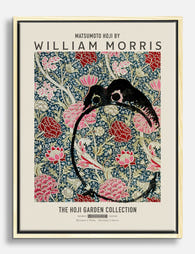
William Morris Garden Blooms Canvas Print
Translation missing: en.products.product.sale_price From €64,95€107,95 -

William Morris, Original Floral Pattern Art Print
Translation missing: en.products.product.sale_price From €17,95€29,95 -

William Morris Botanical Art Print
Translation missing: en.products.product.sale_price From €17,95€29,95 -

William Morris, Daisy Pattern Original Art Print
Translation missing: en.products.product.sale_price From €17,95€29,95 -

William Morris Floral Canvas Print
Translation missing: en.products.product.sale_price From €64,95€107,95 -

William Morris Rose Garden Canvas Print
Translation missing: en.products.product.sale_price From €64,95€107,95 -

William Morris Botanical Art Print
Translation missing: en.products.product.sale_price From €17,95€29,95 -

William Morris, Original Flower Garden Art Print
Translation missing: en.products.product.sale_price From €17,95€29,95 -

Morris Garden Harmony Art Print
Translation missing: en.products.product.sale_price From €17,95€29,95 -

William Morris Rose Garden Art Print
Translation missing: en.products.product.sale_price From €17,95€29,95 -

Morris Garden Tulip Canvas Print
Translation missing: en.products.product.sale_price From €64,95€107,95 -

Morris Botanical Birds Art Print
Translation missing: en.products.product.sale_price From €17,95€29,95 -

William Morris Floral Elegance Canvas Print
Translation missing: en.products.product.sale_price From €64,95€107,95 -

Morris Butterfly Garden Art Print
Translation missing: en.products.product.sale_price From €17,95€29,95 -

William Morris Botanical Birds Canvas Print
Translation missing: en.products.product.sale_price From €64,95€107,95


More from The Frame

How to Build a Blossom Gallery Wall That Actual...
Most blossom gallery walls fail for the same reason: they're a collection of pretty things rather than a composition. The fix is planning, not taste. This guide gives you the...

How to Build a Winter Sports Gallery Wall That ...
Most winter sports gallery walls fail for the same reason: people buy four prints they like, hang them roughly equidistant, and call it done. A gallery wall that looks intentional...

How to Style Matisse Portrait Prints in Every R...
You've fallen for a Matisse face. Now you're staring at a wall, second-guessing the size, the frame, the room, the lot. This is the practical guide that takes you from...