
 Smiles Guaranteed
 Order today for delivery by
Stars and Celestial Motifs in William Morris's Work: The Full Story
The honest story behind Morris-style celestial prints, what he actually designed, and how to shop them well.


If you've searched for William Morris celestial designs lately, you've probably noticed something odd: there's a flood of star-strewn prints in his familiar style, but very little explanation of where they actually come from. The truth is more interesting than the marketing copy suggests, and worth understanding before you commit to a print for your wall.
This is a guide for anyone who wants to buy a Morris-inspired celestial print and feel confident they know what they're buying.
Beyond Florals: Morris's Overlooked Celestial Patterns
William Morris is best known for Strawberry Thief, Willow Bough, Trellis, Pimpernel, and the dense botanical wallpapers that defined late Victorian taste. These are the designs held by the V&A and the William Morris Gallery in Walthamstow, and they're the ones reproduced on tea towels, lampshades and curtains across the country.
The honest position to take, and one that most retailers won't, is this: Morris himself didn't produce a body of star or celestial pattern work in the way he produced florals. There's no Strawberry Thief of the night sky in his archive. The "william morris celestial designs" you see online are almost always modern interpretations, made by contemporary illustrators working in his visual language and applying it to moons, stars and constellations.
That doesn't make them lesser. It just makes them something different, and it's worth knowing the difference before you spend money on one.

What Inspired the Star Motifs in Morris's Work
To understand why celestial designs in Morris's style feel so coherent (even when he didn't draw them himself), you have to understand what genuinely did inspire him.
Morris drew obsessively from the British countryside. Hedgerows, kitchen gardens, riverbanks, medieval tapestries, and illuminated manuscripts. His pattern philosophy, set out in lectures like The Lesser Arts, insisted that good design comes from looking carefully at the natural world and the work of medieval craftsmen. Cosmic symbolism, planets, zodiacs and constellations weren't part of his vocabulary in the way they were for, say, certain Pre-Raphaelite painters or later Art Nouveau designers.
Where stars do appear in work connected to Morris, it's almost always in the context of medieval revival. Think of the Kelmscott Press books, the stained glass produced by Morris & Co. for churches, and the embroideries and tapestries with quasi-medieval backgrounds. Small star or quatrefoil shapes sometimes appear as background fillers, the way a medieval illuminator might pepper a margin. They're decorative dustings, not the subject of the design.
So when modern designers create "Morris celestial" prints, they're drawing on two real things: the geometric fillers of medieval art that Morris loved, and the rhythmic, repeating density that defines his florals. They translate that grammar onto a new subject.
Stars in the Arts and Crafts Movement: Symbol and Structure
Arts and crafts star motifs do exist in the wider movement, and they're worth knowing about because they're the genuine historical reference point for most of what's sold as "Morris celestial" today.
The Arts and Crafts movement, which Morris helped found in the 1860s, valued honest materials, handcraft, and pattern derived from nature and medieval art. Geometric forms, six-pointed stars, eight-pointed stars, quatrefoils, rosettes, were used heavily in Arts and Crafts tilework, metalwork and bookbinding. C.F.A. Voysey, Charles Rennie Mackintosh and the Glasgow School all used star and rose forms structurally, often as repeating grid elements.
In this context, stars weren't astronomical. They were geometric. They served the same purpose as a trellis or a strapwork border: a way to organise a surface and give the eye somewhere to rest between the more elaborate motifs.
This matters because it's the actual lineage of contemporary Morris-style celestial prints. They're not pretending Morris was an astrologer. They're extending Arts and Crafts geometric tradition into a more whimsical, narrative territory that suits modern interiors.

How Morris's Star Designs Compare to His Famous Florals
Set a Morris-style celestial print next to Strawberry Thief and you'll see family resemblance, not identity.
The florals are characterised by:
- Dense, edge-to-edge pattern with no obvious focal point
- Naturalistic but stylised plant forms (acanthus, willow, fruit, birds)
- A muted, slightly earthy palette: indigo, madder red, sage, ochre
- Mirrored or "turn-over" repeats, often based on a vertical axis
- Layering, with foreground motifs sitting on a darker patterned ground
Modern celestial designs in the Morris tradition usually borrow the density, the palette and the layering, but soften the structure. Stars float more loosely. Moons become focal points in a way no element ever does in Pimpernel or Bachelor's Button. The repeats are often less rigorous, designed for a single framed print rather than a wall covered in metres of paper.
The result is something more decorative and easier to live with as a single piece of art. A genuine Morris floral pattern, blown up to 70x100cm and framed on its own, can feel busy and overwhelming. A celestial reinterpretation tends to give the eye more space.
If you want to compare directly, it's worth browsing both the william morris art prints collection and the william morris stars art prints collection side by side. The shift in mood is immediate.
Why These Patterns Are Having a Moment in Modern Interiors
There's a real reason "william morris star design" searches have climbed in the last few years, and it isn't a sudden interest in Victorian textile history.
It's the convergence of three aesthetics that all reward this kind of imagery:
Dark academia. Deep greens, oxblood, brass, leather, and patterned wallpapers in studies and reading nooks. Celestial motifs feel scholarly and slightly mystical without tipping into kitsch.
Cottagecore and modern folk. Hand-drawn, slightly imperfect pattern work, warm colour palettes, references to medieval and Victorian craft. Morris is the patron saint of this movement and always has been.
Maximalist colour drenching. Painting walls, woodwork and ceilings the same deep colour, then layering pattern on top. Morris-style celestial prints work brilliantly against painted-out rooms in inky blue, forest green or burgundy.
The other factor is purely practical. Florals can feel committed in a way some renters and first-time buyers find intimidating. A starry Morris-style print reads as decorative and rich without screaming "I have made a permanent decision about my taste." It's pattern with an exit strategy.
If pattern density appeals to you in general, the wider botanical art prints collection is worth a look too. The same principles of dense, layered, nature-led design apply, just without the celestial overlay.

Choosing a William Morris Star Print for Your Home
A few opinionated rules of thumb, based on what actually works in real rooms.
Go bigger than feels comfortable
The most common mistake people make with Morris-style prints is buying them too small. These designs are dense. At 30x40cm, a celestial Morris print can read as a bit fussy and lost on the wall. At 60x80cm or 70x100cm, the pattern has room to breathe and the motifs become legible from across the room.
If you're hanging above a sofa or a bed, aim for the artwork to be roughly two-thirds the width of the furniture beneath it. For a standard three-seater, that's almost always a 70x100cm framed print, or a pair of 50x70cm prints hung side by side.
Think about the wall colour first
Morris-style celestial designs almost always have a dark or richly toned background. They sing against painted walls in deep blue, forest green, terracotta, plaster pink or warm off-white. They struggle on cold bright white, where the contrast can feel harsh and the pattern stops feeling immersive.
If you have white walls and don't want to paint, choose a print where the background is lighter (cream, sage, pale ochre) so the print doesn't sit on the wall like a black hole.
Decide between framed and unframed early
A framed print with a slim black or dark wood frame leans formal, scholarly, dark academia. A framed print in natural oak feels softer and more cottagecore. An unframed canvas reads more relaxed and contemporary, and works well in informal rooms like kitchens and children's bedrooms.
Frames matter more with Morris designs than with most styles. The pattern is dense, so a fussy ornate frame will fight the artwork. Keep the frame simple and let the print do the work.
Pair them, don't isolate them
Morris-style designs were originally made for whole rooms. A single small print can feel marooned. Two matching prints flanking a bed, or a vertical pair above a console table, almost always looks better than one print alone.
Print Quality Matters: What to Look for in a Morris Art Print
This is the part most shoppers underweight, and it's where a lot of "william morris celestial" purchases disappoint.
Morris designs depend on detail. The whole point of his work is that you can stand a foot away from the wall and keep finding new things: a hidden bird, a fine line of stamen, the cross-hatching on a leaf. If the print quality is poor, all of that disappears into mush.
Things to actually check before you buy:
Printing method. Look for giclée printing on thick matte paper. Giclée uses a wide colour gamut and produces sharp, saturated detail without the dot pattern of cheap digital prints. Matte paper handles dense pattern better than gloss because it doesn't catch the light and obscure the detail.
Paper weight and feel. Thin, flimsy paper is a giveaway of a low-effort product. A proper art print should feel substantial, with a slight tooth to the surface that holds ink well.
Frame construction. This is where the category falls apart most often. The biggest issue with framed art online is frames that arrive separately, are made from MDF or veneer, or are poorly fitted so the print warps or develops bubbles within months. Look for solid wood frames (FSC-certified is a good sign for sustainability), prints fitted into frames before shipping, and acrylic glazing rather than glass. Acrylic is lighter, doesn't shatter, and modern UV-protective acrylic prevents the colours fading even in a sunny room. With Morris designs, where the indigos and madders are doing a lot of the work, fade resistance genuinely matters.
Colour fidelity. Morris's palette is muted and slightly desaturated. Cheap reproductions often crank up the saturation and turn the prints garish. If the deep blues look more like cobalt than indigo, and the reds look like postbox rather than dried blood, the colour matching is off.
Ready to hang. A good framed print arrives with fixtures already attached, in one box, properly fitted. You shouldn't be assembling anything or chasing missing hardware.

A small final thought. The fact that authentic Morris celestial designs don't really exist isn't a reason to avoid these prints. It's a reason to buy them with your eyes open, from somewhere that takes the craftsmanship seriously, and to treat them as what they are: a thoughtful contemporary extension of the Arts and Crafts tradition rather than a museum reproduction. Bought well, they'll outlast every trend that brought them to your attention in the first place.

Fab products featured in this blog
-
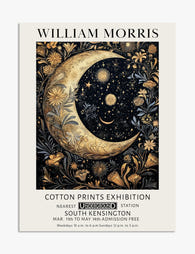
William Morris Moon & Stars Art Print
Translation missing: en.products.product.sale_price From €17,95€29,95 -

William Morris Celestial Moon Canvas Print
Translation missing: en.products.product.sale_price From €64,95€107,95 -

William Morris Stars and Moon Art Print
Translation missing: en.products.product.sale_price From €17,95€29,95 -

Celestial Dreams by Morris Canvas Print
Translation missing: en.products.product.sale_price From €64,95€107,95 -

William Morris Moon & Stars Art Print
Translation missing: en.products.product.sale_price From €17,95€29,95 -
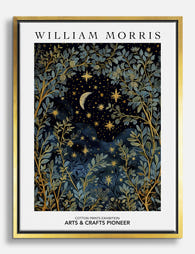
William Morris Night Sky Canvas Print
Translation missing: en.products.product.sale_price From €64,95€107,95 -

William Morris Moonlit Night Art Print
Translation missing: en.products.product.sale_price From €17,95€29,95 -

William Morris Moon & Stars Art Print
Translation missing: en.products.product.sale_price From €17,95€29,95 -

William Morris Nightscape Art Print
Translation missing: en.products.product.sale_price From €17,95€29,95


More from The Frame

The Acanthus Leaf in William Morris's Work: His...
The acanthus leaf has decorated Western buildings for over two thousand years, but William Morris was the designer who finally made it move. His 1875 Acanthus pattern took a stiff,...

How to Style William Morris Moon Prints in Ever...
Morris's celestial work sits in a strange, lovely place: vintage botanical detail meeting deep indigo skies and burnished gold. That makes it more flexible than most decorative prints, but also...

Animals in the Arts and Crafts Movement: How Mo...
The Arts and Crafts movement gave us some of the most enduring animal imagery in British design. But Morris, Voysey, and De Morgan each saw nature differently, and understanding those...