
 Beställ idag, leverans senast
 The 2/3 Rule for Wall Art (And How to Stop Buying Prints That Are Too Small)
The measurement-led guide to picking print sizes that fit your wall, your furniture, and your eye line.


The 2/3 rule explained: how it works for sofas, beds, and console tables
The principle is simple: your art should be roughly two-thirds the width of the furniture it sits above. Not the wall, the furniture. This is the design consensus stylists use because it creates visual balance, so the art reads as connected to the piece below it rather than floating awkwardly in space.
Here's the maths on the three pieces of furniture you're most likely hanging above.
- Standard three-seater sofa (180-200cm wide): 180 x 0.66 = 119cm. Aim for art that's at least 120cm wide. A 100x150cm canvas or a pair of 70x100cm prints hits this target.
- UK double bed (140cm wide headboard): 140 x 0.66 = 92cm. A 70x100cm print landscape, or a pair of 50x70cm prints sitting side by side, lands perfectly.
- Console table (90-120cm wide): 100 x 0.66 = 66cm. A single 50x70cm print, or two 30x40cm prints hung as a vertical pair, works beautifully here.
The 2/3 rule is a floor, not a ceiling. Going up to 75% or 80% of the furniture width almost always looks better than going under. The mistake nearly everyone makes is going smaller.

Why almost everyone buys art that's too small (and how to fix it)
Walk into most British living rooms and you'll see the same thing: a 40x50cm print floating above a 190cm sofa, marooned in white space. It's the single most common decorating mistake, and it happens for predictable reasons.
First, art looks enormous in your hands. A 70x100cm print is roughly the size of a large suitcase when you're holding it. Your brain calibrates to that, then panics. On a wall, six feet away, that same print looks moderate. The room swallows scale.
Second, price anchoring. Smaller prints cost less, so you talk yourself into a 40x50cm "to start." It never gets upgraded. You live with it for four years.
Third, online shopping strips context. You see a print on a product page with no furniture around it. There's no sofa, no console, no doorframe for your eye to measure against. So you guess, and you guess small because small feels safe.
The fix is to stop trusting your gut and start trusting the tape measure. Measure the furniture, do the multiplication, then commit to that number even if it feels too big when the box arrives. It won't be too big on the wall. We promise.
Measuring your wall: the 60-second method that saves returns
Get a tape measure. This takes under a minute.
- Measure the width of the furniture below, not the wall. If it's a 190cm sofa, that's your starting number.
- Multiply by 0.66. 190 x 0.66 = 125cm. That's your minimum art width.
- Multiply by 0.75 for the sweet spot. 190 x 0.75 = 142cm. Aim somewhere between these two numbers.
- Account for the frame. A 70x100cm print becomes roughly 78x108cm once framed (frames add about 4cm per side). Build that into your calculation, especially if you're working with a tight wall.
- Plan the gap. Leave 15 to 25cm between the top of the furniture and the bottom of the frame. Closer than 15cm looks cramped, further than 25cm and the art floats free.
That's it. Five numbers and you'll never order the wrong size again. The reason we're confident about this method is that undersized art is the most common reason people end up returning prints, and the entire problem is solved upstream at the measuring stage.
Single large print vs a pair vs a gallery wall: which layout for which wall
The same wall can take three different treatments. Choosing between them depends less on taste than on the proportions of what's below and the ceiling height above.
When a single large print wins
Single prints work best above long, low furniture in rooms with standard ceilings (2.4m). A 100x150cm canvas above a three-seater sofa has impact and simplicity. There's no spacing decision to overthink, no alignment issue. One print, centred, done.
Single prints also suit horizontal-format imagery: landscape florals, wide meadow scenes, sweeping botanical illustrations. Browse large wall art when you want a piece that does the heavy lifting on its own.
When a pair beats a single
Two prints sitting side by side work brilliantly when:
- Your ceiling is tall (2.7m+) and a single horizontal print would leave too much empty wall above
- You're working with vertical imagery, like single-stem botanical studies or tall floral compositions
- The furniture below is narrow, like a 100cm console where two 40x50cm verticals create more presence than a single horizontal piece
A pair of 50x70cm vertical botanical art prints above a double bed is one of the most reliable layouts in interior design. The verticality lifts the eye, balances the horizontal headboard, and gives the wall rhythm.
When a gallery wall makes sense
Gallery walls solve a specific problem: a large empty wall with no single piece of furniture defining it. Think hallways, stairwells, or the wall opposite your sofa. Six prints at 30x40cm have the same visual weight as one print at 90x120cm, but they create texture and storytelling.
The trade-off is honest: gallery walls take longer to plan, longer to hang, and one wonky print throws off the whole arrangement. If you want low-friction impact, go single. If you want a project, go gallery.

Our size range from 30x40cm to 100x150cm: what each looks like in situ
Here's how each size behaves in a real room. Use this as your shopping shortcut.
30x40cm. Small and supporting. Right for bedside tables, narrow hallway sections, kitchen shelving nooks, or as part of a gallery wall. Never use a single 30x40cm above a sofa. It will look like a postage stamp.
40x50cm and 50x70cm. The most versatile sizes in our range. A single 50x70cm framed print works above a console table, a desk, a chest of drawers, or a single armchair. In pairs, two 50x70cm prints span a double bed beautifully.
70x100cm. Statement size for medium walls. Above a two-seater sofa, a sideboard, or a fireplace mantelpiece, a single 70x100cm framed print holds the wall confidently. It's the largest we offer in our art print range with frames included.
100x150cm (canvas only). The full statement. This is the size you reach for above a three-seater sofa, in an open-plan kitchen, or on a tall stairwell wall. The mirrored edge wrapping on our canvases means the main image isn't cropped at this scale, which matters when you're working with detailed florals or botanical illustrations where every petal counts.
A note on materials at scale: framed prints look more polished and architectural, but they're heavier. A 70x100cm framed piece needs a proper fixing into a stud or a heavy-duty plasterboard plug. Canvas at 100x150cm is significantly lighter for its size, which is why we recommend it for large walls and humid spaces like kitchens.
How to use floral and botanical prints as statement pieces at scale
There's a stubborn assumption that floral art is small and decorative, the kind of thing you tuck in a hallway. That's an outdated default. Used at scale, florals are some of the most striking statement pieces you can hang.
The reason florals scale so well is detail density. A single pressed-fern botanical at 30x40cm reads as decoration. The same image at 100x150cm reads as art. The viewer can see the vein structure, the gradient of green from stem to tip, the texture of the paper underneath. Our giclée printing holds that level of detail because it's designed to be looked at up close.
When you're thinking about how to choose floral art for home, the orientation question matters more than the colour. A horizontal meadow scene needs horizontal furniture below it. A vertical single-stem study needs height to its space, either a tall ceiling or a vertical pair arrangement.
For large floral art prints in a living room, our recommendation is to go bigger than you think and let one piece be the room's anchor. A 100x150cm botanical canvas above a sage green sofa, framed by simple linen curtains, will outperform three medium prints scattered across different walls every time.
Some floral art print ideas that consistently work at scale:
- Single-stem botanicals on cream backgrounds (clean, gallery-like)
- Pressed flower compositions with visible texture (best at 70x100cm or larger)
- Painterly floral still lifes in muted palettes (sage, dusty pink, terracotta)
- High-contrast monochrome botanical line drawings (suit modern, minimal rooms)

Hanging height and spacing: the numbers that actually matter
You've chosen the right size. Now don't ruin it by hanging it badly. Two numbers matter.
Centre height: 145cm to 152cm from the floor. This is gallery standard. The centre of the artwork (not the top, not the bottom) should sit at eye level for the average adult standing in the room. For taller households, edge towards 152cm. For seating-focused rooms like lounges, slightly lower (140-145cm) works because most viewing happens from a seated position.
Gap from furniture: 15 to 25cm. Measured from the top of the furniture to the bottom of the frame. Closer than 15cm and the art looks like it's resting on the sofa back. Further than 25cm and the visual connection breaks. Aim for 20cm and you'll be right.
For pairs, the spacing between the two prints matters too. We recommend 5 to 8cm between the inside edges of the frames. Any wider and they read as two separate artworks rather than a coordinated pair.
For gallery walls, the consistent gap principle is what holds the arrangement together. Pick a number (4cm is a good default) and use that exact gap between every print, on every side. Inconsistent gaps are what make gallery walls look amateur.
Where to hang botanical prints by room
Botanicals are remarkably room-flexible. The question of where to hang botanical prints tends to come down to light and humidity.
- Living room: above sofas, fireplaces, or behind dining tables. Botanicals soften hard architectural lines.
- Bedroom: above the headboard, ideally as a vertical pair. Softer botanicals (ferns, pressed flowers) feel calming for sleep spaces.
- Bathroom: canvas only (poly-cotton handles humidity better than paper). Pressed seaweed or fern studies look spa-like.
- Kitchen: above shelving or a breakfast nook. Botanical kitchen scenes (lemons, herbs) work, but keep them away from direct steam and splatter.
- Hallway: narrow walls suit vertical pairs or a tight gallery wall of 30x40cm botanicals.
The UV-protective acrylic glaze on our framed prints means direct sunlight isn't a problem. South-facing rooms, conservatory walls, sunny stairwells: all fair game.

The decision in one paragraph
Measure the furniture below, multiply by 0.66 for your minimum width and 0.75 for the sweet spot, then leave a 20cm gap above the furniture and centre everything around 150cm from the floor. If the number you calculate feels too big, that's normal. Order it anyway. The wall will absorb the scale, the room will feel more considered, and you'll stop second-guessing every print purchase you ever make.

Fab-produkter som visas i denna blogg
-

Poster surrealistisk blomma med svartvita schackrutor
Translation missing: sv.products.product.sale_price Från 178.00 kr254.00 kr -
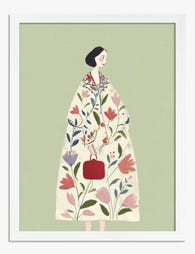
Poster botanisk modeillustration – kvinna i blommig kappa
Translation missing: sv.products.product.sale_price Från 178.00 kr254.00 kr -

Poster brittisk botanisk vy
Translation missing: sv.products.product.sale_price Från 178.00 kr254.00 kr -

Poster lila blommotiv i vintage-stil
Translation missing: sv.products.product.sale_price Från 178.00 kr254.00 kr -

Poster botanisk elegans
Translation missing: sv.products.product.sale_price Från 178.00 kr254.00 kr -

Poster blommor i modern färgstark stil
Translation missing: sv.products.product.sale_price Från 178.00 kr254.00 kr -

Canvastavlor kvinna med blomstrande kappa
Translation missing: sv.products.product.sale_price Från 711.00 kr1,016.00 kr -

Poster kvinna i grönrandig klänning med blomma och apelsin
Translation missing: sv.products.product.sale_price Från 178.00 kr254.00 kr -

Poster botaniska former i boho-stil
Translation missing: sv.products.product.sale_price Från 178.00 kr254.00 kr -

Poster botanisk blomma i modern stil
Translation missing: sv.products.product.sale_price Från 178.00 kr254.00 kr -

Poster livlig blomstermarknad
Translation missing: sv.products.product.sale_price Från 178.00 kr254.00 kr -

Poster botanisk elegans i bordeauxrött
Translation missing: sv.products.product.sale_price Från 178.00 kr254.00 kr -

Poster grafisk blomsterbukett i rosa och grönt
Translation missing: sv.products.product.sale_price Från 178.00 kr254.00 kr -
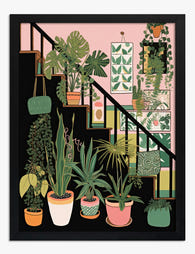
Poster botanisk trappa
Translation missing: sv.products.product.sale_price Från 178.00 kr254.00 kr -

Poster botanisk geometri med blå kruka
Translation missing: sv.products.product.sale_price Från 178.00 kr254.00 kr -

Poster botaniska blad i pastell
Translation missing: sv.products.product.sale_price Från 178.00 kr254.00 kr -

Poster modernt botaniskt motiv i neutrala toner
Translation missing: sv.products.product.sale_price Från 178.00 kr254.00 kr -

Canvastavlor möte i djungeln
Translation missing: sv.products.product.sale_price Från 711.00 kr1,016.00 kr


Mer från The Frame

Why William Morris Prints Look Brilliant in Mod...
William Morris has been quietly miscategorised for decades. His patterns get filed under "country cottage" or "Arts and Crafts revival" and rarely escape, which is a shame because his tree...

Why Arts and Crafts Nature Prints Are the Antid...
The minimalism hangover: why bare walls stopped feeling calming For about a decade, the aspirational interior was a white box with one boucle chair in it. That look has officially...

Botanical Petal Art: Why Close-Up Prints Feel M...
Full florals have had a long run, and they're not going anywhere. But if you've noticed that the botanical art appearing in design magazines, boutique hotel lobbies, and the better-styled...