
 Order today for delivery by
 Landscape vs Portrait Prints: How to Pick the Right Orientation for Your Wall
Forget what the picture shows. The shape of your wall should decide whether you go landscape or portrait.


Most people pick art the wrong way round. They fall in love with an image, order it in whatever orientation it comes in, and then try to wedge it onto a wall it was never going to fit. The smarter approach is to start with the wall and work backwards, because orientation is a spatial decision before it's an aesthetic one.
Landscape vs portrait: it's not just preference, it's about the wall
Orientation is one of the few design choices that actively changes how a room feels. A landscape print stretches the eye horizontally, calming a space and pulling attention along furniture lines. A portrait print does the opposite, lifting the eye upwards and adding height where there isn't any.
Subject matter matters far less than people think. A coastal scene can absolutely work in portrait if the wall calls for it, and a figure study can work beautifully in landscape if cropped well. What you can't fake is fit. A portrait print marooned above a four-seater sofa looks lost. A landscape print squeezed into a narrow alcove looks crushed.
So before you scroll through galleries, look up. Measure the wall. Note what's underneath it, beside it, and how high the ceiling sits. Those three pieces of information will tell you which orientation to buy more reliably than any taste-based instinct.

When landscape orientation wins
Landscape orientation is the natural choice for any wall that's wider than it is tall, and for any space where you're hanging above a horizontal piece of furniture. Sofas, sideboards, beds, consoles, dining benches, low credenzas. All of them want a horizontal companion above them.
The professional consensus on art-to-furniture proportion is the two-thirds rule: your art (or arrangement) should span roughly two-thirds the width of the furniture below. A 220cm sofa wants art around 145cm wide. That's almost impossible to achieve with a single portrait print, but a 100x150cm landscape canvas hits it perfectly, and a 70x100cm landscape framed print gets you most of the way there.
Hallways are another landscape stronghold, but specifically when you're hanging a single anchor piece rather than a series. A long, low landscape print at eye level in a corridor draws you forward through the space. It works with the architecture rather than against it.
Above-headboard placements in bedrooms also lean landscape, especially with kingsize and superking beds where the headboard width demands something that can hold its own. A single 70x100cm landscape framed print centred above a king bed feels considered. Two smaller portraits side by side often feel fussy.
Dining rooms with sideboards or buffets are arguably the most underrated landscape opportunity. A wide landscape piece above a 180cm sideboard creates a clear horizontal band that makes the whole arrangement read as one composition. Browse our landscape art prints and you'll notice how many of them are designed with exactly this kind of placement in mind.
When portrait orientation is the better call
Portrait wins anywhere the wall is taller than it is wide, or where you need to draw the eye upwards. Narrow walls between two windows, the slim wall beside a doorway, the panel of wall flanking a fireplace, alcoves either side of a chimney breast. These are portrait territory.
Portrait is also the right shape for flanking. Twin portrait prints either side of a mirror, a doorway, or a bed create a sense of architectural rhythm that landscape prints simply can't replicate. The verticals echo the verticals of the door or window frame, and the symmetry feels intentional rather than coincidental.
Entryways are a particularly strong case. Most entrance walls are narrow and tall, often broken up by a console table or shoe storage. A single portrait print above a 90cm console reads as a welcome. A cramped landscape in the same spot reads as a compromise.
Stairwells almost always want portrait, and often want a series of them climbing alongside the stair line. Two or three portrait prints staggered up a stairwell follows the diagonal of the stairs and feels like part of the architecture. Browse portrait art prints when you're planning these vertical runs, because the proportions make the staging much easier.
The one bedroom configuration where portrait clearly beats landscape is the flanking-the-bed setup. Two portrait prints on either side of the headboard, hung at matching heights, frame the bed and tighten the whole composition. It's a hotel-suite trick that costs almost nothing to replicate at home.
How orientation changes a room's proportions
This is the part most guides skip, and it's the most useful thing to understand. Orientation is a visual proportion tool. Used well, it makes rooms feel like better versions of themselves.
A landscape print makes a narrow room feel wider. By extending a strong horizontal line at eye level, you're effectively giving the eye a longer track to travel along. In a 3.2m wide lounge, a 100x150cm landscape canvas above the sofa will visibly widen the perceived dimensions of the space. The wall stops feeling like a tight side and starts feeling like a deliberate backdrop.
A portrait print does the equivalent vertically. In a flat with 2.3m ceilings (which is most British new-builds and many older terraces), portrait orientation pulls the ceiling up. The eye reads the vertical line as height. Stack two portraits in a tall, narrow arrangement and you can add what feels like 30cm of imaginary ceiling height.
The opposite is also true, and worth knowing. If you have soaring 3m ceilings and a long, generous room, too many portrait prints will exaggerate the height into something cavernous. A few well-placed landscape pieces will rebalance the proportions and make the space feel grounded rather than churchy.

Mixing landscape and portrait in a gallery wall
"You can mix orientations" is true but useless without rules. There are three approaches that actually work, and they're worth treating as distinct strategies rather than vague permission to combine shapes.
The grid method
Pick a single orientation for the whole grid. Six landscape prints in a 3x2 layout, or four portraits in a 2x2. Mixing orientations inside a strict grid almost always looks broken because the symmetry depends on matching shapes. If you want a clean, considered look in a formal room, this is the right method, and it's worth committing to one orientation throughout.
The salon-style approach
This is where mixing orientations actively helps. Salon-style hangs use varied sizes and orientations clustered tightly together, often filling a large wall floor-to-ceiling-ish. The trick is balance, not symmetry. For every large landscape, you want a couple of smaller portraits to balance the visual weight. Sketch it out on the floor first, take a photo from above, and adjust before you put a single nail in the wall.
The anchor piece strategy
The most foolproof method. Choose one large piece as your anchor (usually a 70x100cm landscape framed print or a 100x150cm canvas), centre it on the wall, then build outwards with smaller prints in the opposite orientation. The contrast in shapes creates rhythm without chaos. The anchor does the heavy lifting and the supporting prints add interest.
A practical rule for any mixed gallery wall: keep the gaps consistent. 5cm between every print is the sweet spot. If your spacing varies, the eye reads the wall as messy regardless of how good the individual pieces are. Pre-curated wall art sets take a lot of this guesswork out, because the orientations and sizes are already designed to sit together.
Common sizing for each orientation
Sizes that genuinely work, broken down by what they suit.
Landscape sizes that earn their place
- 40x50cm landscape: small console tables, narrow side walls, paired above twin beds
- 50x70cm landscape: standard above a 150cm sideboard, single piece above a loveseat
- 70x100cm landscape: above a 200cm sofa as a single statement, above a queen headboard
- 100x150cm canvas: above a 220cm-plus sofa, large dining room walls, open-plan feature walls
For a US 8-foot wall above a 72-inch sofa, a 70x100cm landscape framed print or a 100x150cm canvas covers the proportions cleanly. For a UK 2.4m wall above a standard 200cm three-seater, the 70x100cm framed print is the easy answer.
Portrait sizes that earn their place
- 30x40cm portrait: small alcoves, paired flanking a mirror, stacked in stairwells
- 50x70cm portrait: above a 90cm console in an entryway, single statement on a narrow wall
- 70x100cm portrait: tall narrow walls between windows, dramatic entryway, flanking a kingsize bed
For US 9-foot ceilings on a narrow 30-inch wall section, a 50x70cm portrait sits perfectly. For UK rooms with standard 2.4m ceilings, two 70x100cm portraits flanking a bed is the most reliably elegant arrangement we know.
A note on framing and matting. A wider frame profile or generous mount border effectively shortens the perceived ratio, making a portrait print feel more square and a landscape print feel less elongated. If you want maximum vertical or horizontal impact, go thinner on the frame. If you want a softer, more gallery-like feel, go wider.

When to break the rules on purpose
The above is a system, and like all systems, the best results sometimes come from breaking it deliberately. A single dramatic portrait print above a sofa, in a room with 3m ceilings, can look extraordinary. The "wrong" orientation creates tension, and tension creates interest.
The same goes for a single landscape print on a tall narrow wall. It feels deliberately compressed, almost cinematic, and it works in spaces with strong architectural confidence. The key word is deliberate. If you're going to break the orientation rules, commit fully and scale up. A timid rule-break just looks like a mistake.
Cost and availability are also worth being honest about. Large landscape prints in extreme widths can be harder to find than equivalent portraits, partly because most photographers and illustrators compose for portrait by default. If you can't find the landscape piece you want at the size you need, two matching portrait prints hung tightly together (with a small gap) read almost identically to a single landscape from across the room.
Our recommendation: start with your wall, not the artwork
Measure the wall first. Note the furniture beneath it. Look at the ceiling height. Then decide on orientation, and only after that, start choosing actual images. This order saves you from the most common mistake in home art buying: falling for a print and then forcing it into a space it was never going to fit.
Landscape orientation does horizontal walls, low spaces above furniture, and rooms that need to feel wider. Portrait orientation does narrow walls, flanking arrangements, and rooms that need more apparent height. Mix them in gallery walls only when you have a clear strategy, whether that's anchor-based, salon-style, or single-orientation grids.

If you're working on a living room wall art plan and feel stuck, almost every problem traces back to one decision: did you pick the print to fit the wall, or did you pick the wall to fit the print? Get that right and the rest follows.

Fab products featured in this blog
-

Klimt 20th Century Exhibition Poster Art Print
Sale price From £11.95£19.95 -

Canopy Perspective Art Print
Sale price From £11.95£19.95 -

Rolling Greens Coastal Landscape Art Print
Sale price From £11.95£19.95 -

Sunlit Hillside Vista Art Print
Sale price From £11.95£19.95 -

Moonlit Hills in Paper Cut-Out Art Print
Sale price From £11.95£19.95 -
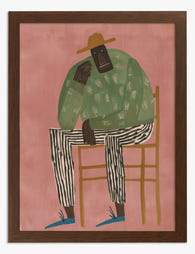
Striped Reflection Art Print
Sale price From £11.95£19.95 -

Bold Blue Portrait Art Print
Sale price From £11.95£19.95


More from The Frame

The Complete Guide to Creating a Sophisticated ...
A cat gallery wall lives or dies by its mechanics, not its subject matter. Frame consistency, precise spacing, and a considered anchor piece will do more for your composition than...

Our Favourite Bird Gallery Wall Sets in Six Frames
Six is the sweet spot for a bird gallery wall. Enough frames to feel considered and substantial, few enough that you can hang the whole thing in an afternoon without...

Framing William Morris Prints: Wood, Colour and...
Morris designed patterns for entire rooms, not for postcards. That matters when you're framing his work, because the wrong frame can turn a masterpiece of Victorian botanical design into visual...