


 Order today for delivery by
 Every Famous Flower Painting by Van Gogh, Explained
The human story behind every sunflower, iris, and almond branch he painted, and how to choose the one that belongs on your wall.


Van Gogh painted flowers more than almost any other subject. Not because they were pretty, but because they were cheap, patient, and gave him something to say when words failed. This is the story behind each of his famous botanicals, and what they can mean hanging in your home.
Why Van Gogh Was Obsessed with Painting Plants
The practical answer is money. Van Gogh could rarely afford to pay models, and flowers sat still for free. His brother Theo, who supported him financially throughout his career, encouraged him to paint subjects that might actually sell, and floral still lifes had a ready market in 1880s Paris.
But there was more to it than economics. Van Gogh treated flowers as a laboratory for colour theory. During his Paris years (1886 to 1888), he used bouquets to experiment with complementary contrasts he'd read about in Delacroix and Chevreul, testing how orange sat against blue, red against green. In a letter to his sister Willemina he described painting flowers as a way "to accustom myself to a different scale of colours."
And then there was the emotional pull. Flowers marked seasons, births, arrivals, recoveries. For a man who moved constantly and struggled with his mental health, painting a blooming branch or a jug of sunflowers was a way of holding onto something alive. If you're browsing his plant and flower prints, it helps to know that almost every one of them was tied to a specific moment in his life.

The Sunflowers Series: More Than Just Pretty Flowers
There are actually two Sunflowers series, and the distinction matters if you're choosing a print.
The first, painted in Paris in 1887, shows cut sunflowers lying on a table or ground. They're darker, more melancholic, and closer to Dutch still life tradition. The second, and far more famous, series was painted in Arles in 1888 and 1889. These are the ones you know: sunflowers upright in a simple earthenware jug, set against yellow or turquoise backgrounds. There are seven of these Arles vase paintings in total, plus a handful of repetitions Van Gogh made of his own compositions.
He painted them for a specific reason. Paul Gauguin was coming to stay at the Yellow House in Arles, and Van Gogh wanted to decorate the guest bedroom with a series of yellow floral paintings as a welcome. "The sunflower is mine, in a way," he wrote to Theo. He saw them as a signature, a symbol of gratitude, and a promise of the artistic partnership he hoped Gauguin would bring.
That partnership famously collapsed within nine weeks, ending with the ear incident on 23 December 1888. But the Sunflowers survived as one of the most recognisable images in Western art. When you hang one, you're hanging Van Gogh at his most hopeful, painted in the brief window when he believed he'd finally found a friend and a home.
The seven Arles versions are scattered today across the National Gallery in London, the Van Gogh Museum in Amsterdam, the Neue Pinakothek in Munich, the Philadelphia Museum of Art, the Sompo Museum in Tokyo, and a private collection. One was destroyed in Japan during the Second World War.
Irises: The Painting That Kept Him Sane at Saint-Rémy
In May 1889, Van Gogh voluntarily admitted himself to the Saint-Paul-de-Mausole asylum in Saint-Rémy-de-Provence after the breakdown that followed Gauguin's departure. Within a week of arriving, before he'd even had a major episode there, he began painting the irises growing in the asylum garden.
The result was Irises (1889), now at the Getty in Los Angeles. It's a dense, close-cropped composition of purple-blue flowers with one lone white iris standing apart. Van Gogh called it "the lightning conductor for my illness," believing that if he kept working, he could hold the worst of it at bay.
The Japanese woodblock influence is unmistakable. There's no horizon, no traditional perspective, just a flattened field of colour and rhythmic line, borrowed from the ukiyo-e prints he'd collected in Paris. He painted a second, softer version in May 1890, Irises in a Vase, using a pink background to make the violet flowers vibrate more intensely.
Irises reads as calm on the wall, but calm hard-won. If Sunflowers is Van Gogh reaching outward toward friendship, Irises is Van Gogh turning inward to survive. It suits quieter rooms: bedrooms, reading corners, hallways where you want depth without noise.

Almond Blossom: A Gift for a Newborn Nephew
On 31 January 1890, Theo's wife Jo gave birth to a son and named him Vincent Willem after his uncle. Van Gogh, still at Saint-Rémy and only months from his own death, painted Almond Blossom as a gift for the baby's bedroom.
The painting is unlike almost anything else in his work. Pale blue sky, silver-white branches heavy with pink-white blossom, no ground, no context, no figures. It's pure hope. Almond trees bloom first in the Provençal spring, sometimes as early as February, and Van Gogh chose them deliberately as a symbol of new life beginning.
The composition owes an obvious debt to Japanese prints, specifically the branch studies of Hokusai and Hiroshige. Van Gogh cropped the branches tight against the picture edge, treated the sky as a flat decorative field, and abandoned Western perspective entirely.
Jo hung it above the baby's cot. The painting stayed in the family and now anchors the Van Gogh Museum in Amsterdam, where it remains one of the most visited works in the collection. For a nursery, a child's room, or anywhere you want a piece that quietly says "a new chapter starts here," nothing in his catalogue comes close.
Roses, Oleanders, and the Lesser-Known Botanicals
Beyond the famous three, Van Gogh painted dozens of other flowers, each tied to a specific mood or moment.
Roses. In May 1890, just before leaving Saint-Rémy, he painted a series of large still lifes as a farewell to the asylum, including two versions of Roses. The white and pale pink blooms in a green vase were originally more vivid pink, but the red pigment has faded over time. They read as tender, almost valedictory.
Oleanders. Painted in Arles in August 1888, Oleanders shows a bouquet of hot pink flowers next to a copy of Zola's novel La Joie de vivre. Van Gogh explicitly linked oleanders to life, joy, and health in his letters. It's one of his most cheerful still lifes and works beautifully in a kitchen or dining room.
The Flowering Orchards. When Van Gogh arrived in Arles in February 1888, he found the almond, peach, apricot, and plum orchards coming into bloom. Over about six weeks he painted fourteen orchard scenes, treating them as a celebration of his arrival in the south. These landscapes sit somewhere between his flower still lifes and his pure landscapes, and they're some of the most joyful work he ever produced.
Paris bouquets. During his two years in Paris, Van Gogh painted dozens of small bouquets: carnations, gladioli, lilacs, poppies, cornflowers, hollyhocks. Most were exercises in colour, painted quickly on days he couldn't afford a model. They're less famous but often more intimate than the grand series.
For a fuller sense of his botanical output, the Van Gogh art prints collection shows how flowers wove through every phase of his career.
How Van Gogh's Style Changed Through His Plant Paintings
If you line his flower paintings up chronologically, you can watch his entire artistic evolution in miniature.
Nuenen, 1884 to 1885. His earliest floral works, painted in the Dutch countryside, are dark, earthy, and heavily influenced by seventeenth-century Dutch masters. Muddy browns, deep greens, brooding backgrounds. If you've only seen the Arles Sunflowers, these paintings barely look like the same artist.
Paris, 1886 to 1888. After moving in with Theo in Paris, Van Gogh encountered the Impressionists and Japanese prints. His palette exploded. The Paris bouquets are experiments: brighter, thicker, more broken brushwork, complementary colour pairings pushed to their limit.
Arles, 1888 to 1889. The Southern French sun changed everything again. The Sunflowers, Oleanders, and Flowering Orchards are dominated by intense yellows, chrome oranges, and cobalt blues. His brushstrokes become directional and rhythmic, building form through movement rather than shading.
Saint-Rémy and Auvers, 1889 to 1890. In his final year, the flowers grew more emotional. Irises, Roses, and Almond Blossom show tighter compositions, more Japanese influence, and a palette that softens even as the brushwork intensifies. There's an urgency to these late works, painted by a man who suspected he didn't have long.

Bringing Van Gogh's Botanical Art Into Your Home
Choosing which Van Gogh flower print to hang comes down to what you want the room to feel like, not just what looks nice.
Sunflowers bring warmth and energy. They work in living rooms, kitchens, and dining rooms, especially spaces with warm neutrals, terracotta, sage, or clay tones. Yellow is a demanding colour, so give it a wall of its own rather than crowding it with competing artwork. At larger sizes (70x100cm framed, or larger on canvas), a single Sunflowers piece can anchor an entire room.
Irises are quieter and more contemplative. They suit bedrooms, home offices, reading corners, and hallways. The blue-violet palette sits beautifully against off-white, warm grey, or pale pink walls. Because the composition is dense, it holds its own even at smaller sizes (30x40cm or 50x70cm).
Almond Blossom is the obvious choice for nurseries and children's rooms, but it also works in bathrooms, entryways, or any space where you want lightness rather than weight. The pale palette needs a clean wall behind it. Avoid busy wallpaper.
Roses, Oleanders, and orchard scenes suit romantic or softer spaces, dining rooms, guest bedrooms, and dressing areas. They're less iconic than the big three, which makes them feel more personal, like you chose them because you actually love them rather than because you recognised them.
A note on format. Van Gogh painted with heavy impasto, and his brushwork is part of the story. On our floral art prints, the matte giclée paper picks up the texture and tonal depth without any glare, so you can stand close and read the individual strokes. Canvas suits the larger, more atmospheric works (the Flowering Orchards, the bigger Sunflowers) where you want the piece to feel more like a painting than a print. Framed with UV-protective acrylic glaze, the colours hold up even in south-facing rooms, which matters for pigments that were already fading a century ago.
Whichever you choose, hang it at eye level (roughly 145 to 150cm from the floor to the centre of the piece) and give it breathing room. Van Gogh's flowers were never meant to be background. They were his way of saying something urgent, and they still are.
If you're building a wall of botanicals more broadly, mixing a Van Gogh with other botanical art prints works well as long as you keep the frames consistent. One Van Gogh among quieter pieces will always be the piece people ask about.

Pick the painting that matches the life you want in the room, not just the wall. Van Gogh painted every one of these for a reason, and the ones that stay with you tend to be the ones whose reason quietly matches your own.

Fab products featured in this blog
-
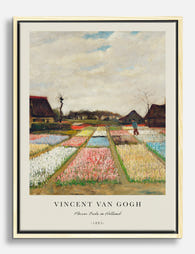
Flower Beds in Holland by Van Gogh Canvas Print
Sale price From £49.95£74.95 -

Flower Beds in Holland by Van Gogh Art Print
Sale price From £11.95£19.95 -

Almond Blossom by Vincent van Gogh Canvas Print
Sale price From £49.95£74.95 -

Almond Blossom by Vincent van Gogh Art Print
Sale price From £11.95£19.95 -
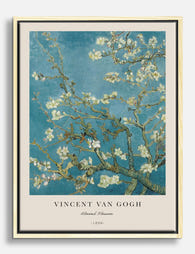
Almond Blossom by Vincent van Gogh Canvas Print
Sale price From £49.95£74.95 -

Allotment with Sunflower by Vincent van Gogh Canvas Print
Sale price From £49.95£74.95 -

Sunflowers by Vincent van Gogh Canvas Print
Sale price From £49.95£74.95 -

Allotment with Sunflower by Vincent van Gogh Art Print
Sale price From £11.95£19.95 -

The Flowering Orchard by Vincent van Gogh Canvas Print
Sale price From £49.95£74.95 -

The Flowering Orchard by Vincent van Gogh Art Print
Sale price From £11.95£19.95 -

Sunflowers by Vincent van Gogh Art Print
Sale price From £11.95£19.95 -

Almond Blossom by Vincent van Gogh Art Print
Sale price From £11.95£19.95 -

Bouquet of Flowers in a Vase by Van Gogh Art Print
Sale price From £11.95£19.95 -

Bouquet of Flowers in a Vase by Van Gogh Canvas Print
Sale price From £49.95£74.95 -

Doctor Gachet's Garden by Vincent van Gogh Canvas Print
Sale price From £49.95£74.95 -
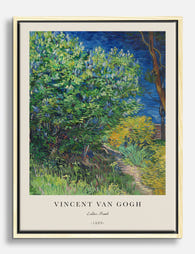
Lilac Bush by Van Gogh Canvas Print
Sale price From £49.95£74.95 -

Doctor Gachet's Garden by Vincent van Gogh Art Print
Sale price From £11.95£19.95 -

Vase With Three Sunflowers by Van Gogh Canvas Print
Sale price From £49.95£74.95 -

Blossoming Acacia Branches by Van Gogh Art Print
Sale price From £11.95£19.95 -

Vase With Three Sunflowers by Van Gogh Art Print
Sale price From £11.95£19.95


More from The Frame

Botanical Prints in the Bathroom: What Actually...
Bathrooms are the most overlooked room for art, and botanicals are the most forgiving subject you can hang in one. The combination of green leaves, soft florals, and tiled surfaces...

What Are Botanical Prints? From 17th-Century Sc...
Botanical prints are detailed, scientifically accurate depictions of plants, originally created to help botanists identify species before photography existed. What began as working documents for scientists in the 1600s has...

The Best Art for an Entryway: What to Hang, Whe...
Your entryway is the first thing you see when you come home and the first thing guests see when they arrive. It's also, for most people, the last wall in...